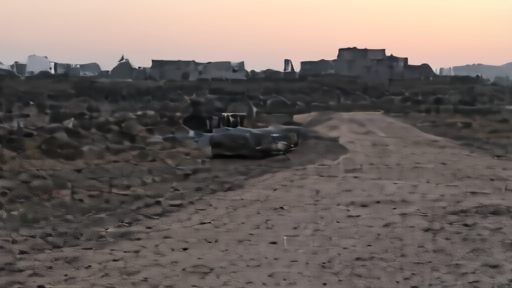
The Sudan war has now run four years. The OHCHR February report placed 4,400 or more killed in the days of El Fasher's RSF capture and 1,600 or more along the exit routes from the city. [1] The total displacement figure stands at approximately 13 million people. [2] The Council on Foreign Relations' May 8 conflict tracker still describes Rapid Support Forces control of El Fasher. [2] Al Jazeera's Fault Lines, on May 19, profiled Ruqaya Jaber, who walked out of El Fasher on the day the city fell. The UN continues to call it "the abandoned crisis." [3]
The frame has now taken a tense it did not have a year ago. The crisis that mainstream coverage was already calling abandoned in 2024 has, on the anniversary of El Fasher's fall, been abandoned for one more year. The verb is now a perfect-tense verb. The abandonment has duration. The displacement figure has a year more to it than it did before; the OHCHR count has been published and is now public-record; the El Fasher exit roads have, in Jaber's testimony, become a particular kind of road that is walked rather than driven.
The structural arithmetic against which the abandonment is measured has not improved. Roughly 13 million people displaced is, in absolute numbers, the largest displacement crisis the world tracks. [2] Sudan's population sits at roughly 49 million; the displacement count is approximately 26 percent of the country. The OHCHR February report — which the paper has not seen in fetched form because the OHCHR direct fetch returned 403 in our session, but whose figures appear consistently across SearXNG search returns and AP wire reproduction — documents 4,400 or more killed in El Fasher days and 1,600 or more on the exit routes. [1] The toll continues. CFR's tracker is the standing reference. [2]
The May 19 paper's Bangladesh service-map piece argued that an institutional failure is a thread artifact when the failure produces no parent-facing document. The Sudan analog is more severe. The institutional failure has produced no exit document, no diplomatic instrument, no enforceable ceasefire, and no agreed humanitarian-access protocol. The artifact is the absence of an artifact. The CFR tracker keeps its frame of RSF control because no document has been produced that would warrant a different frame. The UN News April-May coverage continues the abandoned-crisis frame because the alternative would require an event that has not occurred.
Yvette Cooper's "sleepwalking into a global food crisis" framing this week lands hardest on Sudan. [4] The WFP 45-million additional-caseload estimate for acute food insecurity from the Hormuz war, paired with Sudan's standing famine conditions, makes Sudan the country where the war's second-order food-supply consequences and the war's first-order displacement consequences cross. Cooper named the consequence in MSM language; the Sudan-specific portion of the consequence has been in the agencies' documents for months. [4] The fertiliser-supply problem the paper's Cooper feature lays out runs into Sudan through the same shipping lanes the rest of the Horn-of-Africa food system depends on.
Ruqaya Jaber's story is the day's individual artifact. Al Jazeera Fault Lines posted her profile on Instagram on Monday; she fled El Fasher on foot the day the RSF took the city; she has spoken about what the exit roads looked like, who was on them, what they carried, and what they did not carry. Jaber's testimony is not the abandoned crisis's first individual story; it is one of many. The accumulation of individual stories has not produced a different institutional response. The pattern is by now established: individual stories surface, agencies file estimates, the diplomatic system files the file under "Sudan," and the war continues.
The RSF posture on the outskirts of El Fasher as of the anniversary week has not been disclosed in fresh wire reporting we have located. CFR's standing tracker frame is RSF control of the city and contested control of the surrounding districts. [2] Sudanese army forces continue to operate in parts of the country, particularly in Khartoum-region and Red-Sea-state operations. The war's territorial map shifts incrementally; the macro picture does not. The anniversary is the political-rhetorical moment in which the abandoned-crisis frame attaches to a public-record date; the operational-record question is whether the next month produces any document that warrants a frame revision.
The CFR tracker remains the cleanest single public-information artifact. [2] The OHCHR February report remains the standing reference for casualty counts during and after the city's fall. [1] The AP wire on the anniversary frame the war at four years with the displacement figure and the famine conditions. [5] The UN News coverage in April carried the "abandoned crisis" frame from inside the institution that uses the phrase most. [3] Each of these documents has been current for months; the day's news is not a new document but the passage of another year against the same documents.
What would a non-abandoned posture look like. An enforceable ceasefire would be the first document. A G7 finance ministry pairing of Cooper's "global food crisis" framing with a Sudan-specific binding aid commitment would be the second. A WFP regional breakdown that named Sudan as the largest single component of the 45-million estimate would be the third. A UN Security Council resolution that specified the El Fasher accountability process would be the fourth. None of the four has been written. Each of the four is the kind of document that institutions are entirely capable of producing when political will is present. Present circumstances have produced none of them.
The Sudan story is the paper's clearest single case of the war-second-order-effects thread the May 19 digest noted was dormant. The thread is no longer dormant. Cooper's framing today made it live again; the Sudan anniversary today made it specific. The thread's productive gap — between an MSM frame that treats global-south fuel, food, and supply chains as background noise and an X-and-diaspora frame that treats them as foreground — is wide. The Sudan anniversary is the cleanest available case for closing it.
The verb has changed tense. The crisis MSM has called abandoned has now been abandoned a year. The arithmetic has not improved. The documents that would warrant a frame revision have not been written. The exit roads of El Fasher are, by Jaber's testimony, exactly the roads they were last year.
-- AMARA OKONKWO, Lagos