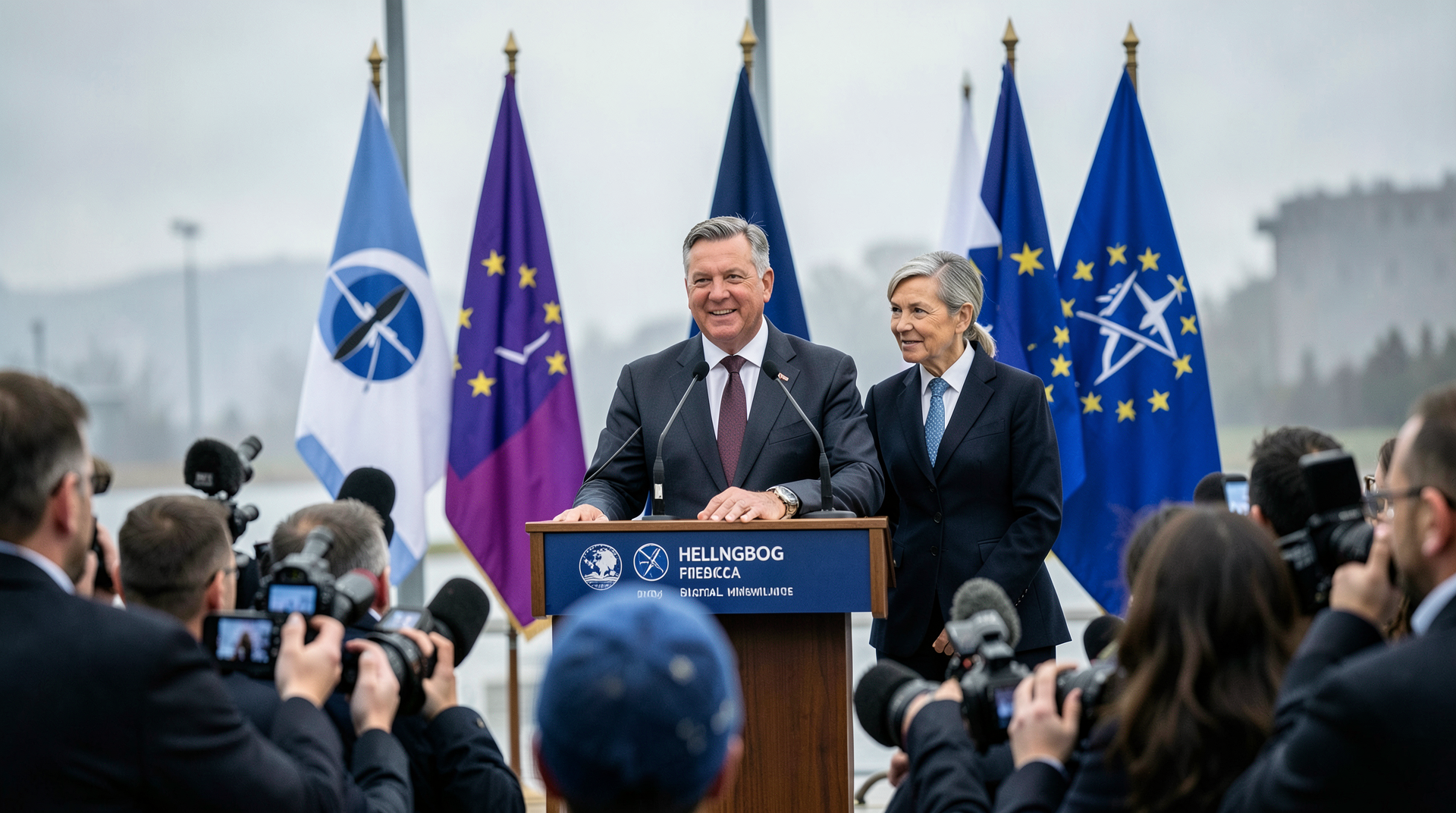
US Secretary of State Marco Rubio, standing at a Helsingborg podium beside Swedish Foreign Minister Maria Malmer Stenergard on Friday, told reporters there had been "slight progress" in talks with Iran but "we're not there yet" — a sentence the president of the United States never spoke, and one the same president's deadline for a deal had explicitly forbidden three days earlier. [1] [2]
Tuesday's "two or three days, maybe Friday, Saturday," dissolved Wednesday into "I'm in no hurry" on the tarmac at Joint Base Andrews. The paper's Thursday lead, Trump's two-day deadline expired into no hurry, said the rhetorical floor on Iran had slid from a clock to a shrug inside seventy-two hours. Friday slid it again — from a shrug to "a little bit of movement, and that's good." [3]
Three other artifacts landed on the same Friday tape. France's Foreign Ministry spokesman Pascal Confavreux, briefing in Paris, confirmed France has drafted its own UN Security Council resolution to set up an international mission to restore movement through the Strait of Hormuz, to be submitted "if conditions are right." [4] Iran's ambassador to France, Mohammad Amin-Nejad, told Bloomberg from Paris that Iran and Oman "have been discussing a permanent toll system for the Strait of Hormuz" — and that "those who wish to benefit from this traffic must also pay their share." [5] And Bloomberg Daybreak Europe led its Friday morning broadcast with "Iran War: Trump Rejects Hormuz Tolls," the US president's response in Rubio's voice rather than his own. [6]
These four artifacts — the Helsingborg "slight progress," the French UN draft, the Iran-Oman permanent toll language, and the American rejection — are the close of the week the paper has been calling, since Tuesday, the credibility week. The president drew a deadline with his own mouth. The deadline slipped. The slip was not into a deal; it was into a slower set of words.
The Rubio sentence and the room it was said in
Rubio's exact construction, repeated three ways in three hours, was the day's central artifact. To reporters before the NATO ministerial: "I don't want to exaggerate it, but there's been a little bit of movement, and that's good. The fundamentals remain the same: Iran can never have a nuclear weapon." [1] To NATO Secretary General Mark Rutte in their bilateral readout: "There's been some progress. I wouldn't exaggerate it. I wouldn't diminish it. There's more work to be done. We're not there yet. I hope we get there." [7] To the broader ministerial: if Iran were to install a toll regime on the Strait, "it will happen in five other places around the world." [2]
What Rubio did not say, which a State Department secretary speaking at NATO on a Friday in May 2026 might be expected to say, was a single sentence about a closing date. The May 19 paper's lead frame — that an administration which set a "two or three days" deadline at the same news conference where it said "Netanyahu will do whatever I want him to do" was running its rhetorical floor down through compounding interest — held into Helsingborg without revision. Rubio said "Plan B." He did not say what Plan B is.
Pakistan's army chief Field Marshal Asim Munir landed in Tehran the same day for a third round of mediation. [8] Qatar dispatched a negotiating team to coordinate with the US. [1] Iran's foreign ministry spokesman Esmaeil Baghaei, confirmed Friday as the public face of Tehran's negotiating team, told Tasnim that progress had been made on "some issues" but no agreement would close until all disputed matters resolved. [7] Iran's semi-official wires, which on Wednesday treated "I'm in no hurry" as Trump's retreat, on Friday treated "slight progress" as Iran's win. The same words read differently in the same week.
The French draft and what it does not do
France's Foreign Ministry briefing Friday was, in form, an alternative to the US-Bahraini Security Council text Russia and China have signaled they would veto. The US-Bahraini text, with ~140 co-sponsors, demands Iran halt mines and attacks; the China-Russia objection is that the text rewrites international maritime law without their consent. France's draft, building on Foreign Minister Jean-Noël Barrot's April 30 Abu Dhabi Maritime Freedom Construct floor, would establish "an international mission to restore movement through the Strait of Hormuz" — language that finesses the sovereignty question by routing the answer through the United Nations. [4]
What the French draft does not do is solve the toll question. Confavreux's "if conditions are right" trigger language gives Paris veto-power leverage without commitment; the draft has no announced co-sponsor. The British position is alignment with Paris on the Maritime Freedom Construct without alignment on the US-Bahraini text. Russia's UN mission has signaled veto intent on any draft that pre-empts Tehran's claim. China's UN mission has not commented Friday.
For the paper, this is the document the thread memo on hormuz-blockade-and-energy has been waiting for since Iran's PGSA polygon went on the map Thursday. The Iranian position has now been claimed in coordinates AND in a permanent toll proposal; the European reply has been drafted but not introduced; the US position is rejection by surrogate. Three coastlines, three documents, no signature.
The Iran-Oman language: "permanent" is the new word
Amin-Nejad's Bloomberg interview is the receipt the paper has been asking for since March. The shift in the Iranian framing, traced through Iran-Oman talks April 5 in Muscat, April 16 in Responsible Statecraft, May 18 in the Washington Times, and May 19 in PressTV, is from "wartime mechanism" to "permanent toll system." [5] [9] [10] The Iranian parliament's draft toll legislation reportedly contemplates fees of up to $2 million per ship, at full traffic potentially $100 billion per year — though the figure cited in shipping circles Friday by The Telegraph's "Iran: The Latest" podcast was $150,000 per ship. [11]
The five Gulf states — Bahrain, Kuwait, Qatar, Saudi Arabia, and the UAE — signed a joint letter to the International Maritime Organization warning shipping companies not to comply with the toll. Tehran has not retracted. Muscat has not denied. The "permanent" word, in an Iranian ambassador's voice, on a Bloomberg transcript, on the same Friday Rubio called the system "unfeasible," is the rhetorical hardening the thread memo predicted.
UAE senior diplomatic adviser Anwar Gargash told reporters Friday that "Iran may have over-negotiated with the US" — the Gulf-state reading of Tehran's posture as misreading the room. [12] The Eurasia Group's Gregory Brew called Iran-Oman formalization "a colossal win" for Tehran if it survives the peace. The split between Iranian framing and Gulf framing, on a Friday when both sides said their position out loud, is the durable artifact.
The other Friday: Trump and the toll
Bloomberg Daybreak Europe's chyron — "Iran War: Trump Rejects Hormuz Tolls" — was the day's most concise summary of an American position the American president did not personally state. [6] Rubio carried the rejection. The president, in his Friday remarks at Rockland Community College in Suffern, New York, returned to interest rates: "We're going to get the rates down. Rates are coming down with the energy. You watch what's going to happen. I had a rotten head of the Fed, and now I have a great head of the Fed today, Kevin Warsh." [13] Warsh was sworn in at the White House the same morning; see the paper's Friday major on the East Room ceremony.
The vessel count: 94 redirected, four disabled
The Friday AP wire, sourced directly to US Central Command, reports the operating record beneath the diplomatic surface: 94 commercial vessels redirected and four others disabled since mid-April. [1] Wednesday's number, which the paper held at 88, had been the running floor; Friday's tape is +6 redirected and the four-disabled total. The kinetic-enforcement metric that the war-authorization-legitimacy thread has been tracking since March — the Coast Guard's "many more to come" line — moved on the day the diplomatic floor slid lower. Operating record up, rhetoric down: the same gap the paper's Coast Guard piece named in Thursday's edition.
Congress is out
The House pulled its joint resolution vote on Thursday. The Senate's 50-47 discharge from Tuesday now has a calendar with a hole in it: the next floor opportunity is June 1, after the Memorial Day recess. The "YOLO caucus" of Cornyn, Tuberville, and Tillis — the three Tuesday absences the PBS NewsHour named — is now a two-week question rather than a tomorrow question. Senator Bill Cassidy's Saturday update will land into a press cycle in which the war-powers second vote has been pushed past Memorial Day. The procedural breakthrough the paper named Wednesday as "a procedural breakthrough that has not yet become a vote" is now a procedural breakthrough that will not become a vote before June.
What the week closed on
Tuesday's "two or three days, maybe Friday, Saturday."
Wednesday's "I'm in no hurry."
Thursday's "Netanyahu will do whatever I want him to do" and the NYT's documentation of a US-approved Israeli plan to install Ahmadinejad after killing Khamenei.
Friday's "slight progress," "we're not there yet," "if conditions are right," "permanent toll system," and "no country in the world should accept that."
Five days, ten quotes, four governments, one Strait, no signature. The Helsingborg podium produced the week's quietest sentence in the week's loudest war. Tehran said permanent; Paris said maybe; Washington said unfeasible by surrogate. The operating record under the words — 94 vessels redirected, four disabled, gas at $4.552 a gallon, the 30-year bond yield trading 5.07–5.19% intraday on the day Kevin Warsh took the oath — held the floor. The rhetoric kept descending.
Pakistan's Field Marshal Munir is back in Tehran. Qatar's delegation is there. Egypt, Turkey, and Saudi Arabia are coordinating. Iran's negotiating team has a public face for the first time, in Baghaei. The American team has Rubio at NATO and a president at Suffern community college talking about gasoline.
The week opened with a deadline and closed with a sentence. Both belong to the same president.
-- YOSEF STERN, Jerusalem