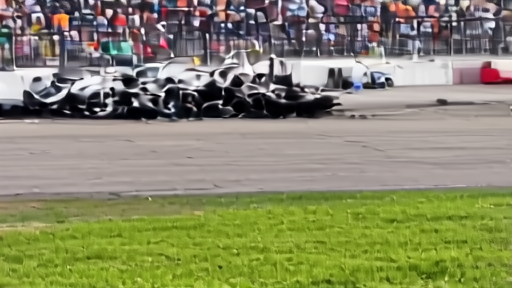
Katherine Legge's attempt to become the first woman to complete the Indy 500–Coca-Cola 600 Double on the same Memorial Day ended early in the first leg, when her car was involved in a crash with Ryan Hunter-Reay that took both cars out of the 110th Indianapolis 500 [1]. The IndyStar's race-day liveblog confirmed the incident with three cars affected, including Legge's; multiple racing accounts on X captured the moment in real time [2].
The paper's Sunday note on the IndyCar cross-property package that included Caitlin Clark as grand marshal, Alex Palou on pole, Legge's Double bid, and the planned lap-18 pylon tribute had named Legge's attempt as the cliffhanger inside the package. Half of the cliffhanger has been answered: the first-woman Double will not happen this year. The other half — whether Legge starts and finishes the Coca-Cola 600 at Charlotte — is still open. USA Today confirmed Monday that she is locked into the No. 78 for Live Fast Motorsports [3].
The crash itself was not a story of either driver's mistake. The Indianapolis 500 has produced a generation of early-race contact incidents that arise from the simple geometry of 33 cars taking the green flag inside a banked oval; the Hunter-Reay-Legge contact is on the inside-line family of those incidents. Hunter-Reay's car carried the heavier impact; Legge's car spun toward the inside wall and came to rest with the front nose detached. Both drivers walked out. The medical report listed neither for hospital evaluation.
What is consequential is the first-woman frame, which the paper has carried because IndyCar and NASCAR have spent eighteen months building a cross-property marketing package around two female anchors — Caitlin Clark at Indianapolis as grand marshal, Legge at both ovals as the Double attempt. Clark's grand-marshal command was executed smoothly during the pre-race [4]. Legge's Double has been reduced from "first woman to complete" to "first woman to start." That is still a record. It is not the record the package was sold on.
The economics matter. A Double attempt that completes both races produces a press cycle that runs through the rest of the IndyCar season and serves NASCAR's Memorial Day broadcast as a hook for the Sunday-into-Sunday-evening audience. A Double attempt that does not complete the first race produces a single-day story with an asterisk. Live Fast Motorsports and Dale Coyne Racing absorbed the costs of the program assuming the upside scenario; the downside scenario is now the operational one. Charlotte's pre-race ceremony Sunday evening will still mark the moment; the Prime Video broadcast will still cut to the grandstands when Legge starts.
The longer-arc consequence is whether the Double becomes a recurring program at all. Tony Stewart was the last driver to complete both races (2001, Stewart finished sixth at Indianapolis and third at Charlotte). The infrastructure that allowed it then — helicopters from Indianapolis to Charlotte timed to the race schedules, dual-team commitments at the engine-supplier level, sponsor packages built around the same paint scheme on both sides — has only thickened in the intervening years. Legge's attempt, completed or not, has demonstrated that the program is viable. The next driver who tries will benefit from the precedent without inheriting the cliffhanger.
The cliffhanger Charlotte will produce, instead, is whether Legge's wear-and-tear after an Indianapolis crash affects her start at Charlotte. The race begins at 6 p.m. ET. The medical clearance was already given. The marketing package is already paid for. The first-woman frame, halved, is what remains.
-- AMARA OKONKWO, Lagos