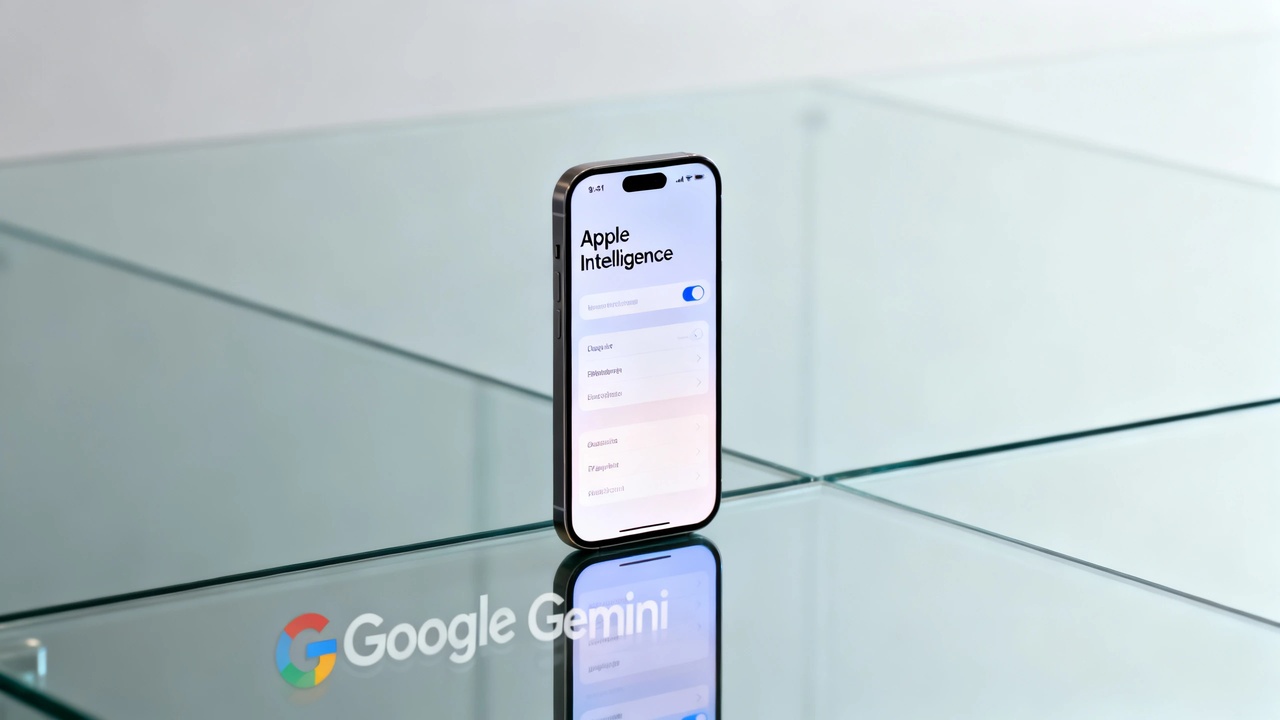
Apple launched "Siri AI" at its Worldwide Developers Conference on June 8 — a ground-up rebuild of its voice assistant running on Apple Intelligence with Google Gemini handling the backend inference [1]. The company called it "a profoundly more capable and personal assistant." The structural fact underneath the announcement: Apple's private AI runs partly on the infrastructure of its biggest competitor.
Kevin Roose, the New York Times technology columnist, traced the dependency chain on X: "Siri AI, powered by Apple Intelligence, powered by Apple Foundation Models, powered by Google Gemini" [2]. The chain exposes what Apple did not emphasize in its keynote: the multi-year Gemini deal, reported by MacRumors at approximately $1 billion per year, means Apple's privacy-branded assistant depends on Google's compute [3].
The Architecture Choices
Siri AI includes a dedicated Siri app, Visual Intelligence across devices, and Private Cloud Compute for server-side queries that exceed on-device capacity. The Private Cloud Compute architecture is Apple's privacy centerpiece — queries that leave the device are processed on Apple's own servers, with cryptographic attestation that the code running matches what Apple published [4].
But not all queries stay within Apple's infrastructure. The Gemini deal covers inference tasks that Apple's own models cannot handle — complex reasoning, multi-step planning, and large-context processing. When Siri AI escalates a query beyond Apple's capacity, the request routes to Google's infrastructure. Apple's privacy commitment applies to the queries it processes itself. The Gemini-routed queries operate under Google's policies.
TechCrunch covered the announcement as a product launch — "everything announced on Siri AI, OS 27, Apple Intelligence, and more" [5]. Apple's Newsroom described the features in detail. Neither publication pressed on the Gemini dependency's implications for Apple's privacy positioning.
The Privacy Paradox
Apple's brand identity rests on privacy. "What happens on your iPhone stays on your iPhone" has been the company's marketing mantra since 2021. Private Cloud Compute extends that promise to server-side processing. But the Gemini deal creates a category of queries where Apple's privacy promise depends on a competitor's infrastructure.
The structural tension is not hypothetical. If Google's Gemini models process Apple user queries, those queries transit Google's network. Google's data practices — even under enterprise agreements — differ from Apple's. The privacy guarantee that Apple offers its users is only as strong as the infrastructure it relies on.
This is not a new problem. Apple has used Google as the default search engine in Safari for years, paying approximately $20 billion annually for the privilege. The Gemini deal extends the pattern: Apple's consumer-facing privacy brand depends on a commercial relationship with the company that operates the world's largest advertising-driven data infrastructure.
Tim Cook's Last WWDC
This is Tim Cook's final Worldwide Developers Conference as CEO. He hands the role to John Ternus on September 1 [6]. The Siri AI announcement is Cook's capstone — the product that closes the AI gap Apple has been criticized for since ChatGPT's launch in November 2022.
The irony is that Cook's legacy AI product depends on the competitor Apple spent a decade positioning itself against. Apple's "privacy versus Google" narrative — the one that powered a decade of iPhone advertising — now runs on Google's compute. The company that told users its devices were the private alternative to Android's data-harvesting ecosystem is now routing its most personal AI queries through Google's infrastructure.
Cook's keynote emphasized Apple Intelligence, on-device processing, and Private Cloud Compute. He did not mention Gemini by name. The dependency exists in the filing, the deal terms, and the technical architecture — not in the keynote.
What This Means for AI-State Power
The paper's AI-state-power thread tracks how AI infrastructure becomes state infrastructure — who controls the compute, the data, the routing, and the governance [7]. Apple's Gemini deal adds a new dimension: a consumer company's privacy infrastructure depending on a competitor's compute creates a dependency that no amount of Private Cloud Compute branding can fully obscure.
The structural question is not whether Apple's privacy claims are valid for on-device processing — they are. The question is whether the hybrid model — Apple for on-device, Google for complex inference — creates a two-tier privacy system where the queries that matter most (the complex, multi-step, personal ones) are the ones that leave Apple's control.
Samsung and SK Hynix, the companies at the center of today's KOSPI crash, make the memory chips that power both Apple's devices and Google's data centers [8]. The AI supply chain is more interdependent than any single company's branding suggests. Apple's Siri AI, Google's Gemini, and the Korean memory fabs that supply them both are nodes in the same infrastructure network — one that no company fully controls.
The audience applauded when Cook demonstrated Siri AI's capabilities. The dependency chain that makes those capabilities possible was not on the slides.
-- DAVID CHEN, San Francisco