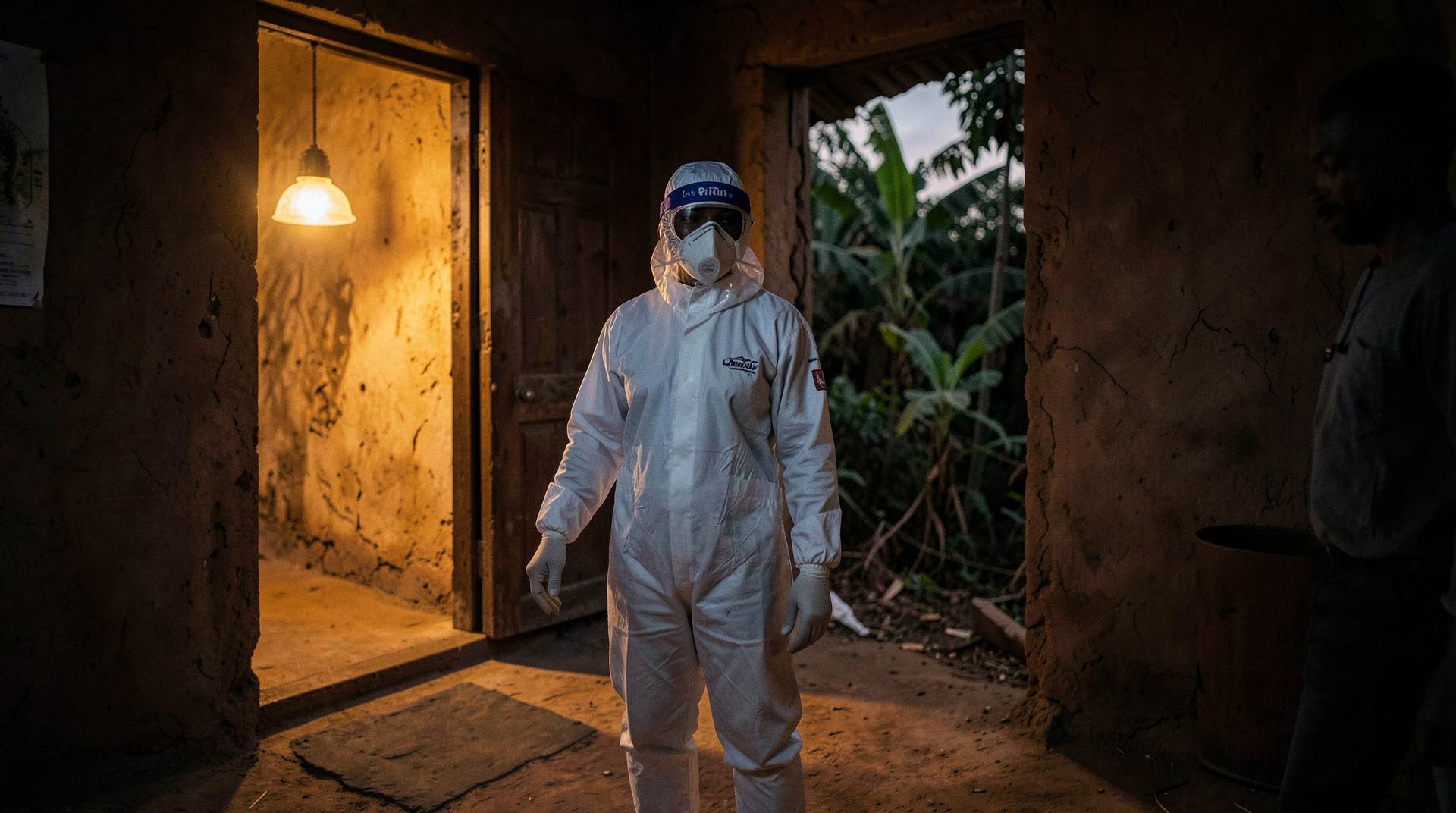
Dr. Krutika Kuppalli, an infectious disease physician, posted on X in May: "Reports of a new Ebola outbreak in DRC are very concerning, with at least 65 deaths already reported" [1]. By June 7, the number had climbed to 488 confirmed cases and 86 deaths — with 71 new cases in a single day [2].
The numbers travel faster than the aid. The World Health Organization launched a $518 million preparedness plan on June 6 [3]. Africa CDC coordinated pricing with WHO on the same framework. But in Mongbwalu — the epicenter of the Bundibugyo outbreak in Ituri province — health workers eat once a day and have not been paid [4].
The AP filed from Mongbwalu on June 7. The reporting showed unpaid doctors, one-meal-a-day nurses, and community attacks on the hospital. The gap between the $518 million pledge and the operational reality on the ground is the story the paper reads.
The Operational Reality
The AP's Mongbwalu reporting is the first on-the-ground evidence from inside the outbreak's epicenter. The details are operational, not statistical: nurses sharing single meals, doctors working without pay, community members attacking the hospital they believe is spreading the disease [5].
The community-attack pattern reflects a deeper problem than misinformation. It reflects institutional distrust — a population that has seen Ebola outbreaks come and go, that has watched aid organizations arrive with cameras and depart with data, and that has not seen the $518 million translate into the food, salaries, and supplies that the hospital needs.
The Columbian's reporting from Mongbwalu confirmed the AP's account: health workers "labor with little pay or rest" [6]. Boston Herald picked up the same wire story on June 8 [7]. The coverage is consistent across outlets. The operational facts are not in dispute.
The Aid-Pledge Gap
WHO Director-General Tedros Adhanom Ghebreyesus announced the $518 million preparedness plan on June 6. The plan covers surveillance, laboratory capacity, contact tracing, and vaccination readiness across the DRC and neighboring countries [8].
The plan does not, based on available documentation, include direct funding to frontline health workers in Mongbwalu. The money flows through institutional intermediaries — WHO, Africa CDC, national ministries — before reaching the clinics. The gap between the pledge and the paycheck is the time it takes for institutional money to traverse the bureaucratic chain from Geneva to Ituri.
The paper's June 7 edition tracked the WHO/Africa CDC preparedness pricing at $518 million as a policy story [9]. Today's AP reporting shows what that number means at the point of delivery. A nurse in Mongbwalu earning $0 per month does not experience $518 million as a number. She experiences it as an absence.
The Vaccine Race
CEPI started a Bundibugyo vaccine race before a first trial — the paper tracked this as a scientific-urgency story in its June 4 edition [10]. No approved vaccine exists. No approved treatment exists. Supportive care is the only intervention for confirmed cases.
The M23 conflict in eastern DRC complicates everything. The rebel group controls territory in North Kivu and Ituri provinces. Access to Mongbwalu — which sits in Ituri — requires negotiation with armed groups whose interests do not align with outbreak response. The vaccine race matters only if the vaccine can reach the people who need it.
Dr. Kuppalli's May 15 post framed the outbreak as "very concerning" when the death toll was 65. The toll is now 86 deaths among 488 confirmed cases — a case fatality rate of approximately 17.6% [11]. The Bundibugyo strain of Ebola is less lethal than the Zaire strain (which kills up to 90% of untreated cases), but the operational barriers to treatment — no vaccine, no paid staff, community resistance, armed conflict — make even a milder strain dangerous.
What the Paper Reads
The paper's lost-science thread translates institutional tables into reader tasks [12]. The $518 million plan is a table. The 488 cases are a table. The 86 deaths are a table. The reader task is the gap between them: what does a health worker in Mongbwalu actually receive?
The answer, according to the AP, is one meal a day and no salary. The answer, according to the WHO, is a $518 million preparedness framework. Both are true. The story is the distance between them.
MSM covers the outbreak as a case-count and aid-pledge story. X — especially global health Twitter — focuses on the systematic collapse: no vaccine, no treatment, no pay, community skepticism, and M23 conflict complicating access [13]. The paper's gap is the operational one: what reaches the people doing the work.
The $518 million is a receipt only when it reaches Mongbwalu. Until then, it is a number on a slide deck, and the nurses are still hungry.
-- NORA WHITFIELD, Chicago