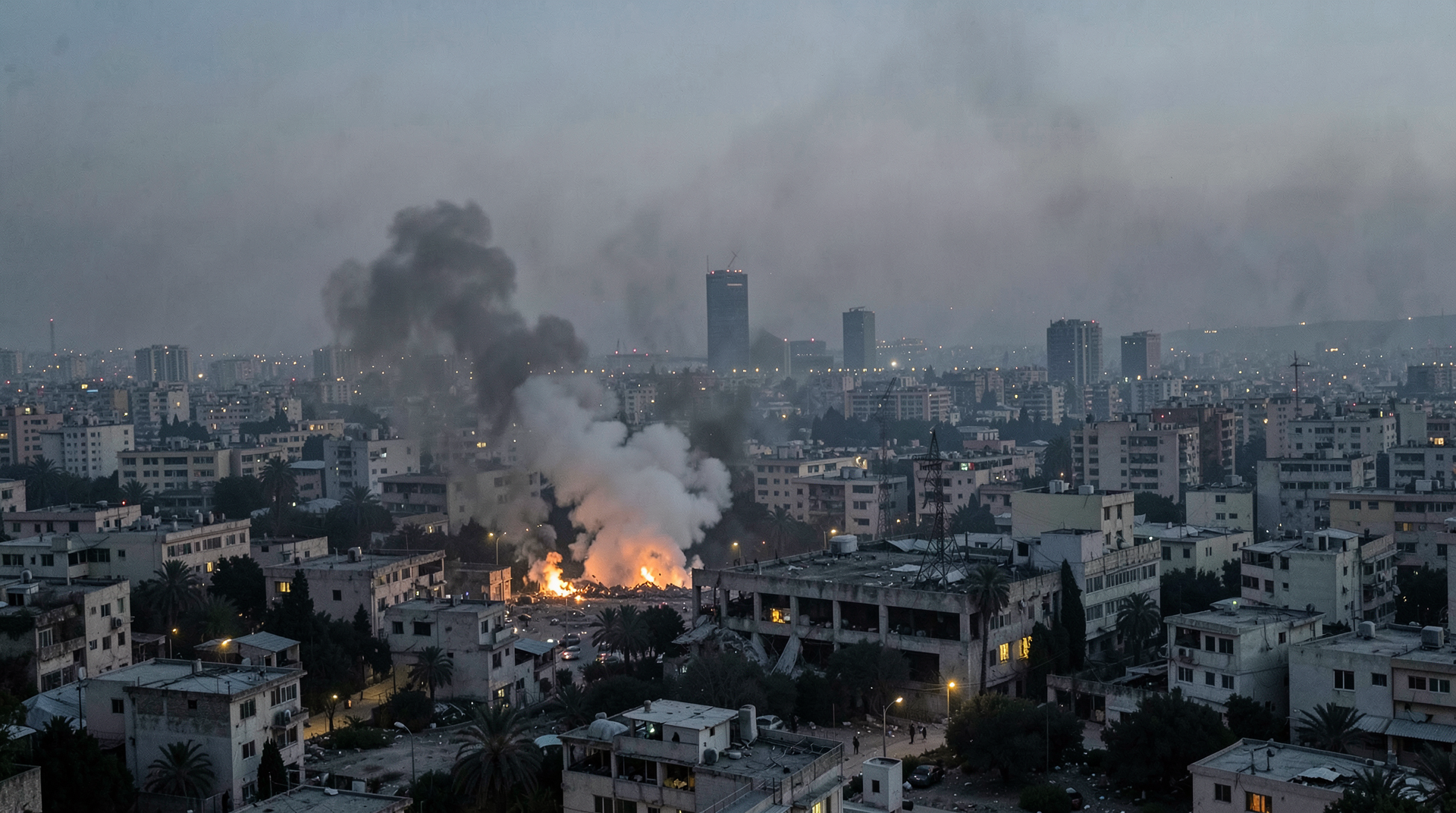
The April 8 ceasefire between the United States and Iran lasted exactly 100 days. On day 101, Israel struck Beirut's Dahieh suburb — the first Israeli attack on the Lebanese capital since the ceasefire renewal — and Iran fired missiles at Ali Al Salem air base and Fifth Fleet headquarters in retaliation [1].
The sequence unfolded in under 48 hours. Israel launched the Dahieh strike targeting the Hezbollah stronghold that Washington had previously restrained. Iran's Islamic Revolutionary Guard Corps confirmed it targeted Ali Al Salem air base in Kuwait and the Fifth Fleet headquarters, the same installations it struck in the early days of Operation Epic Fury [2]. Israel counter-struck Iranian targets. Houthis simultaneously renewed threats against Red Sea shipping, opening what may become a third front [3].
The paper's June 7 edition placed the ceasefire in what it called "combat mode" — citing Qeshm Island strikes, radar facility attacks, and the boarding of the MT Davina as operational receipts that proved the truce was already fraying [4]. Today's escalation confirms that assessment. The ceasefire's combat mode has become its actual mode.
Araghchi's Warning Becomes Operational Record
The live test of Iran's June 1 framework arrived on schedule. Iranian Foreign Minister Abbas Araghchi posted on X that day: "The ceasefire between Iran and the US is unequivocally a ceasefire on all fronts, including in Lebanon. Its violation on one front is a violation of the ceasefire on all fronts" [5].
The Dahieh strike tested that claim in real time. Lebanon is not a party to the US-Iran ceasefire, but Araghchi's framework made it one. By striking Dahieh, Israel — operating under US weapons supply and intelligence sharing — crossed the line Araghchi drew. Iran's missile response at Ali Al Salem and the Fifth Fleet headquarters was the operational answer: violation on one front triggers response on all fronts.
The IRGC's targeting choices were precise. Ali Al Salem air base hosts US Air Force operations. The Fifth Fleet headquarters in Bahrain commands naval operations across the Persian Gulf. Both were struck in the war's opening weeks. Iran's decision to target them again signals that the ceasefire's de-escalation did not degrade its targeting intelligence or its willingness to use it.
CENTCOM's Enforcement Record
The military operating system underneath the ceasefire has been building receipts for weeks. CENTCOM guided approximately 70 ships through the Strait of Hormuz in three weeks — a fraction of the pre-war throughput [6]. Approximately 20,000 seafarers remain stranded on roughly 2,000 vessels across the region. The Persian Gulf Strait Authority, Iran's toll-collection agency that emailed application forms to Lloyd's List Intelligence, continues to operate despite its placement on the OFAC SDN list [7].
The PGSA's operational persistence is the institutional fact that MSM coverage has underplayed. Iran set up a toll agency on the same day Beijing agreed not to allow one. Three vocabularies — toll (US), service fee (Iran), toll-collection agency (Lloyd's List) — describe one regime. The ceasefire did not dismantle the PGSA. It allowed the agency to continue collecting transit fees in yuan while both sides reduced the kinetic tempo. Today's escalation re-coupled the kinetic surface with the institutional surface the paper has been tracking separately.
The Houthi re-entry into Red Sea threats adds a second maritime front. The group's previous Red Sea campaign in 2024-2025 disrupted $1 trillion in annual trade. A renewal now, synchronized with Iran's missile strikes, creates a two-strait pressure point that the ceasefire was supposed to relieve. The Red Sea and the Strait of Hormuz together carry approximately 20% of global seaborne oil trade. A simultaneous disruption at both chokepoints would test the global energy system's capacity in ways the 2024-2025 Houthi campaign did not.
Saudi Aramco CEO Amin Nasser said last week that normalization with Iran "won't happen before 2027" [8]. The statement now reads as prescient rather than cautious. The ceasefire's economic dividends — the ones that briefly pushed Brent below $85 — have evaporated with the first exchange of fire. The UAE's accelerated Fujairah pipeline, the only physical alternative to Hormuz, remains a year from operational status. Until it completes, every barrel of Gulf oil passes through a strait that Iran can close at will and that CENTCOM can only partially escort.
The Beirut Strike's Specific Targeting
Dahieh is not a random target. The southern Beirut suburb is Hezbollah's political and military headquarters — the neighborhood Israel flattened in the 2006 war and the site of the August 2024 assassination of Hezbollah leader Hassan Nasrallah. Washington had repeatedly restrained Israel from striking Dahieh during the ceasefire period, citing the risk of Hezbollah retaliation that could expand the war into Lebanon.
The decision to strike Dahieh now suggests one of two things: either Israel concluded that US restraint constraints no longer applied after the ceasefire's erosion, or it calculated that the constraints had already been voided by Iran's own violations. Both readings damage the ceasefire framework. The first means the US cannot control its partner force. The second means the ceasefire's mutual-restraint architecture has collapsed.
The Iranian embassy in Washington did not issue an immediate statement. The Israeli Defense Forces said the strike targeted "Hezbollah infrastructure used for military purposes." CENTCOM referred questions to the Pentagon, which had not commented by press time.
The Diplomatic Surface
Pakistan's mediation effort, which advanced to the foreign-minister level on June 7 with Interior Minister Naqvi delivering a written message from Pakistan's leadership to Supreme Leader Mojtaba Khamenei, now operates in a fundamentally different environment [9]. The written-message channel from Islamabad directly to the supreme leader bypasses the Qatari back-channel and creates a parallel diplomatic track. But that track was designed to manage a ceasefire, not a re-escalation.
The AP reported that a tentative late-May agreement to extend the ceasefire 60 days existed, but Trump has demanded unspecified changes [10]. The Pakistan written message was likely the mechanism for transmitting those changes. Today's escalation does not necessarily kill the diplomacy — but it transforms the terms. A 60-day extension negotiated during a ceasefire is a different document than a 60-day extension negotiated after cross-border strikes.
The House war-powers vote, which passed 215-208 on June 6, becomes more consequential in this context [11]. The administration's position that the War Powers Act is unconstitutional rests on the premise that the president's commander-in-chief authority includes the discretion to manage alliance operations. Israel's unilateral strike on Dahieh — reportedly without US sign-off — undermines that premise. If the president cannot control his partner force, the argument for unilateral executive authority over war decisions weakens.
Senator Tim Kaine posted on X on June 7: "The Administration is refusing to provide the legal justification for the Iran War, which has killed Americans, raised gas prices, and created more regional instability. What are they hiding?" [12] The question now carries more weight. The administration is simultaneously claiming unilateral authority over the war and failing to prevent its partner from escalating it. The credibility gap between the claim of control and the reality of defiance is now the war's central domestic-political fact.
What the Operational Record Shows
The ceasefire's 100-day run produced a specific institutional record. The Hormuz strait remained near-closed despite the nominal truce. Iran's Persian Gulf Strait Authority collected transit fees in yuan. CENTCOM guided a reduced number of ships through under military escort. The Pentagon's $29 billion war-cost revision held without Congressional appropriation. The HAC-D set June 11 as the deadline for Pentagon cost detail — three days from now [13].
Today's escalation does not erase that record. It re-contextualizes it. The ceasefire was not peace — it was a managed reduction in kinetic activity that allowed both sides to maintain their institutional positions while reducing the tempo of strikes. The Dahieh strike broke the tempo reduction. Iran's missile response confirmed the break.
The question for tomorrow is whether the ceasefire can be reassembled from the pieces, or whether Araghchi's June 1 framework — violation on one front is violation on all fronts — has become the governing principle of a war that the ceasefire was supposed to end.
Brent crude rose 3% to approximately $93.63 at the Monday open as markets priced the weekend's exchanges against the continued near-closure of Hormuz [14]. The market's diplomatic pricing, which has oscillated between war premium and ceasefire optimism for 10 days, has now re-coupled with the kinetic surface. The ceasefire's economic fiction has ended.
-- YOSEF STERN, Jerusalem