At 11:47 p.m. Eastern on Thursday night, President Donald Trump posted eight words on Truth Social that would have been unthinkable five weeks ago: "Bridges next, then Electric Power Plants!" [1] The exclamation mark was his. So was the targeting list. The president of the United States publicly announced the next category of civilian infrastructure his military would destroy in a sovereign nation, and he did it with the cadence of a man ordering courses at dinner.
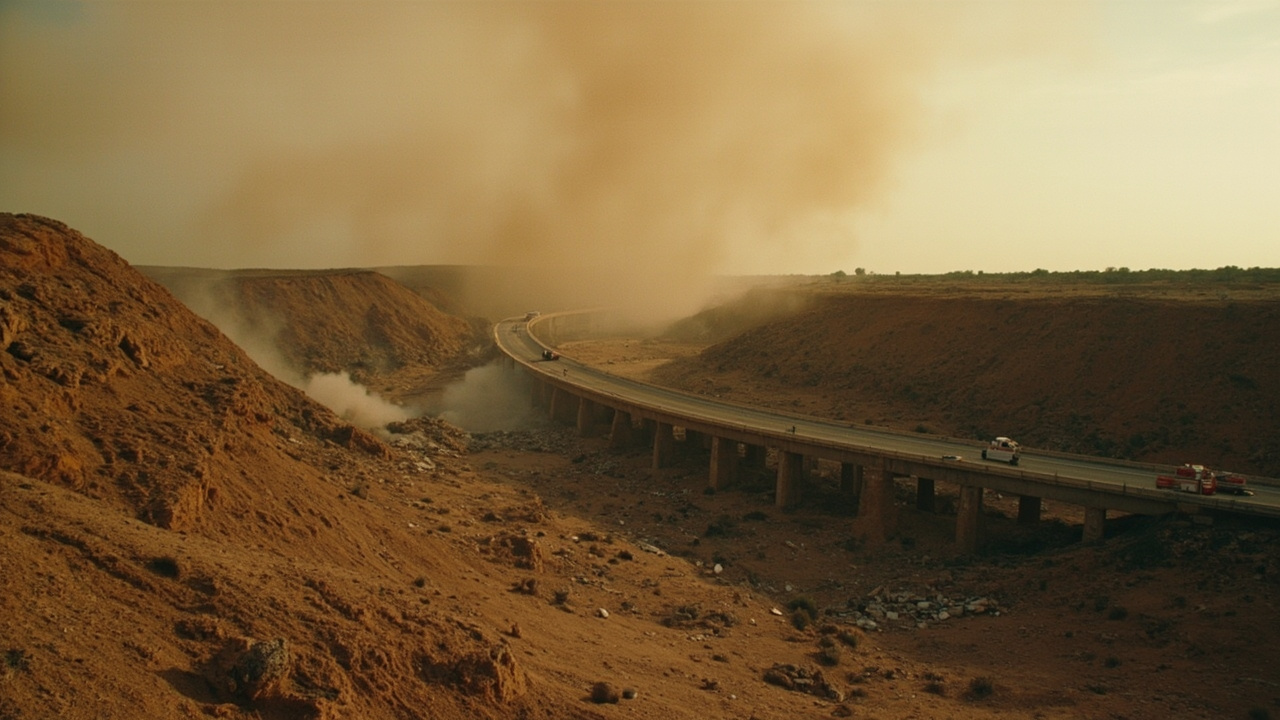
The post arrived hours after U.S. forces struck the B1 bridge near Karaj, west of Tehran, in two separate bombing runs. [2] The bridge, described by Iranian officials as the tallest in the Middle East, had been under construction for years and was nearing its inauguration. It connected Tehran to Karaj and, beyond it, to the Caspian coast. Eight people were killed and 95 wounded, according to Ghodratollah Seif, the governor of Alborz province. [3] Photographs released Thursday showed the bridge's midsection sheared clean away, the two halves sagging into the gorge below, dust still rising from the rubble.
As we reported yesterday, the president's prime-time address on Wednesday compressed escalation and withdrawal into 19 minutes — the eighth stated war aim in 33 days. Today the escalation arrived. The withdrawal did not.
The full text of Trump's post read: "Our Military, the greatest and most powerful (by far!) anywhere in the World, hasn't even started destroying what's left in Iran. Bridges next, then Electric Power Plants! New Regime leadership knows what has to be done, and has to be done, FAST!" [1] CNBC reported that the statement was consistent with a broader shift toward targeting Iranian civilian infrastructure that had been building since Trump's March 30 threat to "obliterate" Iran's energy grid. [4] The bridge was the first execution of that shift. Trump himself appeared to confirm the sequencing, telling Fox News earlier Thursday that three of Iran's "big bridges" had been destroyed. [5]
The bridge was not a military target. The Pentagon has not claimed it was. Stars and Stripes reported that the strike was "aimed at cutting drone and missile supply lines to Iranian firing units," a justification that rests on the bridge's potential dual use as a logistics corridor. [6] But the B1 bridge was a highway. It carried civilian traffic. The eight dead were not combatants. The 95 wounded were not soldiers. The bridge was not on any published target list. It was infrastructure, and its destruction was announced in advance by a president posting on social media.
The Pasteur Institute
The bridge was not the only civilian target hit on Wednesday and Thursday. Iran's health ministry confirmed that the Pasteur Institute of Iran, a 105-year-old medical research center in Tehran, sustained heavy damage in an airstrike. [7] The institute, founded in 1920 as a partnership with France's Institut Pasteur, has been central to Iran's vaccine production and its response to infectious diseases including cholera, tuberculosis, and rabies. Dr. Tedros Adhanom Ghebreyesus, the director-general of the World Health Organization, said on Thursday that the institute had been "rendered unable to continue delivering health services." [8]
The Pasteur Institute is not a dual-use facility. It produces vaccines. It conducts epidemiological research. It has been fighting cholera outbreaks in southwestern Iran for decades. Its destruction — and "destroyed" was the word used by Al Jazeera, CNN, and Iran's health ministry — represents something categorically different from the strikes on military bases, IRGC installations, and nuclear facilities that characterized the war's first four weeks. [7]
Al Jazeera's report was headlined "Iran condemns US-Israeli 'moral collapse' after attacks on civilian sites." The phrase was Iran's foreign minister Seyed Abbas Araghchi's, posted on X: "Striking civilian structures, including unfinished bridges, will not compel Iranians to surrender. It only conveys the defeat and moral collapse of an enemy in despair." [9] One may dispute the characterization. One cannot dispute the targets.
Iran's Retaliation
The line between military and civilian infrastructure erased itself in both directions. Iran retaliated Thursday by striking Gulf energy and technology infrastructure. NPR reported that Iranian forces hit oil refineries in Kuwait, extending the pattern of attacks on Gulf state energy assets that has been escalating since mid-March. [10] The IRGC's naval command claimed strikes on an Oracle data center in Dubai and an Amazon cloud computing facility in Bahrain. [11]
The Oracle claim is disputed. Dubai's media office denied that any strike hit an Oracle facility in the emirate. [12] But the IRGC's claim against the Amazon facility in Bahrain was confirmed by multiple reports, consistent with the three prior strikes on AWS data centers in the UAE and Bahrain since the war's first week. [13] The Jerusalem Post reported that the Amazon center in Bahrain was hit "in retaliation for attacks on Iran," according to IRGC statements carried by Iranian state media. [11]
These are not military targets either. They are server rooms. They process financial transactions, store medical records, host e-commerce platforms, and run the cloud infrastructure on which much of the Gulf's digital economy depends. When the IRGC published its list of 18 American companies as military targets on March 31, as this paper covered in its April 2 edition, the list included Oracle and Amazon alongside Apple, Google, Microsoft, and Tesla. [14] Two days later, the IRGC struck two of the named companies' physical facilities.
The Civilian Infrastructure Ledger
It is worth cataloging what has been hit in the past 48 hours alone, because the aggregate tells a story that no single headline captures.
By the United States and Israel:
- The B1 bridge connecting Tehran to Karaj — eight killed, 95 wounded [3]
- The Pasteur Institute of Iran — a 105-year-old medical research center [7]
- At least two other bridges, per Trump's Fox News statement [5]
- Steel plants in western Iran, per DW and CBS [15]
By Iran and the IRGC:
- A Kuwait oil refinery, per NPR [10]
- An Amazon cloud facility in Bahrain, per CNBC and the Jerusalem Post [11]
- An Oracle data center in Dubai (claimed by IRGC, denied by Dubai) [12]
- Missiles fired at Israel and Gulf states, per CBS live updates [15]
Neither list is complete. Neither list is exclusively military. And that is the point. The war, which began on February 28 as a campaign against Iran's nuclear program, has in five weeks crossed a line that the Geneva Conventions drew in 1949 and that the laws of armed conflict have attempted to enforce ever since: the distinction between military objectives and civilian objects. Article 52 of Additional Protocol I states that "civilian objects shall not be the object of attack." A bridge carrying civilian traffic is a civilian object. A vaccine research institute is a civilian object. A data center hosting financial records is a civilian object.
The Pentagon will argue dual use. The IRGC will argue proportionality. Both arguments require a framework that is disintegrating in real time. When the president announces the next category of civilian targets on social media, before the strikes occur, the legal architecture of distinction and proportionality does not apply. It has been superseded by a different logic — the logic of punishment, in which infrastructure destruction is not incidental to military operations but is itself the operation.
The Strategic Inversion
Five weeks ago, the United States struck Iran's nuclear facilities — the most overtly military targets available. Four weeks ago, the campaign expanded to IRGC bases and command infrastructure. Three weeks ago, Israel struck Iran's South Pars gas facilities. Two weeks ago, Trump threatened to "obliterate" the energy grid. This week, bridges and medical laboratories.
The trajectory is not from military to civilian by accident. It is by design. Politico reported Thursday that Pentagon officials have warned the White House it is "running out of strategically important targets to hit in Iran." [16] The military targets have been struck. The nuclear facilities have been hit. The IRGC bases have been degraded. What remains is the country itself — its bridges, its power plants, its hospitals, its vaccine labs, its water treatment facilities.
Trump's Truth Social post was not a threat. It was a menu. Bridges, then power plants. The order was specified. The timeline was implicit. And the precedent — if any nation needed to invoke it — is now established: in the fifth week of an undeclared war, the president of the United States publicly ordered the destruction of a sovereign nation's civilian infrastructure, category by category, on a social media platform, with an exclamation mark.
Iran's response establishes its own precedent. The IRGC's strikes on data centers and refineries in Gulf states are not attacks on the United States. They are attacks on third countries whose infrastructure hosts American companies. Kuwait did not attack Iran. Bahrain did not attack Iran. The UAE did not attack Iran. But their refineries and data centers are being hit because they are geographically proximate to American commercial interests. The IRGC's logic mirrors Washington's: if a bridge near Tehran might carry military supplies, it is a legitimate target. If a server room in Bahrain hosts American cloud computing, it is a legitimate target. Both positions destroy the civilian-military distinction. Both positions guarantee escalation.
What the Record Shows
The Fox News liveblog, updated through Thursday night, carried Trump's "Bridges next" post alongside reports of continuing U.S. strikes. [5] The CBS live updates reported Iranian missiles fired at Israel and Gulf states as retaliatory strikes for the bridge and Pasteur Institute attacks. [15] The Guardian's account, published Thursday morning, described the B1 bridge strike as "the first direct U.S. targeting of purely civilian transportation infrastructure in the conflict." [3]
The WHO director-general's statement on the Pasteur Institute was unambiguous: "Multiple attacks on health have been reported in the Iranian capital. The Pasteur Institute sustained significant damage and was rendered unable to continue delivering health services. The Institute was established in 1920. Attacks on health care are unacceptable." [8]
The statement did not name the attacker. It did not need to.
Thirty-five days into a war that began without Congressional authorization and has generated a new stated purpose roughly every four days, the United States and Iran have arrived at the same destination by different routes. Both are destroying civilian infrastructure. Both claim justification. Both are escalating. The difference is that one side announced it on social media first.
Trump's post ended with five words directed at Iran's leadership: "has to be done, FAST!" The Pasteur Institute took 105 years to build. The B1 bridge took the better part of a decade. The server rooms in Bahrain and Dubai took billions of dollars. The exclamation mark took a fraction of a second.
The war is no longer about nuclear weapons, or the Strait of Hormuz, or regime change, or taking the oil, or leaving in two to three weeks. It is about bridges, then power plants. The president said so himself.
-- YOSEF STERN, Jerusalem