TL;DR
The Fed raised its inflation forecast to 2.7 percent, held rates steady, and projected one cut it probably cannot deliver — the institutional version of whistling past the oil field.
MSM Perspective
Reuters led with the Iran uncertainty framing; the NYT headlined 'War Upends the Economic Outlook'; the WSJ focused on the lone dissenter pushing for a cut.
X Perspective
Financial X is split between those who see the dot plot as credible guidance and those who call it a polite fiction — markets are already pricing zero cuts in 2026.
On Wednesday the Federal Reserve held its benchmark interest rate at 3.5 to 3.75 percent, raised its core PCE inflation forecast for 2026 from 2.4 percent to 2.7 percent, and projected — in the studied ambiguity of its dot plot — that one quarter-point rate cut remains appropriate this year. [1] The vote was 11 to 1. Governor Stephen Miran dissented in favor of an immediate cut. [2] Chair Jerome Powell, at his press conference, said the economic effects of the Iran war were "too soon to know" and that uncertainty had "increased significantly." [3] The statement was accurate. It was also the institutional equivalent of describing a building on fire as experiencing elevated thermal conditions.
This paper wrote on Thursday that central banks had abandoned the fiction that the energy shock was temporary. That assessment was based on the Bank of England and ECB signaling that rate cuts were off the table for the foreseeable future. On Wednesday, the Federal Reserve made it official. The revised Summary of Economic Projections is not a document that admits to crisis. It is a document that adjusts its euphemisms upward. Core PCE at 2.7 percent — up 30 basis points from December's projection — is the Fed's way of saying that inflation, which was already running above target before the war, is now being accelerated by the war and will not return to target this year. [1]
The question is not what the Fed said. The question is whether what it said bears any relationship to what it expects.
The Dot Plot Fiction
The March dot plot shows a median federal funds rate projection of 3.4 percent for the end of 2026 — unchanged from December, implying one 25-basis-point cut. [4] This is the number the Fed chose to leave in place. It is also the number the market has chosen to ignore.
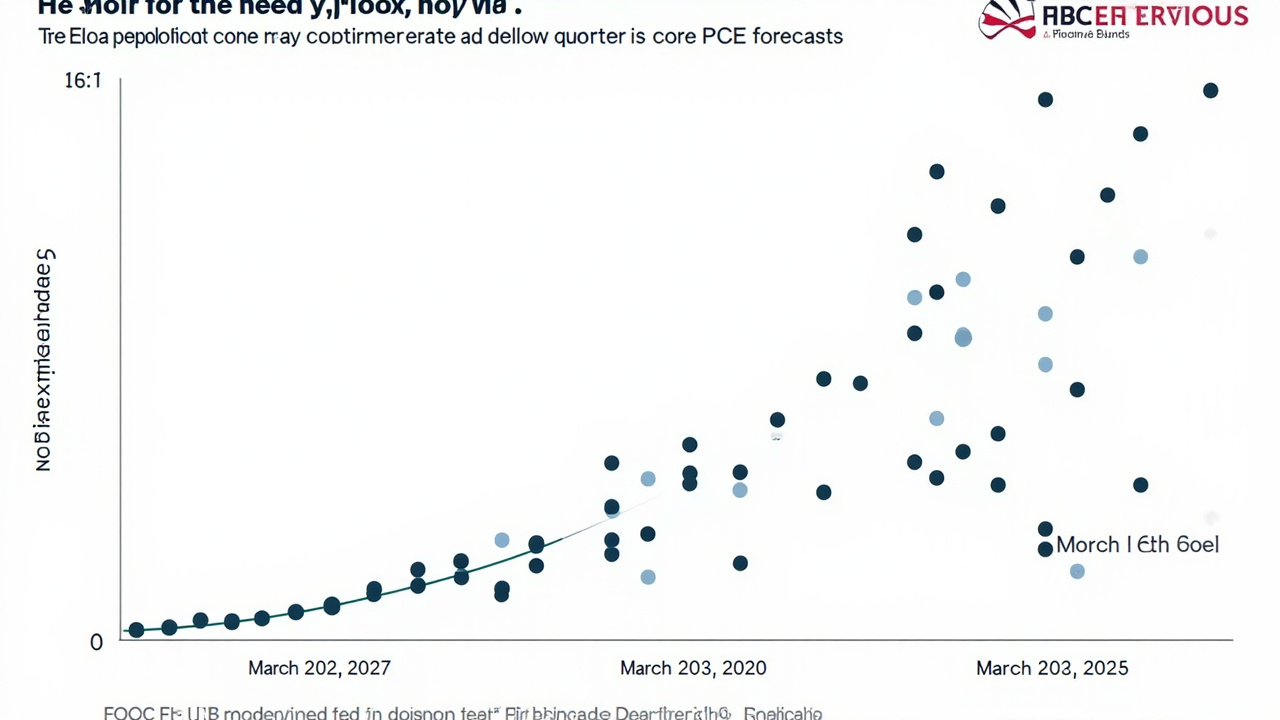
Futures markets, as of Friday, are pricing zero rate cuts in 2026. [5] The gap between the Fed's median dot and the market's implied rate path has widened to roughly 35 basis points — the largest divergence since the 2023 tightening cycle, when the market spent months refusing to believe the Fed would hike as far as it did. Now the disbelief runs in the opposite direction. The market does not believe the cut will materialize.
The skepticism has a name: Brent crude at $112. Core PCE was already running at 3.1 percent year over year in January, before the war began. [6] The February figure, not yet released, will capture only the first days of the conflict. March will capture the full force of the oil shock. Neil Dutta, head of economics at Renaissance Macro Research, told MarketWatch that the Fed's 2.7 percent core PCE forecast was "a pipe dream" — that the actual trajectory, incorporating sustained oil above $100, would bring core inflation closer to 3.5 percent by year-end. [7]
Powell acknowledged the bind at his press conference. "In the near term, higher energy prices will push up overall inflation," he said. [3] The institutional mandate is price stability. The price of the commodity that most directly determines consumer inflation has risen 50 percent in three weeks. The mandate and the reality are at war with each other.
The Miran Dissent
Governor Miran favored an immediate 25-basis-point cut to 3.25 to 3.5 percent, arguing that labor market weakness warranted easing and that the Fed should move toward a neutral rate he estimates at approximately 3.1 percent. [2] It was his second consecutive dissent.
The divide is genuine, not temperamental. The hawks view the inflation risk as primary — oil at $112 feeds into energy costs, transportation, and eventually core goods and services. Cutting into an inflationary oil shock would risk de-anchoring expectations. The doves, including Miran and, per Reuters, Governor Waller, emphasize that the same oil shock that raises prices also slows growth. [8] This is the stagflationary dilemma the Fed spent years insisting it would never face again. The one-cut projection is the committee's attempt to split the difference — a political document dressed in econometric clothing.
What Powell Cannot Say
Powell said the word "uncertainty" eleven times at his press conference. [3] He did not characterize the war as a temporary disruption. He did not predict when oil prices would normalize. He offered no forward guidance of any specificity. A Fed chair who believed the oil shock would prove transitory would say so — as Powell himself did in 2021, a characterization that cost the institution months of credibility. He is not making that mistake again.
The Washington Post reported that Fed officials privately view the Iran conflict as the most significant exogenous shock since the pandemic, with the complication that there is no fiscal consensus on how to respond. [9] NPR summarized the position with uncharacteristic bluntness: the Fed is "holding still because it doesn't know which way to jump." [10]
The Federal Reserve held the rate. It raised the forecast. It projected a cut it may never deliver. This is what institutional caution looks like when the institution is out of good options — a careful, well-documented, meticulously hedged acknowledgment that the war has broken the forecast, and the forecast has not yet been replaced with anything more honest.
-- HENDRIK VAN DER BERG, Amsterdam
Sources & X Posts
News Sources
X Posts