World
TL;DR
Yemen's Houthis fired missiles at southern Israel and attacked a container ship in the Red Sea, opening a second maritime chokepoint alongside the Hormuz blockade.
MSM Perspective
Reuters and the BBC reported the Houthi strikes as an escalation while noting Israel intercepted the incoming missiles.
X Perspective
Security analysts on X warned that simultaneous Hormuz and Bab el-Mandeb disruptions create a 'double blockade' scenario unprecedented in modern shipping.
Yemen's Houthi forces launched a ballistic missile and a salvo of drones at southern Israel on March 28, followed by coordinated attacks on commercial shipping in the Bab el-Mandeb strait on March 29 and 30, marking the group's first offensive operations since the US-Iran war began five weeks ago and opening a second maritime chokepoint at the worst possible moment for global trade [1].
The missile aimed at Israel was intercepted by the Arrow defense system over the Red Sea, according to the Israeli Defense Forces. The drones — at least four, launched from Houthi-controlled territory near Hodeidah — were shot down by a US Navy destroyer operating in the southern Red Sea. No casualties were reported on either occasion [2].
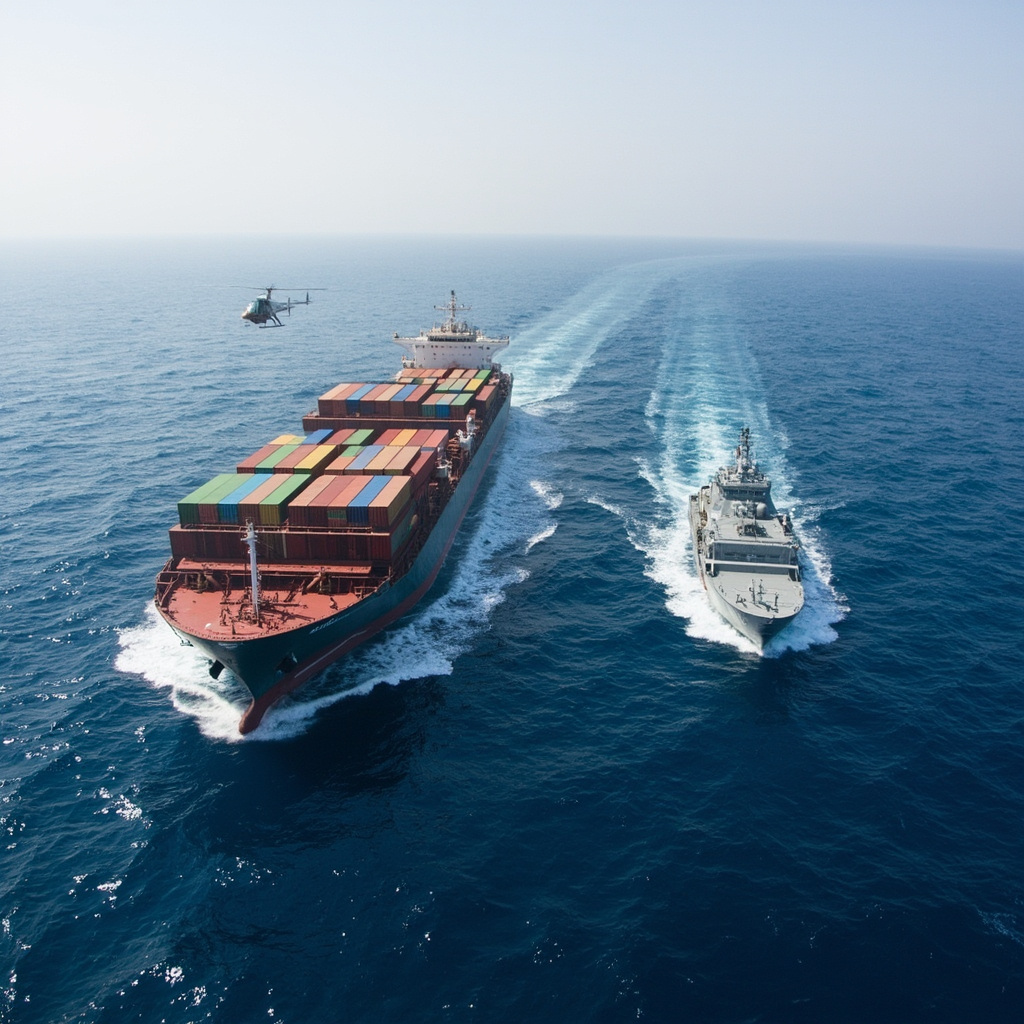
The shipping attacks were more consequential. On March 29, a Houthi anti-ship missile struck the MSC Adriana, a Liberian-flagged container ship transiting the Bab el-Mandeb en route from Jeddah to Djibouti. The vessel sustained damage to its superstructure but remained seaworthy and continued to port under its own power. On March 30, a drone swarm targeted a Greek-owned bulk carrier carrying grain from Ukraine to East Africa; the vessel's armed security team shot down three of five drones, with the remaining two missing their target [3].
The timing was not coincidental. The Houthis had been conspicuously quiet since February 28, when the US-Iran war began. The group's leader, Abdul-Malik al-Houthi, issued a statement on March 1 saying Ansar Allah would "assess the battlefield" before committing to operations. The assessment, it appears, has concluded.
The strategic logic is straightforward. Iran's Hormuz blockade has disrupted approximately 20% of global oil supply, but an American naval escort operation has begun forcing a limited number of tankers through the strait, as this paper reported last week. The Houthis' decision to activate Red Sea operations creates a second disruption at the southern end of the same supply chain. Oil and goods that bypass Hormuz via pipeline to Red Sea ports now face a new threat before reaching the Suez Canal and Mediterranean markets [4].
The "double blockade" scenario — Hormuz from the north, Bab el-Mandeb from the south — is without precedent in modern maritime history. The two chokepoints together control access to the Persian Gulf, the Red Sea, and the Suez Canal, through which approximately 30% of global container traffic and 12% of global oil trade passes. Simultaneous disruption at both points forces shipping onto the Cape of Good Hope route around Africa, adding 10 to 14 days to transit times and raising freight costs by 40 to 60% [5].
Shipping insurers responded immediately. War risk premiums for Red Sea transit, which had declined after the January ceasefire between the Houthis and international shipping, jumped back to near-record levels on March 31. Lloyd's of London reported that several major container lines had already suspended Red Sea transits, with Maersk, MSC, and Hapag-Lloyd all issuing advisories recommending the Cape route [6].
For Israel, the Houthi attacks add a new dimension to an already multi-front conflict. The IDF is simultaneously conducting operations against Iran, managing heightened tensions along the Lebanon border with Hezbollah (which has thus far limited its involvement to occasional rocket fire), and now defending against attacks from Yemen, more than 2,000 kilometers to the south. The Arrow system can intercept Houthi ballistic missiles, but each interception costs millions of dollars and draws from the same missile defense capacity needed against Iran's far larger arsenal [7].
The American military response has been to extend its naval presence. The aircraft carrier USS Eisenhower, already operating in the Arabian Sea for Iran-related operations, dispatched a destroyer group to the southern Red Sea on March 30. But the Houthis demonstrated during their 2023-2024 campaign that dispersed missile and drone launchers in mountainous terrain are extraordinarily difficult to suppress from the air, and the US military has limited appetite for a third simultaneous theater of operations.
The Houthis' calculus is simple: Iran is their patron, and Iran is at war. The 2024 ceasefire that paused Red Sea attacks was premised on a diplomatic arrangement that the current conflict has rendered void. Ansar Allah fights when Iran fights. And Iran, as its parliament speaker declared this week, is not seeking to stop.
-- Yosef Stern, Jerusalem
Sources & X Posts
News Sources
X Posts