Iran's Foreign Minister Abbas Araghchi appeared on state television on Tuesday evening and delivered five conditions for ending the war with the United States — conditions that read less like a negotiating position than like terms dictated to a defeated power [1]. Halt all aggression and assassinations. Provide concrete, binding guarantees the war will never recur. Pay reparations for the damage inflicted on Iran's people. End the war across every front, including Israeli operations in Lebanon and against resistance groups. Recognise Iranian sovereignty over the Strait of Hormuz. That is the counter-proposal. There is no sixth point. There is no room for discussion. "We do not want a ceasefire," Araghchi said. "We want the war to end in a way that it does not repeat, on our own terms. The damages to the people of Iran must also be compensated" [1].
Twenty-four hours earlier, the terms and the paratroopers had arrived in sequence — Washington's 15-point plan delivered through Pakistani intermediaries, followed within hours by deployment orders for the 82nd Airborne Division. The dual track was, as this paper noted, never more naked. But Iran's response on March 25 made both sides of the American gambit explicit by rejecting both simultaneously. The 15-point plan — which demanded dismantling Iran's nuclear programme, accepting limits on its ballistic missile arsenal, and abandoning its militia network in exchange for total sanctions relief — was not merely rejected. It was reframed. Tehran chose to answer America's terms with its own, and the architecture of Iran's five points inverts the American document so precisely that the counter-proposal functions as a mirror held up to what Tehran considers Washington's delusions [1][3].
This is the second time Iran has refused to negotiate under fire. As this paper reported, Iran says tricked twice — struck during talks in June 2025 and again in February 2026. That history of betrayal during negotiation now forms the substructure of Iran's diplomatic posture. "At present, our policy is the continuation of resistance. We do not intend to negotiate," Araghchi added in the same broadcast [1]. The sentence is worth parsing. He did not say Iran would never negotiate. He said the present policy is resistance. The distinction matters because it places the timeline in Tehran's hands, not Washington's.
The Five Points, Decoded
The first condition — cessation of all aggression and targeted killings — is aimed directly at the campaign of strikes that has killed senior IRGC commanders and civilian infrastructure operators since the war's escalation. Iran is demanding not a pause but a full stop, and the word "assassinations" is doing specific work: it refers to the covert Israeli and American operations that have targeted Iranian military figures in Syria, Lebanon, and inside Iran itself. Tehran wants those operations acknowledged, named, and terminated as a precondition [1][3].
The second condition — concrete guarantees against recurrence — is the most legally ambitious. Iran is not asking for a handshake. The demand for "guarantees" implies a treaty-level instrument, possibly with third-party enforcement, that would bind future American administrations. Given that the Trump administration withdrew from the JCPOA in 2018, Iran has reason to believe that executive agreements have the shelf life of a single term. The demand is for something harder to undo — and there is no mechanism in American constitutional law that permits one president to bind the next in perpetuity. Tehran knows this. The demand is structural: it is designed to be difficult to meet [1].
The third condition — war reparations — is the one that will generate the most immediate dismissal in Washington. But the demand is not without precedent in the region. Iraq paid $52.4 billion in reparations to Kuwait through a United Nations compensation commission after the 1990-91 Gulf War. Iran is invoking that model explicitly. The scale of destruction — strikes on military installations, energy infrastructure, and civilian areas across multiple provinces — gives Tehran a factual basis for the claim, whatever the political impossibility of the United States agreeing to pay it [1][3].
The fourth condition — ending the war across all fronts, including against "resistance groups" and Israeli operations in Lebanon — is the most expansive. Iran is asserting that the war is not bilateral. It includes Hezbollah. It includes the Houthis. It includes every militia and proxy force that Tehran considers part of its strategic depth. By demanding that the war end "across all fronts," Iran is insisting that any settlement must be regional, not bilateral, and that the United States must deliver Israeli compliance as well as its own. This is a demand that Washington act as guarantor for a party — Israel — that has not been at the negotiating table and shows no inclination to sit at one [1].
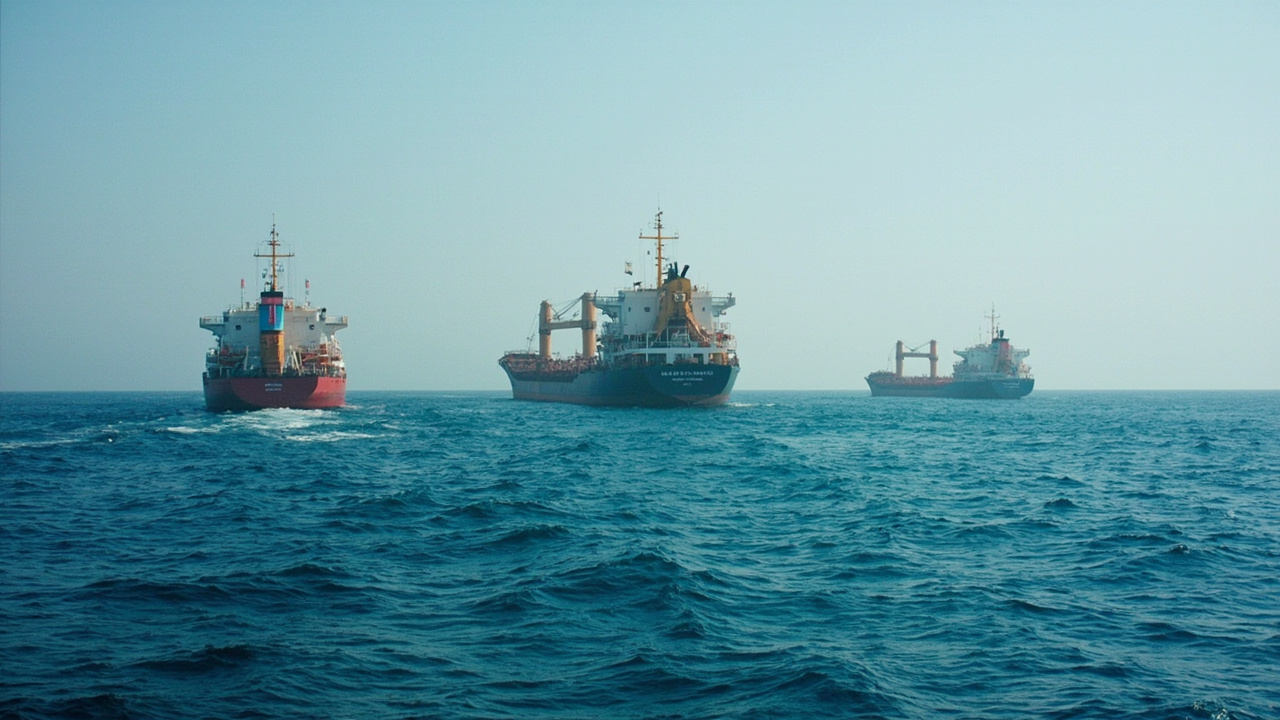
The fifth condition — sovereignty over the Strait of Hormuz — is the one with immediate economic consequences. According to Fortune, Iran has already begun imposing what amounts to a transit toll on vessels passing through the strait, charging approximately $2 million per ship. On March 24, only two commercial vessels crossed the waterway, against a normal daily volume of 150 to 160 [4]. Iran is proposing to formalise what it has already accomplished by force: control of the most important chokepoint in global energy logistics. Fortune reports that Tehran has floated the possibility of collecting these tolls in yuan, a detail that, if accurate, would represent a direct challenge to dollar hegemony in energy markets [4]. The fifth condition is not aspirational. It describes a fact on the water.
The Coordinated Information Campaign
What distinguishes Iran's counter-proposal from previous diplomatic exchanges is the manner of its delivery. This was not a private communiqué passed through intermediaries. It was a coordinated public broadcast across every Iranian diplomatic and military channel simultaneously.
The Iranian Embassy in South Africa posted the five conditions in full on X, listing them as declarative facts rather than proposals: "Iran's conditions to end the war: end to aggression by the enemy, concrete guarantees preventing the recurrence of war, guaranteed payment of war damages" [1]. The Iran consulate in Mumbai went further, posting a statement that read like a battlefield communiqué: "Iran will end the war at a time of its own choosing and only if the conditions it has set are fulfilled. It will not allow Trump to determine the timing of the war's end" [1]. Fars News Agency broadcast Araghchi's remarks with the key line extracted for maximum impact: "We do not want a ceasefire... We want the war to end in a way that it does not repeat, on our own terms" [1].
But it was the Iranian military command's video statement that delivered the sharpest edge. The video, circulated widely on Iranian state-affiliated channels, included a line directed at Washington with undisguised contempt: "Our first and last word has always been, is, and will be this: someone like us will never come to terms with someone like you — not now, not ever. Do not call your defeat an agreement" [1]. Military spokesperson Lieutenant Colonel Ebrahim Zolfaghari added a question that doubled as an insult: "Have your internal conflicts reached the point of you negotiating with yourselves?" [1]. The line targets the visible divisions between the Pentagon's escalatory posture and the White House's intermittent interest in a deal — a fracture that Tehran has been watching closely and now openly mocks.
Parliament Speaker Mohammad Bagher Ghalibaf issued his own warning on X, cautioning against any attempt to occupy Iranian islands in the Persian Gulf — a reference to persistent speculation that the United States or its Gulf allies might attempt to seize strategic positions near Hormuz [1].
The Military Calendar
The timing of Iran's counter-proposal is inseparable from the military calendar. March 27 — now less than 24 hours away — marks two simultaneous deadlines. The first is the expiry of the most recent operational pause, after which American strikes are expected to resume at full intensity. The second is the arrival window for Marine Expeditionary Units that have been transiting toward the Persian Gulf [2].
The deployment arithmetic is significant. The 82nd Airborne Division has been ordered to send between 2,000 and 3,000 paratroopers. Combined with the Marine Expeditionary Units already in motion, the total American ground force assembling within striking distance of Iran will number between 6,000 and 8,000 troops [2]. This is not an invasion force — Iran's geography, population, and military infrastructure would require multiples of that number — but it is a force designed to seize and hold specific objectives: islands, port facilities, coastal installations.
Iran's counter-proposal lands precisely in the gap between those two deadlines. It arrives after the paratroopers have been ordered but before they have arrived. It arrives after the 15-point plan was delivered but before Washington can claim a response is overdue. The timing is a message in itself: Iran is not scrambling to respond to American pressure. It is dictating the rhythm of the exchange.
The View from London and Washington
Former MI6 chief Alex Younger offered an assessment this week that would have been unthinkable in the early days of the conflict: "The reality is the US underestimated the task, and I think as of about two weeks ago lost the initiative to Iran" [2]. The statement is remarkable not for its content — analysts across the region have been saying the same thing for weeks — but for its source. The former head of British foreign intelligence does not make such statements carelessly.
White House press secretary Karoline Leavitt maintained the administration's position that "talks continue, they are productive" [3]. The gap between that characterisation and the content of Iran's counter-proposal is vast enough to constitute its own form of information. If Tehran's five conditions represent the substance of what Washington considers "productive talks," then the word "productive" has been emptied of meaning. If, as is more likely, Leavitt's statement refers to a separate back-channel that has not yet absorbed Iran's public rejection, then the administration is describing a process that Tehran has already declared dead.
What Tehran Is Actually Doing
Strip away the diplomatic language and the military posturing, and what Iran has done is straightforward. It has rejected America's terms. It has issued its own. And it has designed those terms to be unacceptable — not because Tehran does not want the war to end, but because it wants the war to end on a timeline and in a manner that it controls.
The demand for reparations will not be met. The demand for Hormuz sovereignty recognition will not be granted through negotiation. The demand for guarantees binding future administrations exceeds the constitutional authority of any American president. Iran knows all of this. The five points are not a realistic basis for settlement. They are a declaration that Iran does not consider itself the party under pressure.
This is the logic of a state that believes it is winning — or, more precisely, a state that believes the other side is losing faster. The Strait of Hormuz is effectively under Iranian control. Global shipping has been diverted. Oil prices reflect the disruption. And the American military buildup, formidable on paper, has not yet been tested against Iran's layered coastal defence network, its arsenal of anti-ship missiles, and the geographic reality of a narrow waterway flanked by Iranian territory on three sides.
March 27 will arrive tomorrow. The pause will expire. The Marines will reach their positions. And Iran's five conditions will sit on the table, unanswered and perhaps unanswerable, while the machinery of escalation grinds forward on its own momentum.
Yesterday, the dual track had never been more naked. Today, Iran stripped it bare and held it up for the world to examine. The terms and the paratroopers came from Washington. The counter-terms and the contempt came from Tehran. The distance between the two positions is not a negotiating gap. It is the width of a war.
-- YOSEF STERN, Beirut