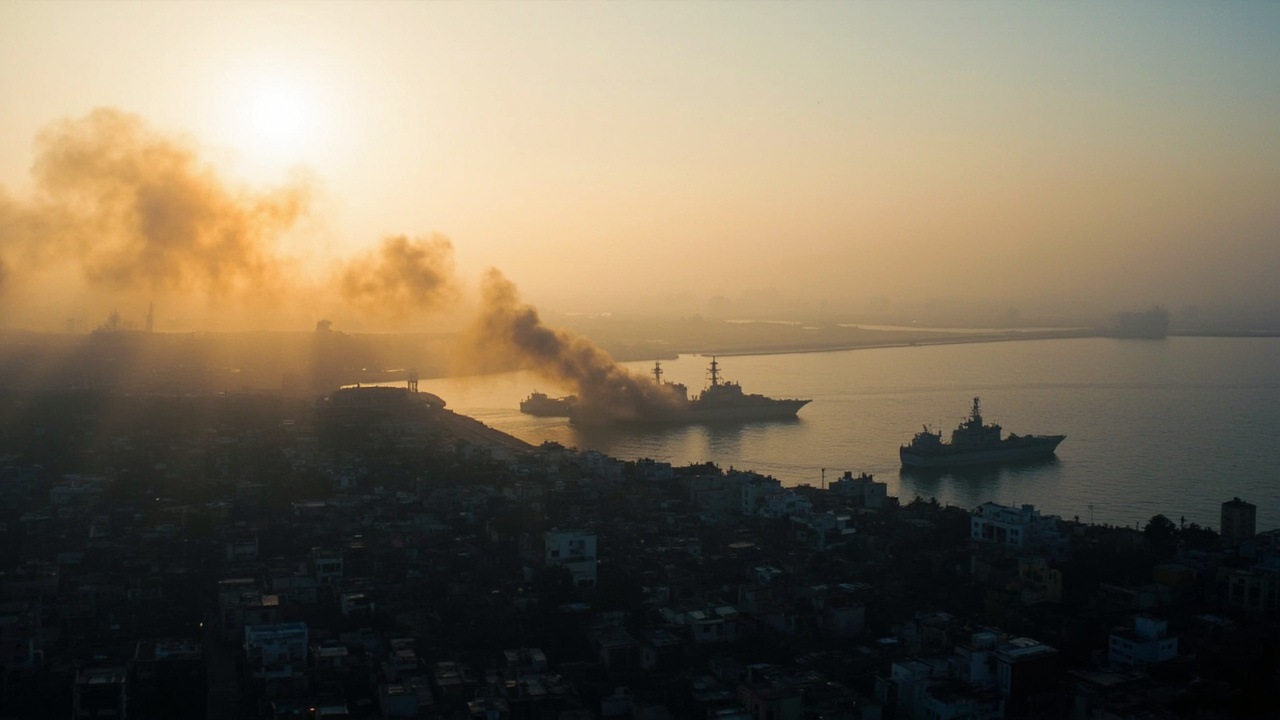
Alireza Tangsiri, the commander of the Islamic Revolutionary Guard Corps Navy who ordered the closure of the Strait of Hormuz and built the toll regime that collapsed global shipping through the world's most important oil chokepoint, was killed early Thursday in an Israeli airstrike on his apartment hideout in Bandar Abbas. Israeli Defense Minister Yoav Katz confirmed the strike, calling it "precise and deadly." Tangsiri was with other senior IRGC officers at the time. Iran has not confirmed his death. [1][2]
This is not an ordinary targeted killing. Tangsiri was the operational commander of the blockade — not a political figure, not a symbolic leader, but the man who ran the machinery. He oversaw the drone and cruise missile testing programs that enforced the closure. He posted on X about the strait's shutdown. He signed the orders that turned 150 daily vessel transits into fewer than six. He was the reason the terms and the paratroopers were dispatched in the first place, and the reason the toll Iran's MPs wanted written into law had an operator ready to collect.
Now that operator is dead. The question that follows is whether the blockade is a system or a man.
The Target
Tangsiri had commanded the IRGC Navy since 2018, when he replaced Rear Admiral Ali Fadavi. His appointment signaled a harder line on the strait. Within months, he publicly warned that Iran could close Hormuz at will. He oversaw the seizure of the British-flagged tanker Stena Impero in 2019. The US Treasury sanctioned him that year, designating him under Executive Order 13876 for supporting the IRGC's "destabilizing activities." Treasury sanctioned him again in 2023 under a broader IRGC maritime enforcement action. [3]
He was not a desk commander. Tangsiri visited forward naval positions regularly, appeared in propaganda videos aboard fast-attack craft, and maintained an active social media presence. In the weeks after the strait closure, he posted repeatedly on X about Iran's sovereign right to control the waterway. The posts were not rhetorical. They were operational updates dressed as ideology.
Under his command, the IRGC Navy developed a layered defense system for the strait: fast-attack boats armed with anti-ship missiles, shore-based cruise missile batteries along the Hormozgan coastline, drone swarms capable of coordinated attacks on tanker convoys, and a network of underground missile storage facilities carved into the coastal mountains. The system was designed to be redundant — to survive the loss of any individual component, including its commander.
Whether it survives the loss of this particular commander is the operative question.
The Strike
The airstrike hit a residential apartment in Bandar Abbas, the port city that serves as the IRGC Navy's primary headquarters and sits at the narrowest point of the Strait of Hormuz. Israeli officials described it as a precision strike on a known IRGC meeting location. Tangsiri was reportedly meeting with other senior naval officers when the strike occurred in the pre-dawn hours. [4]
Bandar Abbas is not an easy target. It sits 1,500 kilometers from the nearest Israeli air base, deep inside Iranian territory and protected by multiple layers of air defense. Reaching it requires either aerial refueling over hostile or contested airspace or a standoff weapon launched from distance. The strike demonstrates either Israeli aircraft penetrated that deep — which would represent an extraordinary operational achievement — or that standoff munitions now have the range and precision to reach targets well inside Iran's defensive envelope.
Defense Minister Katz's language was notably specific. "Precise and deadly" is not boilerplate. It signals confidence in the kill assessment. But Israel has been wrong about high-value targets before, and Iran's silence cuts both ways: they may be suppressing confirmation to deny Israel a propaganda victory, or they may genuinely be assessing what happened in the rubble.
Tasnim News Agency, which is close to the IRGC, initially published a statement claiming Tangsiri was "safe and sound" and called assassination reports "untrue." That statement was later deleted. The deletion is not confirmation. But it is notable. [5]
The Blockade Without Its Commander
The Hormuz blockade has been the single most consequential military operation of this war — not because of the missiles or the drone swarms, but because of the economics. Before Tangsiri's forces closed the strait, approximately 21 million barrels of oil transited daily, representing roughly one-fifth of the world's petroleum supply. As this paper reported, crossings dropped 95 percent. More than 3,200 vessels remain stranded on either side. The toll regime — $2 million per transit, payable in yuan — represented something more ambitious than a blockade: it was an attempt to build a parallel settlement system under live fire.
That system required an operator. It required someone who could coordinate the fast boats that intercepted approaching vessels, the shore batteries that provided the implicit threat, the communications network that processed transit requests, and the political connections that ensured the IRGC's naval branch — distinct from Iran's conventional navy — maintained primacy over the strait. Tangsiri was that someone.
The IRGC Navy's organizational structure suggests the system should survive him. The First Naval District, headquartered in Bandar Abbas and commanded by Rear Admiral Mosayeb Bakhtiari, handles day-to-day strait operations. The shore-based missile batteries operate on pre-programmed targeting data. The fast-boat flotillas are commanded at the flotilla level by mid-grade officers. The drones can be launched from dispersed sites by operators who have never met the navy commander.
But systems that look redundant on an organizational chart often depend on a single integrating authority in practice. Tangsiri was the man who decided when to escalate and when to let a vessel through, who coordinated with the Supreme National Security Council on the political dimensions of each transit decision, who maintained the relationship with China that made yuan-denominated payments possible. That judgment function is not easily replaced by a subordinate operating under fire.
Reports emerged Thursday that Bakhtiari was also killed in combined US-Israeli strikes, though these remain unconfirmed. If true, the IRGC Navy's command chain in the strait has been decapitated at two levels simultaneously. [6]
The Dual Track
This paper noted yesterday that the terms and the paratroopers represented a dual track — diplomatic demands alongside military preparation. Today, one side of that dual track killed the other side's key operator.
Consider the timing. Iran's five-point counter-proposal sits unanswered in diplomatic channels. The 82nd Airborne has written deployment orders. Two Marine Expeditionary Units arrive in the theater tomorrow — the same day the five-day ceasefire pause expires. Netanyahu ordered maximum strikes on Iran's arms industry this week, reportedly out of concern that Trump might end the war before Israel finishes its target list. Seven waves of missiles were launched from Iran toward Israel on Thursday. Isfahan was struck again. Kuwait and Saudi Arabian bases hosting American forces were struck overnight. In Abu Dhabi, interception debris from a UAE missile defense engagement killed two people.
The war is accelerating on every vector simultaneously. The diplomatic track is stalled. The military track just removed the man who made the strait closure operational. If the blockade weakens, Iran loses its most powerful economic lever. If the blockade holds despite Tangsiri's death, the strike was strategically irrelevant — a high-value kill that changed nothing on the water.
Iran's Silence
Iran's refusal to confirm or deny is itself significant. When Qassem Soleimani was killed in January 2020, Iran confirmed his death within hours, declared three days of national mourning, and used the killing to generate a surge of nationalist sentiment. The silence on Tangsiri suggests one of three things: they do not yet know whether he survived, they are confirming and preparing a response, or they have decided that acknowledging the kill gives Israel a victory they prefer to deny.
The third option is the most interesting. If Iran treats Tangsiri's death as a non-event — if they name a successor within hours, maintain blockade operations without interruption, and refuse to give Israel the satisfaction of a public mourning — it would demonstrate exactly the institutional resilience that makes the IRGC dangerous. The Revolutionary Guard was designed to survive the loss of individual commanders. It was built for a war of attrition against a technologically superior adversary. Every senior officer knows he is a target. The succession plans exist precisely because the leadership assumed strikes like this would come.
The next 48 hours will answer the question. If strait transit numbers — already at rock bottom — show no change, the blockade survived its architect. If IRGC naval coordination falters, if vessels begin probing the strait without paying, if the fast boats are slower to respond, the kill was operational, not just symbolic.
What Comes Next
The strategic picture is now layered with contradictions. The US has terms on the table and paratroopers in the air. Israel has killed the blockade's commander and is bombing Iran's arms industry on an accelerated timeline. Iran is firing seven missile waves at Israel while its counter-proposal waits for a response. The ceasefire window closes tomorrow. Marines arrive the same day.
The man who closed the strait is dead. The strait, for now, remains closed.
Whether those two facts stay in contradiction depends on whether the IRGC Navy is what its designers intended: a system that outlives any single commander. Or whether Tangsiri was what his enemies believed: the irreplaceable operational mind that held the blockade together through personal authority, political connections, and sheer force of will.
The answer arrives at the speed of the next vessel that tries to transit Hormuz without paying.
-- Yosef Stern, Jerusalem