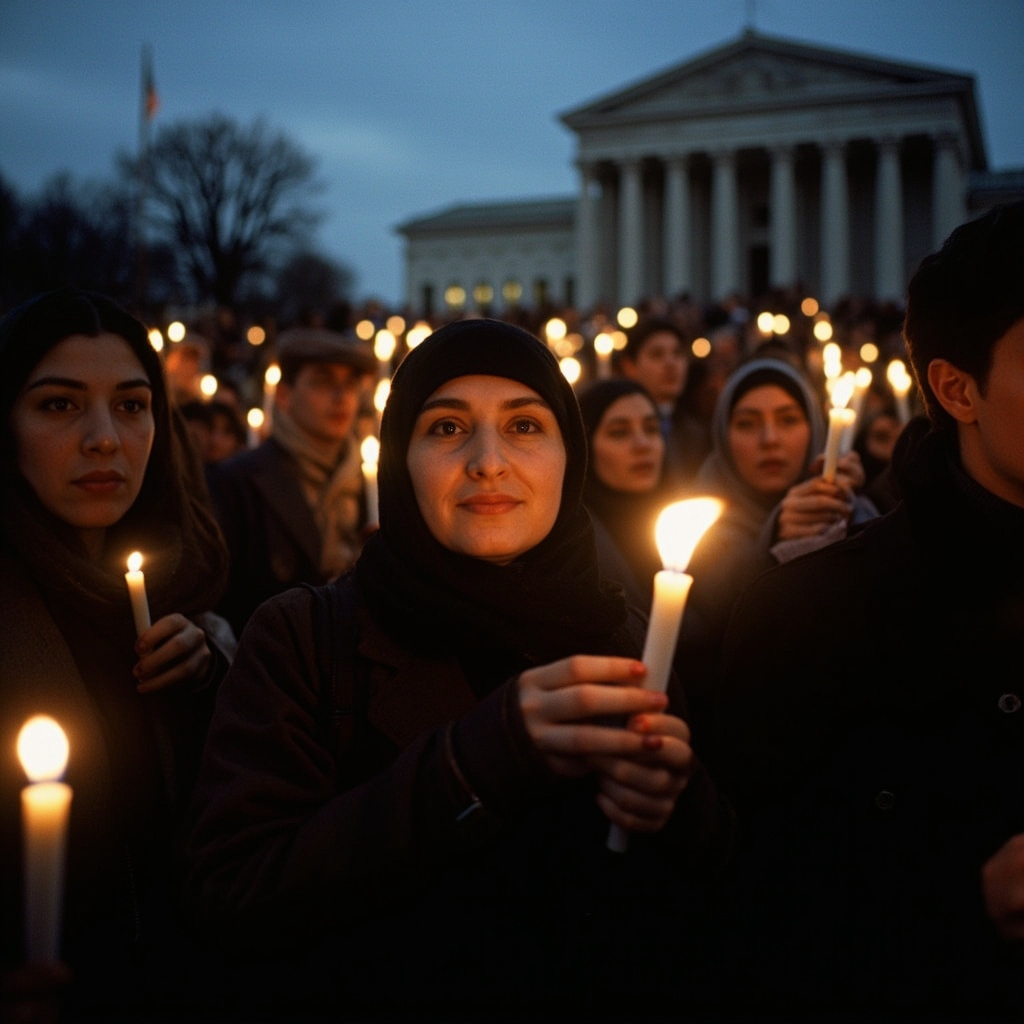
Saturday, nine million people marched. Monday, zero policies changed. Tuesday night at 8 PM EDT, they lit candles.
The No Kings movement's third national action drew an estimated eight to nine million participants across more than 3,300 organized events on March 28 -- the largest single-day protest in American history, surpassing even the Women's March of 2017 [1]. The Guardian confirmed more than eight million across the U.S. and a dozen countries [2]. Springsteen headlined in Minnesota. Hundreds of thousands flooded downtown Chicago. Every state participated.
And then Monday arrived, as this paper noted in its predecessor coverage, and nothing arrived with it. No executive order reversed. No congressional hearing scheduled. No war authorization debated. The president called the protests "very small and very ineffective" [3]. The administration's Monday press briefing did not mention them.
The Tuesday vigils were organized through nokings.org and the Mobilize platform, with events confirmed in all fifty states. The format was deliberate: candles, not signs. Silence, not chanting. The movement's organizers understood something about the image they needed. Nine million people shouting had produced nothing. Perhaps nine million people standing quietly would produce a different kind of pressure [4].
The strategic question the vigils posed was not rhetorical. It was the central problem of American protest in 2026: What does a movement become when it can move millions of bodies but cannot move its government?
The Women's March of 2017 drew an estimated four million people. Within two years, it had helped flip the House in the 2018 midterms. The Tea Party rallies of 2009-2010 drew far fewer bodies but produced a congressional wave that reshaped the Republican Party. The difference was not size. It was mechanism. The Tea Party had primary challenges. The Women's March had candidate recruitment. Both converted energy into institutional pressure.
No Kings has, so far, converted energy into more energy. The first protest in January drew two million. The second in February drew four million. The third drew nine million. The growth curve is extraordinary. The policy impact is zero. The movement is getting better at exactly one thing: getting people to show up.
On X, the conversation after Saturday had already moved past vigils. The trending discourse was about general strikes. The argument, articulated across thousands of posts, was simple: marches are events the government can schedule around. Economic disruption is something it cannot [5]. Several prominent accounts called for a national work stoppage in April. The Chicago Activism Hub posted organizing details for an April 6 action [6].
MSM covered the vigils as extension, not evolution. NPR's Saturday coverage emphasized the diversity of grievances -- "ICE, Iran war, economic concerns" [7]. The BBC framed the movement's persistence as a form of democratic vitality. Neither outlet addressed the zero-policy-response gap directly.
The gap is the story. Nine million people represents roughly 2.7 percent of the U.S. population marching on a single day. It is, by any historical measure, an extraordinary mobilization. It produced, by any policy measure, nothing. The administration is not negotiating with the movement. It is not acknowledging it. It is waiting for it to exhaust itself.
The vigils Tuesday night were beautiful. Candles flickered outside courthouses and state capitols and churches and town squares. People stood together in the dark. The question that hung in the air was whether beauty is enough -- whether bearing witness is a form of power, or whether it is what power looks like when it has nowhere to go.
The next No Kings action has not been announced. But the general strike calls are getting louder. The movement's choice -- escalate to economic disruption or continue the pattern of ever-larger marches that produce ever-larger non-responses -- will define whether March 28 was a peak or a pivot.
-- MAYA CALLOWAY, New York