TL;DR
Iran struck the world's largest LNG facility and knocked out 17 percent of Qatar's export capacity — the war has now broken a country that wanted no part of it.
MSM Perspective
Al Jazeera led with Qatar expelling Iran's military attaches; Le Monde detailed Pearl GTL damage; Reuters and BBC anchored to the $20 billion revenue loss.
X Perspective
Energy and OSINT accounts are posting satellite imagery of Ras Laffan fires, framing the 17% capacity loss as proof the war is now a global energy crisis, not a regional one.
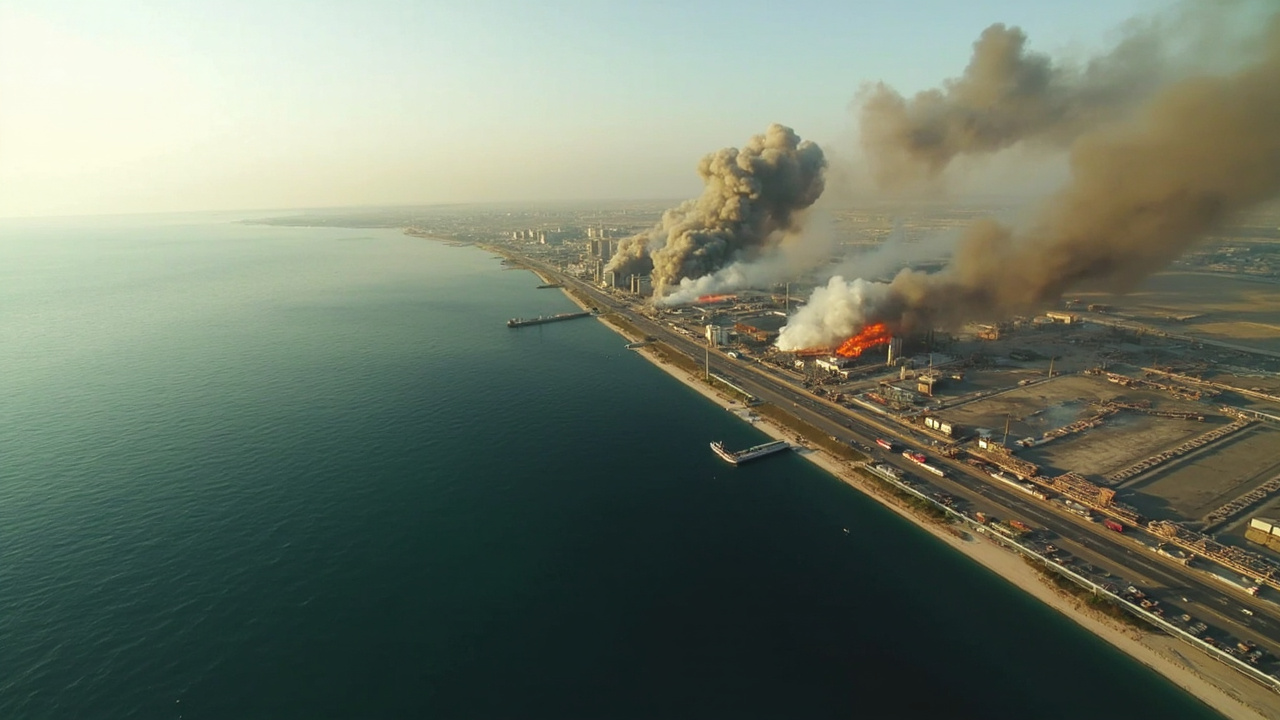
Five Iranian ballistic missiles arced toward Qatar's northern coast on Wednesday, March 18. Qatari air defenses intercepted four of them. The fifth struck Ras Laffan Industrial City, the largest liquefied natural gas facility on Earth. [1] A second wave arrived in the early hours of Thursday, March 19, hitting the complex again. [2] By the time QatarEnergy assessed the damage, 17 percent of the country's LNG export capacity — roughly 12.8 million tonnes per annum — had been knocked offline. The estimated annual revenue loss: $20 billion. [3] The repair timeline: up to five years. [4]
Qatar is not at war with Iran. It is not a party to Operation Epic Fury. It has not hosted American strike aircraft nor offered its bases for the campaign. The emirate has spent decades cultivating a position as the Gulf's indispensable mediator, the country that talks to everyone — Tehran, Washington, the Taliban, Hamas. That position depended on a single premise: that neutrality had value, and that value would be respected. On March 18, Iran destroyed the premise along with a gas-to-liquids facility.
The missile that penetrated Qatar's defenses struck the Pearl GTL plant, a joint venture between QatarEnergy and Shell, which converts natural gas into ultra-clean diesel, lubricants, and other liquid products. [5] Fires erupted across the facility. Emergency teams contained the blaze within hours, but the structural damage to the plant and to adjacent LNG processing trains — specifically Trains 4 and 6 — was described by QatarEnergy as "extensive." [3] The company's statement was clinical in the way that state energy companies are clinical when the damage is catastrophic: the strikes "resulted in extensive damage" and "reduced Qatar's LNG export capacity by approximately 17%."
Qatar's Prime Minister, Sheikh Mohammed bin Abdulrahman Al Thani, responded the following day with a public statement unusual for its directness. "Wisdom seems to be lacking these days," he said, calling on Iran to stop expanding the conflict. [6] The Ministry of Foreign Affairs summoned Iran's ambassador. Qatar expelled Iran's military and security attaches — a diplomatic downgrade short of severing relations entirely, but severe by Gulf standards. [1] The Qatari foreign ministry condemned the strikes as "a blatant violation of Qatar's sovereignty and territorial integrity" and demanded a full Iranian investigation.
Iran's justification, such as it was, followed a pattern now familiar from this war: the strikes were framed as retaliation for Israeli attacks on Iranian energy infrastructure, specifically the March 17 Israeli strikes on Iran's Kharg Island oil terminal. [7] The logic, if it can be called that, was symmetrical escalation — you hit our energy, we hit energy. But Qatar's LNG infrastructure is not Israeli. It is not American. It supplies gas to Japan, South Korea, the United Kingdom, and half a dozen other countries with no involvement in the conflict. The Iranian missiles did not hit a belligerent's assets. They hit the global energy supply chain.
The ripple effects were immediate. European natural gas futures spiked 12 percent on Wednesday, their largest single-day move since the early weeks of the Ukraine war. [8] Qatar supplies approximately 20 percent of global LNG trade. Asian spot prices, already elevated by Strait of Hormuz disruptions, surged to levels not seen since 2022. The BBC reported that the attacks "sent shockwaves through energy markets already rattled by the wider conflict." [8] Morningstar analysts noted that the beneficiaries would be American LNG exporters and, ironically, Australia — countries far enough from the conflict to capture displaced demand. [9]
For Qatar, the financial damage is serious but not existential. The country's sovereign wealth fund holds an estimated $500 billion in assets. It can absorb revenue losses that would bankrupt smaller nations. The deeper wound is strategic. Qatar's entire foreign policy architecture rests on being useful to all sides — a posture that requires physical inviolability. Ras Laffan was supposed to be the facility too important for anyone to hit, the industrial equivalent of a neutral embassy. Iran hit it anyway.
Le Monde reported that the strikes damaged not only the Pearl GTL facility but also caused fires at an adjacent LNG loading terminal, temporarily halting all shipments from the facility's northern berths. [5] QatarEnergy said that full restoration could take "up to five years" for the most severely damaged infrastructure. [4] That timeline suggests not merely repair but reconstruction — components that must be fabricated, shipped, and installed in a facility that may come under attack again.
The broader pattern is now unmistakable. This war, which began as a US-Israeli air campaign against Iran's nuclear and military infrastructure, has methodically expanded to engulf countries that sought to remain outside it. Lebanon's children are dying under Israeli bombardment. Saudi Arabia's oil infrastructure has been targeted. And now Qatar — the Gulf state most committed to diplomatic neutrality — has lost 17 percent of its most valuable economic asset to Iranian missiles.
The Qatari foreign ministry's statement concluded with a demand for "international accountability." It is a reasonable demand. It is also, given the trajectory of this war, unlikely to produce results. The international order that would hold Iran accountable for striking a neutral state's civilian energy infrastructure is the same order that has failed to prevent the war's escalation at every previous stage. Qatar intercepted four of five missiles. The one that got through rewrote the region's strategic map.
-- HENDRIK VAN DER BERG, Doha
Sources & X Posts
News Sources
X Posts