"To be honest with you, my favourite thing is to take the oil in Iran." Donald Trump said this to the Financial Times on March 30, 2026, one month and one day after the first American bombs fell on Iranian territory. He said it plainly. He said it without qualification. He said it as though he had been waiting to say it.
The sentence is not a gaffe. It is not a negotiating tactic dressed up for the editorial board. It is a statement of preference from the commander in chief of a war that has killed thousands of people, sent oil above $100 a barrel, and produced no Authorization for Use of Military Force, no congressional declaration, and no publicly stated objective — until now. [1]
The paper has spent weeks charting how the war widened while Washington pretended not to notice — the Houthi entry, the Diego Garcia deployment, the quiet doubling of the carrier group — each escalation presented not as policy but as operational necessity. That pretense ended Monday morning, Pacific time, when the Financial Times published its interview. And the Muslim world that convened in Islamabad without Washington's blessing now has its answer about what Washington actually wants from this war.
Trump elaborated. He said the United States could seize Kharg Island "easily." He said he was the only person who could achieve such a thing. He said "some stupid people" in the US objected to the idea of taking Iranian oil. The word "stupid" was doing significant work in that sentence: the people he was dismissing were not fringe voices but the State Department officials, allied governments, and legal advisers who have spent a month constructing the diplomatic and legal architecture around a war that the president just described as a resource seizure operation. [2]
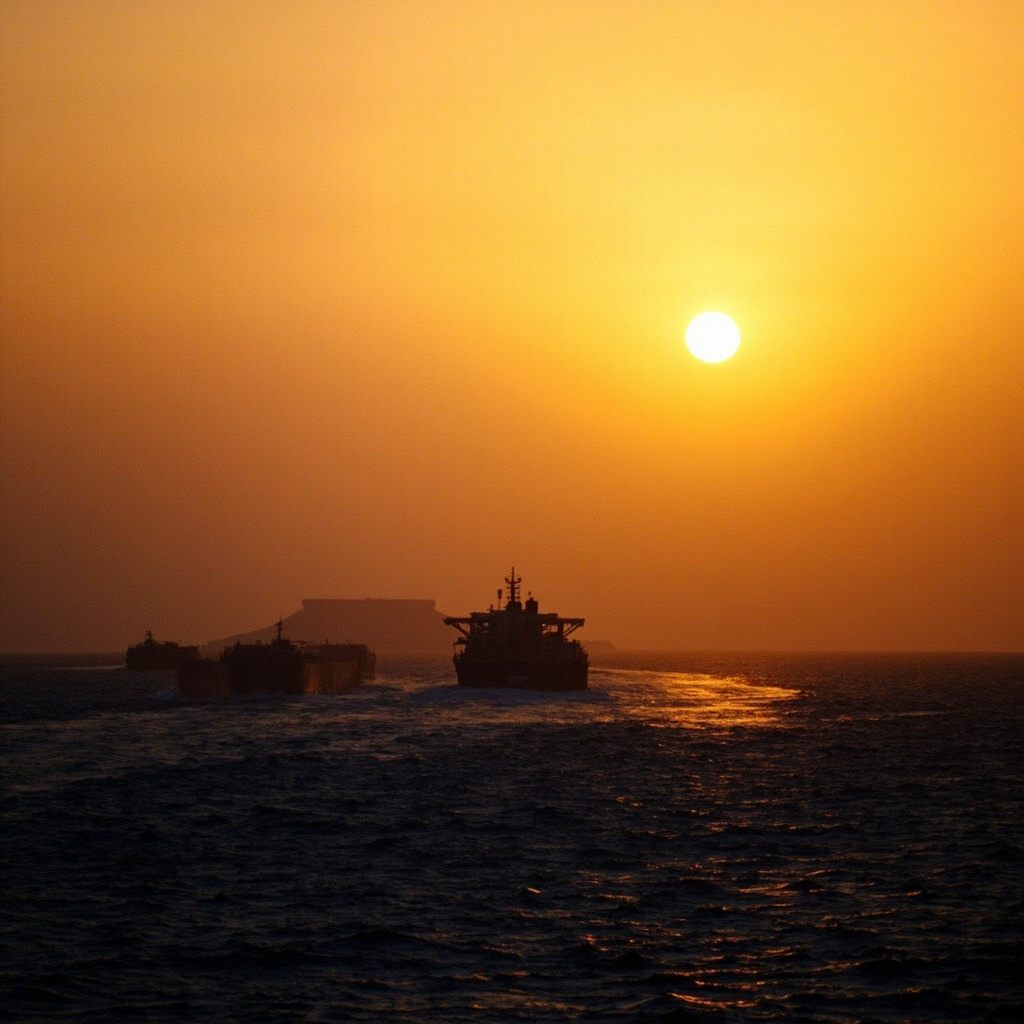
Kharg Island is the nerve center of Iran's oil export infrastructure. Located in the northern Persian Gulf, roughly 25 kilometers off the coast of Khuzestan province, it handles approximately 90% of Iran's crude exports. The loading platforms, the sub-sea pipelines, the single-point mooring buoys — these are the facilities that filled the supertankers that sailed through Hormuz before the war, and that now load the yuan-denominated cargoes that Iran sells through its blockade toll system. Seizing Kharg would not merely deprive Iran of revenue. It would hand Washington control of the mechanism Iran built to monetize American military pressure. It would be the checkmate the oil market has been pricing since March 1.
The IRGC Naval Commander warned in mid-March that any attack on Kharg Island would create "a new and harsh equation for global energy security." [3] The warning was credible then. It remains credible now. Kharg is not defended by conscripts and rusting anti-aircraft systems. Its defense is integrated with the broader IRGC naval architecture — fast boats, anti-ship missiles, drone swarms, mines. The island can be damaged. Whether it can be "taken" and held, in the sense that Trump meant, is a question that military planners understand better than the president appears to.
But the military analysis matters less than the political disclosure. Thirty days into a war conducted without statutory authority, the president has told the world's most widely read financial newspaper that his preferred war aim is control of Iranian energy infrastructure. This does not fit into any of the legal frameworks offered to justify the conflict. Not self-defense under Article II. Not the 2001 AUMF, which was written for al-Qaeda. Not the 2002 AUMF, which was written for Saddam Hussein's Iraq. Seizing Kharg Island for its oil is not self-defense under any interpretation of international law that has enjoyed American endorsement since 1945. [4]
The oil comment arrived simultaneously with the collapse of the Islamabad talks, a coincidence so perfect that it strained credulity as coincidence. Pakistan had convened Saudi Arabia, Turkey, and Egypt in a quadrilateral format designed to produce a ceasefire framework. Iran had sent its second-tier foreign policy apparatus — not Araghchi, who matters, but the spokesmen and deputies who attend talks the principal has already decided to reject. The 15-point US peace plan, which Al Jazeera obtained and published last week, demanded the dismantling of Iran's uranium enrichment capability, the withdrawal of all IRGC forces from Syria, Lebanon, and Yemen, and the cessation of ballistic missile development — demands so comprehensive that Iranian parliament speaker Mohammad-Bagher Ghalibaf described them as "humiliation dressed in diplomatic language." [5]
Ghalibaf was in Islamabad, technically. He was not there to negotiate. He was there to document the bad faith, and the FT interview provided the documentation in real time.
The most significant reaction came not from Tehran but from Ankara. Turkey's spy chief attended the Islamabad talks alongside the foreign minister — an unusual dual-track signal that analysts have read as Erdogan positioning Turkey as the indispensable mediator while simultaneously gathering intelligence on both sides. When the FT interview landed, Turkish officials went quiet. A government that has staked its foreign policy brand on bridging the gap between Washington and Tehran has no institutional response to a president who says the gap he wants to bridge is the distance between American forces and Iranian oil terminals.
The international legal dimension is not subtle. Under international law, seizing the natural resources of a sovereign nation constitutes pillage — a war crime under the Geneva Conventions and the Rome Statute of the International Criminal Court. The United States is not a party to the ICC, and Trump's domestic lawyers have spent decades arguing that Article II war powers are essentially unlimited. But the comment will circulate in every capital where lawyers and officials are deciding whether to provide overflight rights, port access, refueling facilities, or intelligence sharing to American forces. "Take the oil" is not an abstraction. It is a policy statement with treaty implications. [6]
The market understood immediately. WTI crude, which had been trading at $99.40 before the interview published, jumped $3.46 in the hour following publication. Kharg Island insurance premiums — already at wartime levels — surged. The shipping industry, which had spent three weeks repricing for the possibility of Hormuz interdiction, began repricing for the possibility of Hormuz control. These are different calculations. One prices in disruption. The other prices in transformation.
Speaking separately to reporters aboard Air Force One on Monday, Trump said the war would end "very soon" and that Iran was "extremely eager" to reach an agreement. He said Iran had agreed to send 20 "big boats of oil" through the Strait of Hormuz as a "tribute" — a word he used without apparent awareness of its implications. A tribute is what a vassal pays a suzerain. It is not the vocabulary of diplomatic resolution between sovereign states. It is the vocabulary of imperial subordination. [7]
The 82nd Airborne deployment — roughly 2,000 troops ordered to the Middle East in the past week, with the Pentagon reportedly planning for weeks of ground operations — acquires new meaning in light of the interview. Ground forces configured for "weeks of operations" are not configured for aerial bombardment. They are configured for territorial control. The president has described what territory he wants to control.
Thirty days, 8,700 dead by the most conservative estimates, $590 billion in global economic losses by Sunday Guardian Live's count, and now a president who has stated plainly, in print, to the newspaper of record for international finance, that his preference is to take the oil. [8]
The war has acquired a stated purpose. Whether the stated purpose is achievable — whether Kharg Island can be seized, held, and operated by a force fighting without congressional authorization, against an enemy that has shown it can absorb sustained bombardment for a month — is the military question. The political question is simpler and already answered: every country that has been asked to support this war on humanitarian or security grounds now knows what it is actually for.
The stupid people, as the president calls them, were not wrong.
-- YOSEF STERN, Jerusalem