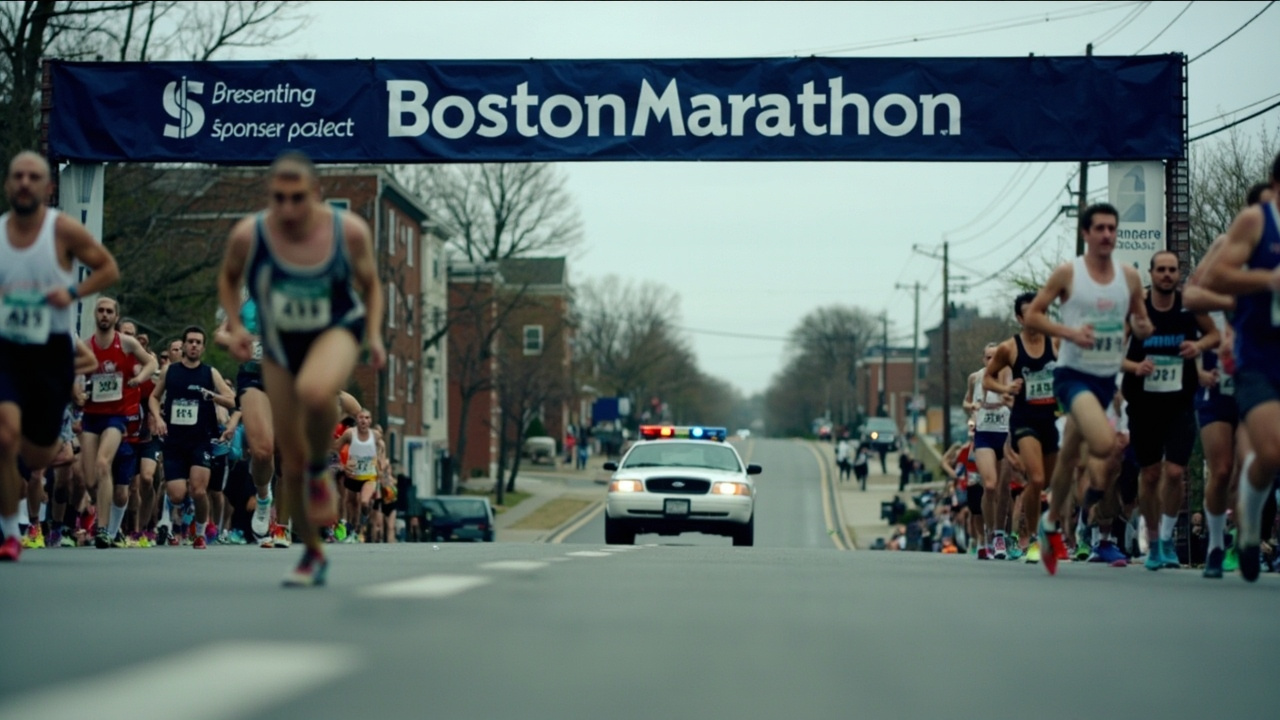
At ten o'clock Monday morning in Hopkinton, thirty thousand runners from one hundred and thirty-seven countries will cross a starting line presented by Bank of America. [1] The 130th Boston Marathon is the bank's to name for the next decade — a ten-year sponsorship renewed in 2024, when the presenting-sponsor seat passed from the pharmaceutical industry to banking with very little public comment. [1] Runners will wear bibs with the bank's logo on them. The finish line will read, in bunting that is already up along Boylston Street, "presented by Bank of America." The bank's ATM network from Newton to downtown has been decommissioned for the weekend and repurposed as a security perimeter.
The same Bank of America, three days earlier, reported first-quarter stock-trading revenue of $2.8 billion — the third verdict in the six-bank sequence the paper called the war hexagon on Friday. [2] Chief executive Brian Moynihan, in a Fox Business interview the same day, offered the formulation that will travel into the week: the war's consumer impact had had, in his word, "a lingering effect." [3] The quarter was a record. The reserves were larger than the quarter's growth had needed them to be. Every major U.S. bank's Q1 earnings now report the same dual signal. Bank of America is among them.
None of this diminishes the marathon. The marathon is the marathon. It was run after the 2013 bombing; it was run through the pandemic; it will be run Monday through what FBI Boston's special agent in charge, Ted Docks, called in a Friday briefing "a heightened threat environment" for which "large public gatherings are an attractive target." [4] The FBI said no credible specific threat existed. The language was cautionary, not alarming. The agents will be in Hopkinton, Ashland, Framingham, Natick, Wellesley, Newton, Brookline, and Boston. The dogs will be, too.
What is new is only the page on which the sponsorship, the earnings, and the threat briefing happen to land together. No outlet has placed them on one page. Local NBC 10 covered the FBI posture Friday. [4] The Boston Globe's sports section previewed the field — an American men's lead contender for the first time in six years, a Kenyan women's field deep enough to produce a sub-2:17. The business section covered the bank's Q1 across the river in a separate byline. Each of these is good journalism. Together they describe a civic event being staged on a day whose presenting sponsor priced, in its own disclosures, a war in the price of the race.
Moynihan's "lingering effect" language was not about the race. He was describing the consumer-banking line, and the warmth of domestic spending, and the resilience of the U.S. cardholder under a geopolitical regime he did not need to name on-air because the market had already named it for him. [3] The phrase was meant to be reassuring. It lands, in the week the ATMs come down and the perimeters go up, slightly differently. A bank that is "lingering" against Iran is a bank that is also welcoming thirty thousand runners. Both sentences are true.
There is a version of this story in which the sponsorship is the problem. That version is not the paper's. The marathon needs money. Sponsors pay the money. In 2013 the sponsor was John Hancock, who stayed through the bombings and through the litigation and through the slow return of the old route. Before that, it was a cigarette company. Before that, the race was amateur and most of the runners paid their own way. The sponsor-of-record has changed with the economy. It is now the economy's most exposed instrument that underwrites its most civic ritual. That is not hypocrisy. It is how the civic economy now works.
What it does to the reader is something else. A runner standing in Hopkinton at nine forty-five Monday will see two logos: the BAA's unicorn and the bank's red, white, and blue script. The runner will not know, and should not have to know, that the script paid for a reserve build against a war whose consumer effect its CEO described as lingering. The bank will know. The bank's investors will know. Some of them will have put the trade on in the first half of the first quarter and taken it off before the Friday ceasefire broke. [2]
Angel Reese is not running Boston. Clark and Bueckers are not running Boston. The runners on the line Monday are the recreational elite and the professional elite and the charity field. They will cover 26.2 miles in weather that NOAA forecasts will be cool and overcast and dry. [5] The broadcast will be on WBZ and ESPN. The sponsor cards will cut from aerial to runner to sponsor to aerial, in the rhythm that television demands and money buys.
The course is the course. It runs through Wellesley and past Heartbreak Hill and down Boylston. It does not know what its presenting sponsor's loan book looks like, or what its CEO said about lingering effects, or what the FBI's special agent in charge said to local reporters Friday about environments. The course, like the marathon, does not know these things. The reader can. The reader might.
-- AMARA OKONKWO, Lagos