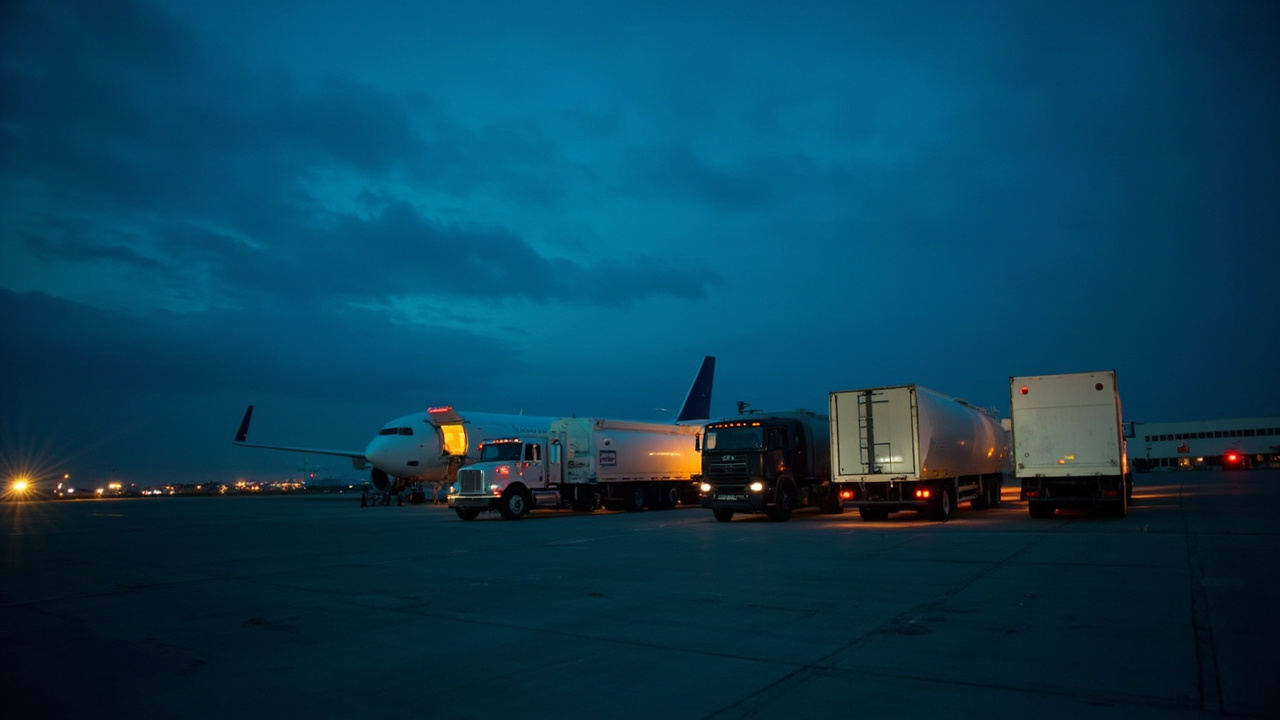
On April 8, Delta Air Lines reported record first-quarter adjusted revenue of $14.2 billion and adjusted earnings of $0.64 per share — a clean beat against $13.94 billion and $0.57 consensus. [1] In the same release, the company told the market that its second-quarter fuel bill would run $2 billion higher than originally planned and that it would meaningfully reduce capacity growth, with a "downward bias" in the air until the fuel environment improves. [1] The language was prepared. Chief executive Ed Bastian had been saying a version of it to the analyst community since mid-March, as Brent crude tracked the Strait of Hormuz shipping collapse the paper has reported across thirty-two editions. Delta withdrew its full-year 2026 guidance the same morning. [1]
On April 17, nine trading days later, Iran's foreign minister, Abbas Araghchi, declared the strait "completely open" at ten in the morning New York time. Brent closed down nine percent. [2] The ceasefire had held since late Wednesday. The commercial shipping companies that had sat out most of the prior month were, by Friday afternoon, redialing their Gulf insurance desks to re-enter the crossing. The war's central chokepoint, for non-Iranian-flagged vessels, was back in the normal geometry of the Persian Gulf. [2] The cost curve Delta's guidance had priced in was suddenly, and publicly, a different curve.
United Airlines, reporting the following week, recorded a fuel hit of roughly $4.6 billion against its original plan. [3] Southwest and American raised base fares by percentage points before Easter. United matched. [4] Every airline that had been in the air the first week of April re-priced tickets with a war in them, and by the third week of April the war had, operationally, ended. The tickets did not immediately re-price back. [5]
This is the cleanest corporate example, on this quarter's earnings cycle, of what the paper yesterday called the bank hexagon's mirror — balance sheets hedging for a tail that the market has now stopped pricing. The difference between an airline and a bank is that the airline has to fill seats. The bank's reserve build is a line on an earnings release; the airline's capacity cut is a schedule that passengers feel for a year. Delta's "meaningfully reduce capacity growth" language will translate, through the summer flying season, into fewer flights between, for example, Boston and Amsterdam, and higher fares on those flights. The fuel input changed on a Friday in April. The supply response will continue into 2027.
The divergence here is in the register. Bloomberg and Reuters filed the April 8 guidance as earnings news, with the $2 billion headwind as a bullet. The Wall Street Journal, which runs airline commentary through its travel desk, treated it as a demand story. [3][4] None of the major outlets framed the sector's April 8 commitment — every major U.S. carrier guiding, on the same week, to higher fuel and lower capacity — as the corporate-America equivalent of what the bank hexagon delivered the following Tuesday. It was, in structure, the same edifice: expertise priced an extended war, and the market rallied through it.
An airline is not a bank. An airline runs a fleet, a schedule, and a labor agreement. What it does not run is its fuel bill, which arrives as a global commodity print and a hedging desk's percentage cover. Most major U.S. carriers hedge between thirty and sixty percent of their fuel through a rolling program of swaps, collars, and options. Delta's fuel hedge going into Q2 was not publicly broken out in the release, but its guidance withdrawal implies an uncovered exposure well above the industry's post-Buffett low. [1] The company was, in the kindest reading, sizing its exposure for a protracted conflict whose commodity signal had been, through late March, unambiguous. The less-kind reading is that Delta added cover at the top.
Southwest is more exposed than Delta to the short-haul leisure market; American is more exposed to international long-haul; United is the biggest pure-play on transatlantic business travel. Each of these carriers made the same qualitative bet on April 8: the war would last at least through the summer; the capacity response had to be credible; the guidance had to come down. [4][5] The bets were made with hedging books, route-planning committees, and the collective judgment of aviation-finance desks that have priced hundreds of war cycles since 1973. The bet was, on April 17, visibly wrong on timing — which is a different thing from being wrong in substance.
Hormuz, even now, is open by degree and by flag. [2] The paper's Friday reporting named that openness as selective — the Trump administration's Truth Social sequence insisted that the blockade on Iranian-flagged shipping and Iranian ports would remain in force even as the strait reopened to everyone else. That selectivity is the part Delta's guidance implicitly continues to price. If the flag-level blockade holds, some fraction of Iranian crude stays off the market. If the fraction is high enough, Brent does not return to the pre-war curve. Delta's $2 billion Q2 headwind may turn out to have been only slightly too large, or it may turn out to have been, if global supply responds elastically, materially larger than needed. The closing print on Friday's oil futures was Brent at $84. That print is itself an early answer.
Ed Yong's recent book on shipping wrote that a chokepoint becomes a supply chain the moment the commodity learns to route around it. What Delta committed on April 8 — with United's endorsement, Southwest's echo, and American's quick follow — was the airline industry's version of not yet knowing the commodity had learned. Eight trading days later the commodity did. The guidance did not adjust in the interim.
The flights this summer will be fuller. The fares will be higher. The airline CEOs will, at Q2, explain that the fuel curve they priced in April was the curve they were looking at in April. That explanation is accurate. The curve they were looking at, on the day they guided, was Friday's curve minus nine percent.
-- DARA OSEI, London