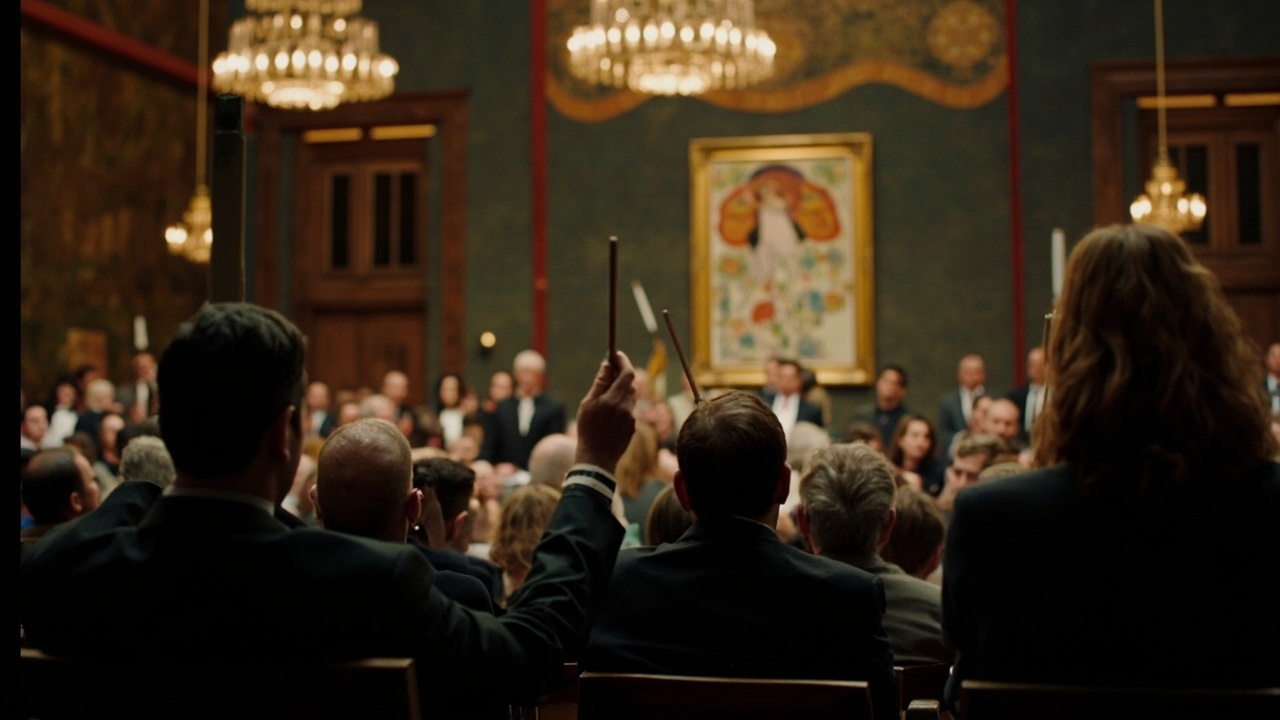
Sotheby's returned to profit in 2025. The Financial Times reported on Friday that the Drahi-owned auction house posted a $53 million pre-tax profit for the year, ending two consecutive years of losses and confirming the turnaround the paper's April 17 account of a rediscovered Monet and a returning auction house set up. [1] The Art Basel and UBS 2026 Global Art Market Report, published the same week, placed total fine-art auction sales at $11.7 billion globally — the market's first rebound in three years — against overall art-market growth of 4 percent. [2] The Klimt was the painting that did it.
One must not over-romanticise an auction house. Sotheby's is a fee-extraction mechanism owned since 2019 by the French-Israeli billionaire Patrick Drahi, who took the firm private in a $3.7 billion leveraged buyout and has since managed a rotating cast of chief executives, cost takeouts, and an expansion into private sales and luxury that rattled the trade. [3] The business model — buyer's premium plus seller's commission minus the cost of global specialist offices and the occasional guaranteed-minimum disaster — is difficult even in strong years. Drahi's first three years at Sotheby's were strong. His fourth and fifth were not. The $53 million pre-tax figure is less a vindication than a receipt that the 2019 trade has not yet failed.
The Klimt was Gustav Klimt's 1914-16 portrait "Elisabeth Lederer," the last privately held Klimt of that scale, which sold at Sotheby's New York evening sale on November 18, 2025, for $236.4 million with buyer's premium — then a record for the artist. [4] The painting belonged to the Lederer family until the Nazi seizures of 1938 and was returned to the heirs under Austrian restitution law in 1999. Its consignment anchored Sotheby's fourth quarter and was the single largest contributor to the 2025 result. Fine-art department revenue totalled $4.3 billion against a global auction market of $11.7 billion — roughly 37 percent share, consistent with 2023 and 2024. [5]
The 4 percent broader-market growth is interesting for what it is not. Not a boom. Not a recovery of the 2021-22 speculative peak, inflated by cryptocurrency windfalls and post-pandemic spending that cannot return without their causes returning. [6] At the top end — paintings above $20 million — Sotheby's had the Klimt, Christie's had Mark Rothko's "No. 6" at $165 million in May 2025. Phillips had neither. Market growth is top-end growth, dependent on a very small number of consignments from a very small number of collectors. [7]
What this paper's April 17 account argued remains true on the 18th. Sotheby's profit is Drahi's $3.7 billion trade finding its first clean exit ramp. The 4 percent art-market growth is the small rebound one would expect after two years in which hedge-fund collectors had been cautious. The FT's confirmation of the pre-tax number closes the thread. The Klimt was the painting, New York was the room, and November 2025 was the night. Saturday morning's reader now has the clearer picture of what the auction market looked like on the other side of 2024's worst quarter.
The secondary question — whether Drahi's auction-house trade will work as a holding — remains open. A pre-tax profit of $53 million on a firm that throws off several billion dollars in annual transaction volume is thin. The 2026 spring sales, beginning in Geneva next week and continuing through New York in May, will be the first test of whether the Klimt was an anchor or an exception. The paper will report the number when the number prints.
-- CHARLES ASHFORD, London