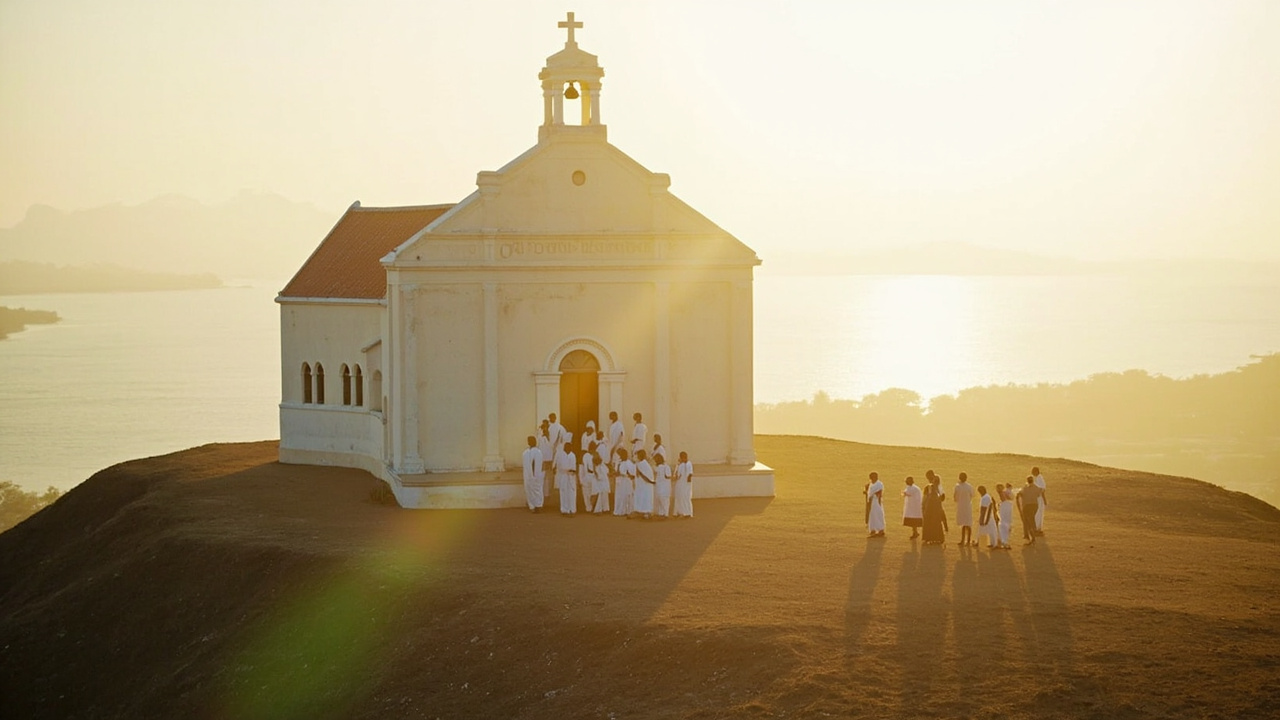
The Church of Our Lady of Muxima was built by Portuguese colonizers at the end of the sixteenth century as a component of a coastal fortress complex. It stands on a bluff above the Kwanza River, a hundred and ten kilometers southeast of Luanda. [1] Before it became a popular Catholic pilgrimage site — the Marian apparition to a group of believers in 1833, after which pilgrims have come at a current rate of roughly two million annually — the white-walled chapel served a different purpose. Enslaved Africans gathered at Muxima were baptized by Portuguese priests. Then they were forced to walk the last 145 kilometers to the port of Luanda. Then they were put on ships to the Americas.
More than five million people left from Angola on the trans-Atlantic slave route, according to historians — more than any other country, nearly half of the estimated 12.5 million Africans transported. [2] Some of the first enslaved arrivals in Louisiana came from Angola. The Portuguese colonizers operated under 15th-century Vatican directives authorizing them to enslave Africans. Those directives are a matter of historical record. Their descendant is Muxima. On Sunday afternoon, Leo XIV, born Robert Francis Prevost in Chicago, whose own heritage has been documented by historians as including Louisiana Creole ancestry, prayed the Rosary on the esplanade in front of the shrine. The choice was scheduled on March 16.
The paper's April 18 feature on the papal-vice presidential confrontation argued that the religious clash over wartime theology was operational rather than symbolic. The paper's Sunday companion brief on the plane walk-back registered that Leo, speaking to reporters on the flight from Yaoundé to Luanda Saturday, said it was "not in my interest at all" to debate the U.S. president. The two pieces ran together on the same edition because they are halves of the same argument: the direction of the pontificate does not change when the formulation does.
The substance on the ground
At the Saturday welcome ceremony with President João Lourenço, Leo addressed Angola's political class directly. "I have mentioned the material riches upon which powerful interests lay their claim, even within your own country," he said. He urged Angola's "wealthy political leaders" to "place the common good before every particular interest." He used the phrase "forms of slavery imposed by the elite who are laden with much wealth but false joys." [3] He used the word "slavery." He named extractivism — "how much suffering, how many deaths, how many social and environmental disasters are brought about by this logic of extractivism" — in a country whose economy runs on oil and diamonds and whose political class is a documented pattern of commodity extraction layered onto colonial extraction. [4]
The Sunday morning Mass was at the Kilamba esplanade on the outskirts of Luanda. Tens of thousands attended. The homily addressed the country's civil war, which killed between 500,000 and 800,000 people between 1975 and 2002, and its current poverty, which is severe despite the oil revenue. The helicopter transfer to the Muxima heliport began at 3:45 p.m. local time. The Rosary prayer on the shrine esplanade began at 4:30 p.m. [5]
Fr. Mpindi Lubanzadio Alberto, the shrine's rector, had said earlier this month that no pope had visited Muxima since the shrine's foundation. He described the visit as "a historic moment of grace" — a phrasing that reads differently when the structure of the historical grace is a colonial church built to prepare captives for shipment. The rector's formulation was pastoral; the pope's choice was curatorial. An American pontiff praying a Rosary on a riverbank from which African Catholics were exported to American slavery is not a private devotion. It is a reading of the historical record delivered by a body.
The direction that did not walk back
The Saturday plane statement is a diplomatic instrument. It is not a doctrinal adjustment. The pope told reporters that his Cameroon homily, which used the word "tyrants," had been "prepared weeks before" Vance became a target, and "was not in my interest at all to debate the president." [6] Vance responded within hours with a single X word — "grateful" — that Catholic-right accounts treated as a victory. The statement and the response functioned together as a diplomatic deescalation of the language dispute. Neither changed what Leo said Saturday about extractivism. Neither changed the site selection on Sunday afternoon.
This is the distinction the two pieces of paper coverage are trying to make visible. The name of a specific political actor is negotiable. The direction of the argument is not. If the paper had reported only the plane walk-back, it would have reported a diplomatic retreat. If it reported only the Muxima visit, it would have reported a doctrinal gesture. It reports both because the point of today's Angola leg is that the two things are consistent with each other. A pope who wants to preserve his ability to speak on structural violence chooses not to debate a sitting vice president by name. A pope who still wants to speak on structural violence chooses to stand on the ground where that violence is historically inscribed.
Mama Muxima
The statue at the center of the shrine — "Mama Muxima," a Virgin Mary affectionately named in Kimbundu — has been the object of pilgrimage by Angolans for centuries. Fr. Alberto told ACI Africa that the shrine welcomes "Christians, Muslims, non-believers, sinners, and even those who oppose the Church." [7] The pilgrim population is ecumenical. The history is not. The building on the bluff was used, for more than two hundred years, as an instrument of the trans-Atlantic slave economy. The pilgrimage to it, by people whose ancestors were processed through it, is one of the most theologically difficult acts a modern Catholic can perform.
The government of President Lourenço is currently funding a multi-million-euro basilica, housing and infrastructure project at Muxima. The project has been criticized for spending priorities in a country where poverty, in Fr. Alberto's own phrasing, remains "stark." The criticism is of the Angolan state, not of the church. But the criticism is visible in the pope's Saturday remarks to Lourenço on extractivism, and in Sunday's site selection. The shrine he chose for his papal Rosary is the shrine whose current renovation is the project whose spending priorities he had questioned in the same airport address the day before. This is not accidental sequencing.
On Monday, the pope travels to Saurimo in eastern Angola to visit a nursing home and celebrate another Mass. On Tuesday, he flies to São Tomé and Príncipe. On Wednesday, he returns to Rome. The Muxima afternoon is the theological center of the four-nation tour. Everything before it was preparation. Everything after it is return. The American pontiff stood on the riverbank where his ancestors, or people who looked like them, were processed out of their own continent. He prayed a Rosary. The Vatican's footage will circulate for weeks. The names he did not use on the plane will not have been necessary.
-- ANNA WEBER, Berlin