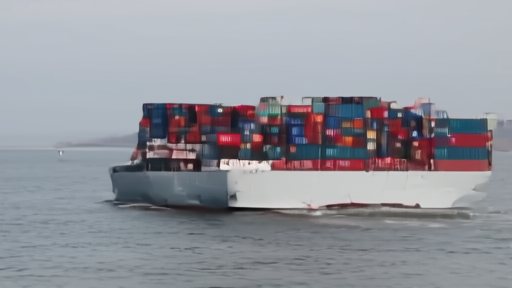
CMA CGM told Agence France-Presse on Sunday evening that one of its vessels "was the subject of warning shots" on Saturday in the Strait of Hormuz. [1] The International Maritime Organization, in a parallel statement, identified the ship as the CMA CGM Everglade, a French-flagged container vessel damaged north of Kumzar, Oman. The crew is safe. The IMO is logging the event as the twenty-fourth shipping incident in the region since March 1. For the French shipping major, it is the second of its own hulls to make operational contact with Iranian enforcement in seventeen days.
The first was the CMA CGM Kribi, a 5,466-TEU Maltese-flagged container ship owned by CMA CGM that transited the Strait eastbound on April 2, hugging the Iranian coastline through the Tehran-approved corridor between Qeshm and Larak Islands. [2] The Kribi's AIS destination field was briefly set to "Owner France" as she entered Iranian territorial waters — a flag-assertion tactic deployed as a kind of passive-voice claim to non-belligerent status. Reuters reported on April 3 the transit signalled "Iran may not consider France a hostile nation." [3] The Financial Times reported it as the first Western European passage since the effective closure. Three hundred and eighty-two hours later, a second French hull of the same company lost containers to an unidentified projectile north of Kumzar.
The paper's Sunday coverage of Paris hosting a fifty-country Hormuz coalition conference without Washington anticipated precisely this exposure. The transatlantic security architecture is bifurcating on the war's central chokepoint; commercial Europe cannot be held out of the enforcement envelope the way American hulls can, because American hulls have a navy to escort them and French container ships have a commercial calendar. The paper's April 18 framing — falsified inside eighteen hours, as Saturday's lead conceded — treated the strait as selectively open. The Everglade is the selectivity expressed as a hole in a container stack.
The two events that bracket the seventeen days tell the same story in opposite registers. On April 2, the Kribi paid for its passage — reports across maritime press estimate transit fees of two million dollars in yuan to navigate the corridor; Iran, which has been demanding tolls from eligible carriers, released only the fact of transit, not the price. [2] The Kribi exited toward Oman, continued toward Pointe-Noire in the Republic of Congo, and executed its delivery schedule. The event was tolerable: one company, one ship, one fee, one voyage completed under a flag assertion explicit enough to communicate nationality. The commercial architecture, viewed from Marseille, held.
On April 18, the Everglade — larger, French-flagged directly rather than Maltese-flagged Owner-France, sailing through what had been announced as a reopened strait twelve hours earlier — took damage from an unidentified projectile. [4] The UKMTO reported three incidents across the Saturday morning: two tankers struck by IRGC gunboat fire (the Indian-flagged Sanmar Herald and Jag Arnav, documented by a Times of India audio release), and a container ship hit by the unidentified projectile that CMA CGM has now confirmed was theirs. The Everglade's containers absorbed the impact; the ship did not catch fire. The crew is safe.
What Marseille has not said — and what IMO's statement carefully does not claim — is whether the projectile was identified as originating from an Iranian position. Trump asserted Sunday on Truth Social that "bullets" had been "aimed at a French ship and a freighter from the United Kingdom." [5] The IMO's formulation is narrower: the vessel was "damaged." The UKMTO's account is narrower still: a projectile, unidentified. The ambiguity is structural rather than accidental. Iran's enforcement has been demonstrating for weeks that it will permit selective transit; the Everglade's experience documents that the selectivity has at least one edge case, and that French hulls are on the edge.
For the CMA CGM leadership — a Marseille-based family enterprise that last traded at roughly $200 billion in equivalent listed capitalization before going private, the world's third-largest container carrier — the seventeen-day data window is the operational question Paris's coalition conference was structured to address. If the Kribi's tolled passage was a precedent and the Everglade's damaged passage is its limit, then commercial Europe's two-month experience of Hormuz has produced one commercial fee paid and one hull damaged. The company's late-February advisory had already suspended Suez transits and rerouted three services via the Cape of Good Hope. [6] The Everglade's incident strengthens the case for that rerouting across the rest of the fleet.
The Paris conference's deliverables on Saturday — the ones the paper's coverage called "operational commitments" as distinct from "diplomatic language" — must now include the shipping industry's response to two CMA CGM data points. France-UK Hormuz coalition partners heard the Everglade story Sunday at what were meant to be follow-up sessions; Germany's Merz, still publicly seeking U.S. participation in the mission, must now address why a French-flagged ship took a projectile Saturday while his own rhetorical position holds that the mission should wait for Washington. [5] The bifurcation the paper named last week has a hull number: IMO 9894985, CMA CGM Everglade, 366 meters long, operating out of Marseille with a French crew.
China's silence on the Kribi's April 2 transit was read at the time as Beijing assessing whether the corridor was usable. The Everglade's damage is the counterpoint data point. Chinese operators have since paid tolls and transited (two COSCO container ships through the Persian Gulf in early April); the question the data point forces is whether Beijing continues treating Hormuz as negotiable with Tehran while Marseille is being treated as punishable. If the architecture distinguishes by flag rather than by fee — and the Kribi's Maltese-flag Owner-France workaround succeeded while the Everglade's direct French flag did not — then the distinction is political rather than commercial, and European operators will need to price the politics into the insurance. The Lloyd's syndicate will calibrate the premium for French hulls this week in a way it did not last week.
For the paper's European readers, the summary is uncomfortable: in seventeen days, Marseille has learned that transit is possible if the flag is attenuated and the toll is paid, and that transit is dangerous if the flag is direct and the timing is wrong. The French coalition was built to dilute the second lesson across many flags, many hulls, and many operators. The Everglade's incident is the first French commercial hull to test whether the coalition can actually deliver that dilution. The answer Sunday evening is: not yet.
-- CHARLES ASHFORD, London