At 10:00 a.m. Eastern on Friday, Iran's foreign minister Abbas Araghchi posted to X the exact language the paper's April 13 reading of the blockade had argued was the only language the strait was likely to produce. "In line with the ceasefire in Lebanon," he wrote, "the passage for all commercial vessels through Strait of Hormuz is declared completely open for the remaining period of the ceasefire on the coordinated route." [1] Eleven minutes later, at 10:11 a.m., Donald Trump posted on Truth Social that the United States naval blockade on Iranian-flagged ships and Iranian ports would remain in full force until a broader peace deal was signed. [2][3] The sequence was brief enough that both posts sat on the same X timeline at the same time. Institute for the Study of War aggregated the two into a single thread by lunchtime. [4]
The reader of Friday's headlines in most major outlets would have seen one fact first: the strait is open. That reader would have had to scroll two or three paragraphs to find the second fact: the strait is open for everyone except Iran. The paper's Day 3 coverage of the blockade argued that porosity by flag was the architecture, not a bug; on Friday that architecture became the declared US position, spoken by the enforcer, in eleven minutes of real time. The paper's position had been that the blockade's flag filter was the instrument. The position now needs a refinement: the filter is now also the peace.
The language the posts used
Araghchi's post is worth reading slowly. It announces reopening "for all commercial vessels." It does not say "including Iranian-flagged." It does not say "except Iranian-flagged." It specifies "the coordinated route." The word "coordinated" is the word that carries the weight. A coordinated route is a route the enforcer is coordinating; it is a corridor, not a strait. The paper noted on April 16 that CENTCOM's language had narrowed from "fully implemented" to "no Iranian ship crossed," — the enforcer's own word-choice conceded the China exception. Araghchi's language on Friday concedes the American corridor. Both concessions point at the same geometry. The channel that was open before the war was a geographic fact; the channel that reopened Friday is an administered one.
Trump's post arrived fast enough to be read as continuous with Araghchi's, though the two governments wrote independently. The second post's specifics mattered. It enumerated the continuing elements of the enforcement: "Iranian ships" and "Iranian ports." [3] Ports is the piece that was underemphasized on Friday. A ship is a mobile target; a port is a piece of sovereign territory. Maintaining a blockade of sovereign Iranian ports while commercial traffic of all other flags passes the same strait is not a paused interdiction. It is an unblinking one. Bandar Abbas, Shahid Rajaee, Assaluyeh, Kish — none of them received commercial tonnage on Friday afternoon.
What the IRGC said
Late Friday evening Tehran time, the Islamic Revolutionary Guard Corps published a statement — circulated in English by Institute for the Study of War — criticizing Araghchi's reopening post. [4] The IRGC did not dispute that ships were passing. It disputed the rhetorical concession. In the regime's own internal language, the strait's closure had been a leverage instrument; its reopening, negotiated through a ceasefire the IRGC did not set, was a leverage concession the foreign ministry had made without Guard sign-off. That division — the civilian ministry announcing a coordinated opening while the military arm publicly rebukes the announcement — is not just factional theater. It is the reason the strait's commercial opening does not amount to a comprehensive ceasefire. Iran has two arms of the state, and on Friday they were not saying the same thing about the same strait.
The US, for its part, has two posts. Trump's first post of the morning had welcomed Araghchi's announcement in effusive terms, thanking Iran for the reopening. The second post — the blockade-stays post — arrived eleven minutes later. There was no walkback in between. Both stand. The Araghchi-Trump-blockade-Trump sequence is the shape of the Friday announcement: a ceasefire that is not a ceasefire, an opening that is not an opening, a blockade that is not a blockade.
The flag-filter question
The operational question the lawyers are asking is what legal basis a state has for enforcing a selective blockade by flag during a period its president publicly calls an end to fighting. Under the San Remo Manual on Armed Conflict at Sea, which informs customary maritime law, a belligerent can interdict enemy vessels and neutral vessels carrying contraband. The San Remo framework assumes an active armed conflict. A selective blockade of one state's ports and vessels while commerce of all other flags passes unimpeded through the same strait is a posture the framework does not neatly accommodate. Either the war is active, in which case the blockade has legal foundation and Trump's ceasefire rhetoric is a misdescription, or the war has ceased, in which case the blockade is an economic sanction dressed in naval uniform. It cannot be both.
The choice between those two framings has consequences for insurers. War-risk premiums on Gulf tonnage had been quoted at roughly 10 percent of hull value as late as Thursday; by Friday afternoon some underwriters were offering rates closer to 4-5 percent for non-Iranian flags transiting the coordinated corridor. [5] Iranian-flagged tonnage, by contrast, became uninsurable in the usual London market. The market has made the call before the diplomats: the blockade is an economic measure; the ceasefire is a commercial corridor. The legal question — whether the US can keep one without the other — is being deferred.
What is in the corridor
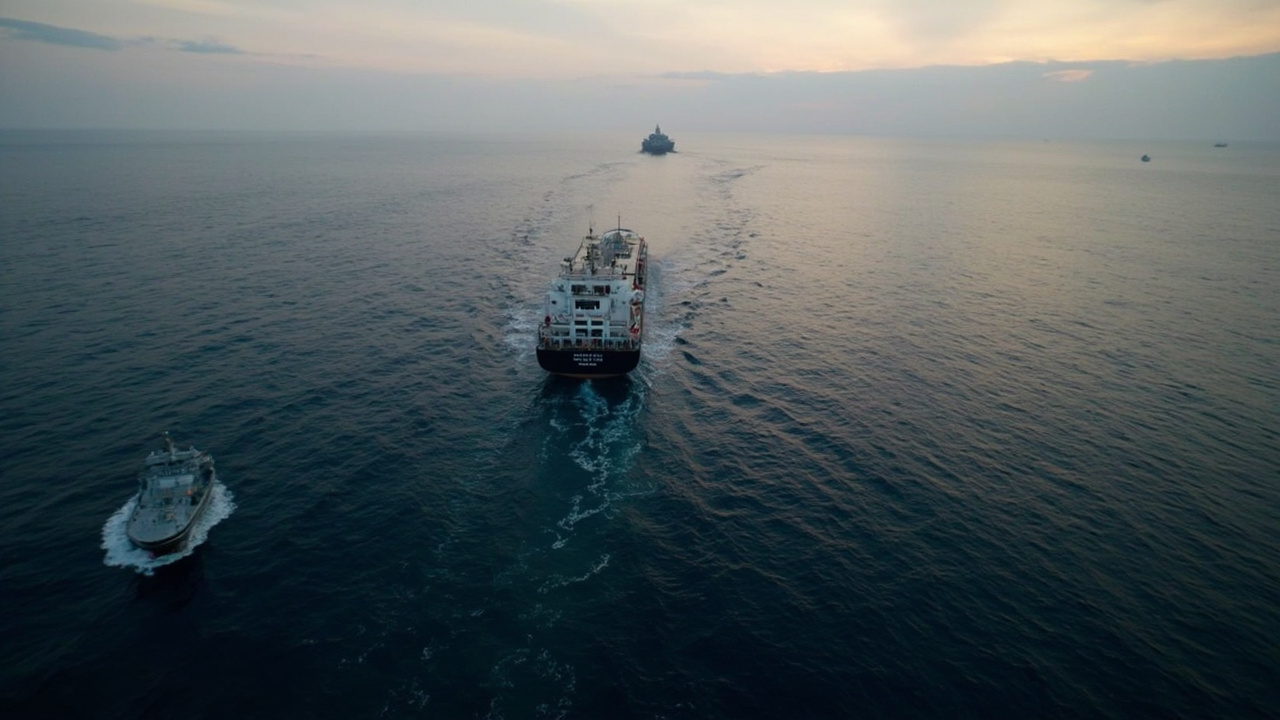
The commercial passage through the coordinated route on Friday moved about 17 transits through the Strait of Hormuz, according to ship-tracking data aggregated by maritime analysts. That is well below the pre-war daily throughput of roughly 50 transits but sharply above the one-to-three daily transits the strait had averaged during the blockade's worst weeks. [6] Of those 17, none flew the Iranian flag, which is the single cleanest metric of what Friday's reopening actually did. The corridor is Saudi, Emirati, Kuwaiti, Japanese, South Korean, Indian, and Chinese traffic. The Iranian share of the strait's commercial flow has moved from "impaired" to "zero by design."
The Chinese share deserves its own sentence. On April 13, the paper noted that CENTCOM's narrowed language — "no Iranian ship crossed" — tacitly conceded that Chinese-flagged traffic had been passing throughout. The China exception endures under the reopening. Sinopec tonnage is still moving; the four Chinese-crewed vessels the paper tracked in Week One of the blockade are still lifting cargo. The China-shaped hole in the enforcement regime is not a ceasefire artifact. It predates Friday by three weeks and continues through it.
Europe's rejoinder
The European response to the selective reopening arrived inside hours, and it did not sound like a ceasefire rejoinder either. Emmanuel Macron and Keir Starmer chaired a videoconference in Paris on Friday with more than 45 nations — participants described the figure as around 50 including international organizations — to plan a multinational naval presence in the strait "as soon as conditions allow." [7][8] The Elysée statement was careful about one phrase: the planned mission "does not include the US or Iran for now." [7] Friedrich Merz, meeting separately with reporters, said Germany still wanted US participation and was prepared to vote Bundestag authorization for a mission only once a ceasefire held and a UN mandate covered the deployment. [9]
The European mission is the counterpart to Friday's selective corridor. It exists because European insurers, European fleets, and European bunker suppliers do not trust the US corridor to remain stable under a blockade's flag-filter terms. Forty-five states planning a civilian-protection mission in a strait the American president has declared open is not the conduct of allies treating a ceasefire as settled. It is the conduct of allies building redundancy against an architecture they have now seen name itself.
The posture is the peace
The word "ceasefire" describes what did not happen on Friday. Fighting was not declared ended; a blockade was not lifted; a port was not reopened; an Iranian vessel was not cleared. What happened was that commercial traffic of all non-Iranian flags was coordinated through a corridor, and the war's enforcer declared one counterparty's flags and ports still interdicted. That is a selective peace, and a selective peace is not a concession of posture — it is the posture, maintained under a different name.
The paper wrote on April 13 that the blockade's porosity was its architecture, and that CENTCOM's refusal to enforce against Chinese hulls was the blockade functioning as designed. Friday extends the position: porosity by flag is the architecture, and now porosity is the peace. The strait is open, the blockade is in force, and the difference between the two is the flag painted on the hull.
The insurers already know. The Europeans are moving. The IRGC is publicly rebuking its own foreign minister. The ships are moving through a coordinated corridor the Americans coordinate. The ports are dark. The peace is selective. The enforcer said so at 10:11 a.m. Eastern.
-- YOSEF STERN, Jerusalem