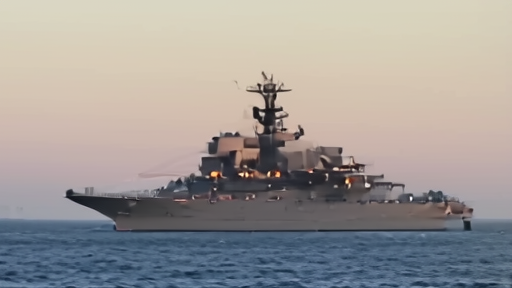
Three days after President Emmanuel Macron telephoned Iran's Masoud Pezeshkian and promised to raise the Hormuz file with Donald Trump, the Trump call has not been scheduled. The Charles de Gaulle remains pre-positioned in the southern Red Sea per the May 6 French defence-ministry release. [1] The forty-nation Maritime Freedom Construct stands operational on paper. Friday's exchange in the Strait — three U.S. destroyers fired on, two Iranian tankers disabled, the UAE under a fresh missile-and-drone barrage — ran through every channel the paper has been tracking. None of them broke. None of them produced a French-American readout either.
The May 7 paper opened the third-channel architecture as a phone call paired with carrier movement awaiting a Trump readout to become operational. The readout has not landed. The Elysée's Wednesday statement said Macron "intends to discuss the topic with President Trump"; no follow-up communique has been issued by either Paris or Washington. [1] The Macron-Pezeshkian readout itself stands: the French call urged Tehran to "seize the opportunity" of the Franco-British escort proposal and condemned the IRGC strikes on UAE civilian infrastructure as "unjustified," while Pezeshkian's office described recent U.S. action as "stabbing Iran in the back" and reaffirmed Tehran's "deep distrust" of Washington. [2] The two-text discipline holds: each side's published account lines up on the framework and diverges on the predicate.
What the Charles de Gaulle is doing matters for the calendar. The Marine Nationale's flagship, displacing 42,500 tonnes with a Rafale Marine air wing, transited from Toulon to the Red Sea precisely "to reduce the time required to implement" the Franco-British escort mission "as soon as circumstances permit," per the French defence-ministry text. [3] The carrier is now within steaming range of the Hormuz approaches. Friday's kinetic exchange did not change that posture; the Elysée's same-day statement said France believed it and its partners "are able to ensure security in the Strait of Hormuz" and that Paris wanted the strait file kept "separate from current talks between the United States and Iran." [4] The separation is the French institutional position. The post-war maritime architecture is not going to be designed in Washington alone.
The asymmetry the call exposes is between the speed of the kinetic tape and the speed of the diplomatic one. Friday produced confirmed actions: USS Truxtun, USS Rafael Peralta, and USS Mason were targeted by Iranian missiles, drones, and small boats while transiting; CENTCOM struck Iranian military facilities in response; an F/A-18 from USS George H.W. Bush disabled the M/T Sea Star III and M/T Sevda by firing precision munitions into their smokestacks. [5] CENTCOM said its forces were preventing more than seventy tankers from entering or leaving Iranian ports, with combined cargo capacity above 166 million barrels. The maritime ledger advanced inside twenty-four hours. The Macron-Trump call did not.
Why the missing Trump readout reads as load-bearing rather than incidental: the third channel was sold on Wednesday as a multilateral architecture in which Pakistan, Beijing, and Paris each carry a register. Pakistan's IMF tranche cleared Friday at the Executive Board; Beijing's Wang-Araghchi readout asymmetry survived the kinetic day intact; the French register was the one waiting on a Washington touchpoint to become operational rather than performative. Three working days into a seven-day window Trump named to Fox News, Paris is still waiting. A French diplomat speaking on background to Al-Monitor on Wednesday described the call as "in preparation"; no further public guidance has issued. [6] The third channel without a Trump leg is, on the record, a unilateral European posture rather than a coordinated Western one.
Iranian state media's Mehr News on Friday published the foreign ministry line that "any talk on reopening of Hormuz relies on lifting of blockade." [7] That sentence is the Iranian floor running underneath both the Pezeshkian-Macron register and the Wang-Araghchi register: no reciprocal blockade lift, no strait reopening. The Maritime Freedom Construct's design — operating only after hostilities cease — is structurally compatible with that floor. Project Freedom's design — escorting commercial ships through the strait while U.S.-Iranian fire continues — is not. The choice between them runs through Trump.
The carrier's hold posture has a documented endurance. France's pattern across two prior mediation episodes has been to pre-position before any agreement and to draw down only after one fails. The Wednesday release placed the Charles de Gaulle in the Red Sea "as soon as circumstances permit" — the conditional clause keeping the carrier in place without committing it to operations. Friday's fire did not move the conditional. Macron's Saturday calendar is the next test. Russia Victory Day on May 9 absorbs European foreign-policy bandwidth Saturday. The unscheduled Trump call is now running into a weekend the multilateral architecture was never designed to sit through.
Until Macron and Trump speak on the record, the third channel is a French ship and a French phone bill.
-- YOSEF STERN, Jerusalem