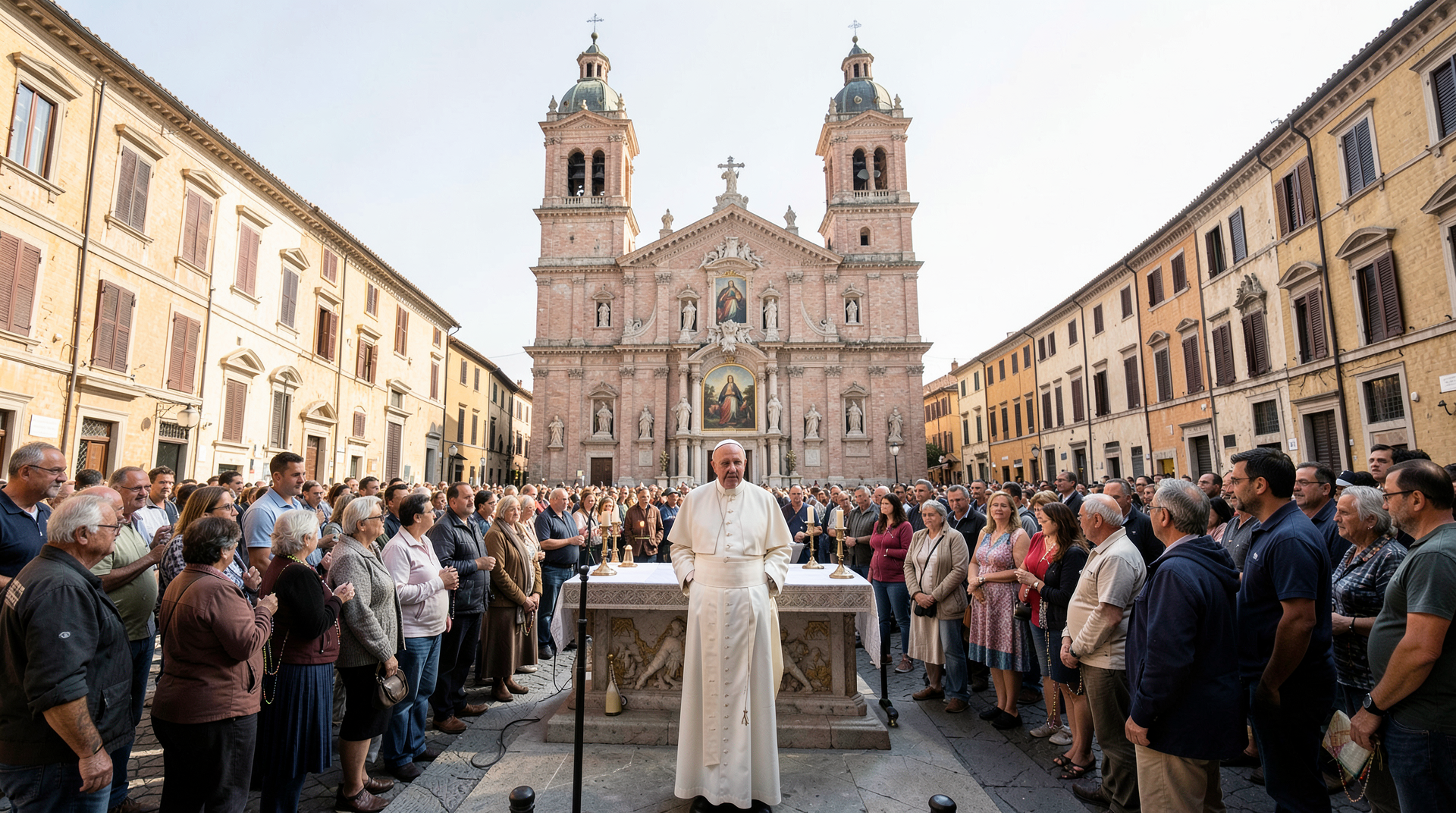
At 10:30 a.m. Friday in Piazza Bartolo Longo, with the twin bell towers of the Pontifical Shrine of the Blessed Virgin of the Holy Rosary of Pompeii at his back, Pope Leo XIV celebrated the Mass that opened the first anniversary of his pontificate. [1] In the homily, the first U.S.-born pope asked: "May there come from the God of peace a superabundant outpouring of mercy, which touches hearts, appeases grudges and fratricidal hatreds and enlightens those who have special governmental responsibilities." [2] He went further before closing: "many call themselves Christians but offend God." [2] Earlier, addressing the wars still being fought "in so many regions of the world," he said: "We cannot resign ourselves to the images of death that the chronicles propose to us every day." [2] The homiletic register the May 7 brief flagged carried what the previous day's diplomatic register absorbed.
The May 7 paper named the canonical-calendar artifact the day before the visit: May 8 is both the first anniversary of Leo's election and the local feast of Our Lady of Pompeii, a date Saint Bartolo Longo chose in 1876 for the laying of the shrine's cornerstone. The May 7 major on the Apostolic Palace audience framed the closed-door meeting between Secretary of State Marco Rubio and Pope Leo as both sides agreeing on one word, "frank", with the readout language as the test. The May 7 brief on the documentary-register silence on the 1995 Pachamama photographs tracked Day 50 of Vatican silence as a position-by-absence frame. Friday compressed all three. The audience produced no public rebuke of Trump's "endangering Catholics" line. The homily produced one. The Pachamama silence is at Day 51 and held.
What the homily said in plain Italian — "appeases grudges and fratricidal hatreds and enlightens those who have special governmental responsibilities" — has a specific Vatican grammar. "Fratricidal" carries the Cain-and-Abel register: a war between brothers, a war whose moral content the Catholic magisterium has named as the destruction of human dignity. "Special governmental responsibilities" is the Vatican-Italian formula for heads of state. Together, the phrase asks God to enlighten those who are at war and those who are governing it. The phrase did not name Donald Trump or Iran or Israel. It named the moral category in which the magisterium reads the war. The next sentence — "many call themselves Christians but offend God" — is the harder line. The Pope spoke in Italian, in a Marian shrine, to thirty thousand Italian pilgrims, on the day his pontificate became one year old. The line was not delivered to Washington. It was delivered to the universal Church, with Washington in the audience.
This is the difference between the homiletic register and the diplomatic register. Thursday's audience between Rubio and Leo at the Apostolic Palace lasted half an hour, with doors closed and no press. Brian Burch, the U.S. ambassador to the Holy See, had pre-staged it as "frank conversation about U.S. policy" and disputed the idea of "some deep rift." The Vatican Press Office did not, at last record, use the word "frank" in any post-audience readout; the readout language followed the Vatican's traditional patterns of "candid" or "cordial" exchange, which preserve disagreement on the record without naming it. What Rubio said publicly afterward was thin. The Vatican Press Office issued no follow-up document on the war. Both sides, by the day's end, had absorbed the rebuke into the diplomatic register. The Pope, twenty-four hours later, took it back out of that register and put it on a Marian shrine.
The choice of Pompeii is the structure. Bartolo Longo, whom Leo canonized on October 19, 2025, founded the Pompeii shrine after a radical conversion away from occult practices, and wrote the Supplica to Our Lady of the Holy Rosary that is recited at noon every May 8 and on the first Sunday of October. The May 8 date Longo chose for the shrine's foundation stone was the local feast of Our Lady of Pompeii — the same Marian feast Leo invoked from the loggia of Saint Peter's a year ago, when he stepped onto the central balcony for the first time as pope and said: "Today is the day of the Prayer of Supplication to Our Lady of Pompeii." [3] [4] The shrine's facade has carried the inscription Pax — "Peace" — since 1901. [4] The site is, in the canonical-calendar grammar, the shrine where peace is prayed for on a fixed day. The pope who chose it for his anniversary chose homiletic over administrative as the year's structuring genre.
That choice is itself a position. A first-anniversary message delivered from the Loggia of Saint Peter's would have invited a state-of-the-pontificate register: institutional statements about appointments, doctrinal frames, governance reforms. The Pompeii pilgrimage produces something else. The Pope arrived at 8:50 a.m., met "the Temple of Charity" — disabled, elderly, and disadvantaged people the shrine's volunteers serve — in the Luisa Trapani Hall, walked through the streets in the popemobile to Piazza Bartolo Longo at 9:45, venerated the relics of Saint Bartolo Longo at 10:00, and celebrated Mass in the square at 10:30. [4] At noon the Supplica was prayed. He had lunch with the shrine community before departing for Naples in the afternoon, where roughly thirty thousand more people awaited him in Piazza del Plebiscito. [2] The schedule is pastoral. The schedule is Marian. The schedule is the deliberate genre choice that makes the homiletic register the public form of the answer.
The Vatican's reading of war is the magisterium the homily invoked. Pope Francis, in 2017, declared even the possession of nuclear weapons "to be firmly condemned." Leo's prior public interventions have stayed inside that magisterial frame: the April 11 prayer vigil in Saint Peter's, where he said "Stop! It is time for peace! Sit at the table of dialogue and mediation, not at the table where rearmament is planned and deadly actions are decided"; the Christmas Urbi et Orbi message that distanced the Church's peace from "the silence of weapons that comes from a ceasefire" and placed it in the register of "wild peace"; the October 11 Marian Vigil in which he urged "those who guide the fate of peoples: have the courage to disarm." [5] The April 16 @Pontifex post that the Pompeii homily extends placed the doctrine on X in plain English: "Let us reject the logic of violence and war, and embrace peace founded on love and justice — an unarmed peace, not based on fear, threats or weapons." [6] The Pompeii homily compresses the year's catechesis into a single sentence about fratricidal hatreds. The next sentence — about Christians who offend God — moves the doctrine from the abstract to the specific. The category being addressed is the category the prior week's Trump-Vatican exchange placed inside Christian identity politics, with the secretary of state framing nuclear nonproliferation as a defense of Catholics and the president invoking "endangering Catholics" as a line of attack. The homily refused that frame.
What the Vatican has produced this week is a sequence in which each register answered a different way. Tuesday: Trump's Truth Social post that Pope Leo's stance against military action in Iran was "endangering a lot of Catholics." Tuesday: the Pope's reply to journalists at Castel Gandolfo that the Catholic Church "for years has spoken out against all nuclear weapons, so there is no doubt there." Tuesday: Italian Foreign Minister Antonio Tajani calling Trump's comments "neither acceptable nor helpful to the cause of peace." Wednesday: the Pope's General Audience at Saint Peter's. Thursday: the Apostolic Palace audience between Rubio and Leo, half an hour, doors closed. Friday: the Pompeii homily. Each day moved the dispute through a different register. Each register has a different audience and a different evidentiary weight. The diplomatic register can absorb. The homiletic register cannot — the homily is, by design, a teaching. The teaching delivered Friday is that the war's moral category is fratricide, and that the people who carry it have governmental responsibilities the magisterium asks God to enlighten.
The state-level cohort that has gathered around the Pope's position is now five. Italian Prime Minister Giorgia Meloni, a Trump ally, has taken exception to the U.S. president's comments. Defense Minister Guido Crosetto has said the war "puts U.S. leadership at risk." Tajani's public post defended the Pope. Leo's plane presser to Algiers on April 24 — calling Trump's threats to Iran's "whole civilization" "not acceptable" — was the homiletic register before it had a state cohort behind it. The cohort that Friday's homily addressed is, in part, the cohort the war has produced. The state-level back-and-forth between Washington and Rome is now a documentary record of disagreement. The homily refuses to ratify Washington's framing without naming Washington.
The second-order frame the May 7 brief named is what the Vatican does next with the Pachamama documentary register. Day 51 of Vatican silence on the 1995 Pachamama photographs continues. The Press Office has not formally addressed the question. The contrast Friday's homily makes against the documentary-register silence is what the next week will test. The homiletic register has spoken. The administrative register has not. Whether the Vatican Press Office issues a follow-up readout that uses the homily's "fratricidal hatreds" formula in any subsequent State Department exchange is the next documentary test. Whether Trump's Truth Social or Rubio's State Department responds to the homily by Saturday is the next political test. The silence-after-rebuke pattern has held for ten days against the National Science Board firing, eleven days against the FCC's ABC license cliff, twelve days against the Stars and Stripes Day 12 frame, and four days against the Pulitzer slate. The Pompeii homily now joins that ledger — but on the side of the speaker who refuses to be silent.
What the homily did not say is also part of the document. It did not name Iran. It did not name Israel. It did not name Trump. It did not name nuclear weapons. It did not name the strait. It named "those who have special governmental responsibilities," "fratricidal hatreds," "the wars still being fought in so many regions of the world," "the images of death that the chronicles propose to us every day," and "many [who] call themselves Christians but offend God." Each phrase is a category. Each category contains the named persons the homily refuses to name. The Vatican's grammar of public address has, for two thousand years, used the universal to address the particular. Friday's homily continued that grammar.
What the homily named, in the universal, is the frame the next year of the pontificate will carry. "We cannot resign ourselves to the images of death": this is the refusal of the chronicles' news cycle as the moral horizon. "May there come from the God of peace a superabundant outpouring of mercy": this is the prayer that the diplomatic register cannot make. "Many call themselves Christians but offend God": this is the rebuke that the Christian identity politics of the prior week's exchange demands but cannot frame. The homily's three movements take the war out of the news cycle, place it inside the magisterium, and return the moral question to those whose calling is to teach it. The Pope, after a year in office, is operating in the homiletic register because the documentary register has not been able to absorb the political moment without ratifying it.
The shrine in Pompeii has welcomed four popes in the past five decades — John Paul II twice (1979, 2003), Benedict XVI (2008), Francis (2015), and now Leo. Each visit has carried a register. Leo's, on the morning of his anniversary, in front of thirty thousand pilgrims, with the Pax inscription on the basilica facade visible behind him, was not a state-of-the-pontificate. It was a Mass. The homily's "fratricidal hatreds" sentence is what the Mass produced. The homily's "many call themselves Christians but offend God" is what the year's catechesis required. The homily's prayer that God enlighten those with governmental responsibilities is what the magisterium asks of the war. The diplomatic register on Thursday absorbed the political moment. The homiletic register on Friday refused to.
In the afternoon the Pope traveled to Naples by helicopter, met with the clergy at the cathedral, venerated the relics of San Gennaro, and addressed roughly thirty thousand more people in Piazza del Plebiscito. The Marian image of the Immaculate Conception, which marks its bicentenary this year, was brought into the square. Leo entrusted the city to the Virgin and imparted the apostolic blessing. Naples is, like Pompeii, a city of pilgrimage in the Catholic Mediterranean grammar. The visit closed at the Vatican heliport at 19:30. [4] The day was, by design, a Marian-pilgrimage day on a feast that has been observed for 150 years. The day was, by accident of the calendar that nobody planned, the day after the Apostolic Palace audience and the day before the next round of whatever Washington and Tehran put on the page in Hormuz.
The homily was not an accident. The schedule was set in February. [3] The pope who chose this day for his anniversary chose this register for his answer. What the choice produces, as the year's documentary record now clearly contains, is a public position the magisterium can defend without naming. "Many call themselves Christians but offend God." The grammar permits the universal address. The audience knows the particular. The teaching, in Vatican terms, is delivered.
The Pope returns to Rome Friday evening with one year complete. The next year begins with the homiletic register on the page. The diplomatic register, owned by the Vatican Press Office and the Apostolic Palace, has its own work. The two registers will need to meet, eventually, in some written document Washington and Rome can both read. What Friday provided is the moral frame inside which that document will be written.
-- ANNA WEBER, Berlin