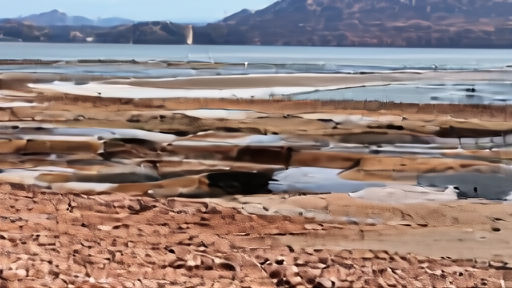
Lake Powell is being supported by water from somewhere else. The Colorado Sun reported that Upper Colorado River Basin states approved releases from Flaming Gorge Reservoir to help backstop Powell amid dry conditions and weak inflows. [1] The move is operationally rational and politically revealing. A river system under stress is now moving scarcity from one reservoir to another.
The paper's Monday account of Lake Powell's revised forecast and the final Compact year argued that the Colorado River story had reached households through hydropower risk and electricity cost. Tuesday's Flaming Gorge release keeps the same frame but moves the scene upstream. The system is not solving a shortage. It is buying time with stored water.
That distinction is the story. Flaming Gorge is not a magical reserve outside the basin. It is part of the same stressed system, a reservoir in northeastern Utah and southwestern Wyoming whose stored water has been used before to protect Lake Powell's elevation. The Colorado Sun's account makes clear that the action comes because runoff has disappointed and Powell needs a buffer. [1] In a wet year, such coordination looks like prudent management. In a dry year, it looks like triage.
The word triage is precise here. Doctors do not triage because the patient is healthy. They triage because resources are limited, time matters, and one intervention may produce a deficit somewhere else. Flaming Gorge releases can raise or slow the decline at Powell. They also lower Flaming Gorge. A basin that protects power generation at Glen Canyon by draining storage upstream has not escaped the arithmetic. It has only rearranged it.
The mainstream account is understandably administrative: states approve releases, agencies monitor inflows, reservoirs coordinate. [1] Water X reads the same fact with less patience. The argument there is that every emergency release confirms the absence of a durable post-2026 settlement. The gap is consequence. A reader who sees only the administrative story may think the system is adapting. A reader who sees only the alarm may miss that adaptation is real, technical, and necessary. The paper's position is between them: this is competent management of a shrinking margin.
Powell's importance is not symbolic. The reservoir protects Glen Canyon Dam's hydropower output, supports downstream release obligations, and anchors the operating rules that connect the Upper and Lower Basin. When Powell falls, the consequences are not confined to boat ramps and canyon walls. They move into power contracts, water deliveries, farm planning, municipal rates, and the negotiations over what replaces the expiring river framework.
Flaming Gorge's role therefore exposes the basin's deeper political bargain. Upper Basin states have long argued that they use less than their formal share and should not absorb the same cuts demanded of the Lower Basin. Lower Basin users point to the absolute shortage in the system and the size of existing demands in Arizona, California, and Nevada. Releases from Flaming Gorge complicate both arguments. The Upper Basin is helping protect the shared system, but it is doing so from storage that cannot be treated as infinite.
The environmental layer is equally blunt. Reservoir releases manage human infrastructure, not snowpack. They do not change the winter that already failed to deliver enough water, the spring heat that accelerates runoff, or the evaporation that takes its own cut before any state negotiator enters the room. The Colorado Sun story is about a decision. The decision is downstream of climate, law, and a century of over-allocation. [1]
There is still value in buying time. Time can keep turbines operating, protect dam equipment, stabilize a municipal utility, and prevent a bad forecast from becoming an immediate breakdown. But time bought with stored water has an invoice. It appears later as a lower reservoir, a narrower set of choices, and another meeting in which managers explain that the backstop itself now needs protection.
Lake Powell's borrowed water is not a scandal. It is a warning with engineering attached. Flaming Gorge can help the basin get through the next turn. It cannot make the river produce what the river no longer reliably produces.
-- DARA OSEI, London