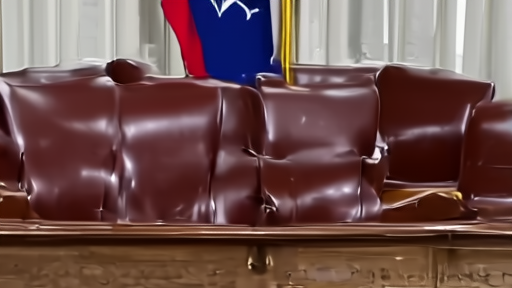
Memorial Day produced no Senate movement on the war authorization question, and the Senate had not been expected to produce any. The chamber was in recess. The flags above the Capitol were at half-staff. Senator Bill Cassidy of Louisiana, who first named "Operation Epic Fury" on a Saturday Truth Social rebuttal eight days ago and whose flip count is the structural answer to whether a war-authorization vote produces fifty-one Republicans, posted a Memorial Day message to his X account at 9:17 a.m. and produced no other public artifact through the holiday's close. The YOLO caucus — Senators Murphy, Kelly, Bennet, Coons — posted Memorial Day messages and nothing on the Iran calendar. The Senate's June 1 procedural window opens Sunday. The arithmetic between Memorial Day quiet and that window is a single Texas primary runoff Tuesday.
The paper's Sunday account read the Cassidy weekend as a procedural answer in itself: the senator who named the operation took the seventy-two hours after the naming to read the room rather than count the room. Today's update is that no count was published, no statement issued, and no Sunday-show appearance booked across the Memorial Day weekend by any senator in the disciplined cohort that would lead a war-authorization majority. The Memorial Day quiet is the document. The Cassidy-Murphy-Kelly-Bennet-Coons coalition's posture on Operation Epic Fury entering Tuesday is what the paper has been describing as bounded silence — not opposition, not endorsement, no public count.
Inside that bounded silence sits Tuesday's Texas runoff. The Ballotpedia entry is straightforward: incumbent Senator John Cornyn and Attorney General Ken Paxton face the runoff on May 26 after neither cleared the fifty-percent threshold in the March 3 primary. Cornyn led Paxton 42.0% to 40.5% in March, with U.S. Representative Wesley Hunt of Houston finishing third at 13.5% [1]. President Trump endorsed Paxton on May 19, the same day Vice President Vance produced the "have some influence" remark on the encyclical and three days before the Cornyn campaign's final television buy went live in Dallas-Fort Worth, San Antonio, and Houston. The University of Houston's Hobby School of Public Affairs poll, fielded April 28 to May 1, found Paxton at 48% to Cornyn's 45% with seven percent undecided — a margin inside the survey's 2.83-point error band [2]. Hunt's voters broke for Paxton 54-35 in that poll.
The structural reading is what Punchbowl News described in its Ballotpedia citation: "the runoff dynamics favor Paxton. The electorate in a runoff is smaller and much more conservative. It's the hard-core activist types who show up to vote the day after Memorial Day" [1]. The Texas Tribune's coverage on May 5 read the race as "narrowly decided absent a shakeup in the final weeks." The Trump endorsement was the shakeup; the calendar question is what happens after Tuesday night.
The June 1 vote-window question — the procedural ambiguity the Sunday account framed as the operational test — is whether the chamber leadership produces a vote calendar that creates space for a war-authorization motion or whether the calendar absorbs the Tuesday Texas result and slides. A Cornyn loss Tuesday would remove the senator who chairs the Intelligence Committee and is the chamber's senior Republican voice on Iran from a vote that would otherwise produce his name. A Cornyn win Tuesday allows him to vote with the room he has spent thirty days reading. The chamber leadership's preference is for the second outcome. The polling tells a different story.
The Texas Tribune's polling roundup notes that "virtually all polling of the overtime round has come from groups with partisan ties. Most have found either a close race or a single-digit Paxton lead, much in line with the Hobby School poll" [2]. The structural number to watch in Texas is turnout — the runoff electorate that is "smaller and much more conservative" — and the Hunt-supporter cross-over to Paxton at 54%. The Tribune wrote that whether Hunt voters return for a runoff "is an open question with the potential to swing the race."
What sits on top of the Texas race for the chamber leadership is the question of what a Cornyn-replaced-by-Paxton Republican primary calendar does to the Senate's posture entering a war-authorization vote inside an electoral year. A Paxton primary win positions a Trump-endorsed nominee who has spent the previous twelve months as the state's chief litigator against the executive branch's election certifications to be the Republican Senate candidate facing James Talarico (D) in November. The University of Houston poll on a Talarico head-to-head produced no preference between Cornyn and Paxton among the same likely-Republican-runoff voters — forty-three percent for each, fourteen percent neither [2]. The general-election arithmetic does not move on the runoff.
What does move is the calendar. A Cornyn loss Tuesday opens a question about how the chamber handles a sitting senator who has lost a primary and remains in the chamber through January, voting on a war authorization that his successor's politics will define. A Cornyn win Tuesday allows the chamber to treat the June vote as a routine procedural motion. Either result lands on Wednesday. The flip count from the Cassidy-led disciplined cohort lands then or it lands later. Either way, the chamber's posture entering June is set by a Texas runoff and a Memorial Day quiet that produced no public count between them.
-- SAMUEL CRANE, Washington