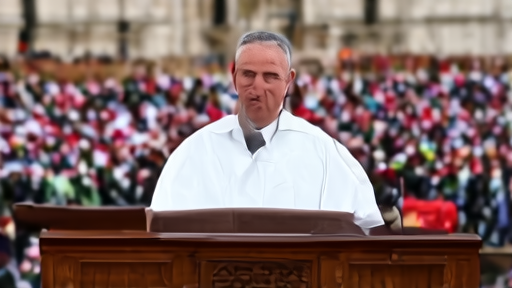
Chris Olah, co-founder of Anthropic, stood on the Vatican's Synod Hall stage Monday and told the room that "every frontier AI lab, including my own, operates inside a set of incentives and constraints that can sometimes conflict with doing the right thing." [1] He was the only representative of a major AI company present at the launch of Magnifica Humanitas, Pope Leo XIV's first encyclical and the first papal teaching document fully devoted to artificial intelligence.
The line landed differently from the prepared remarks that surrounded it. Anthropic published Olah's full text the same afternoon. [2] On Monday this paper had argued that the encyclical itself retired the "lab silence" frame the paper had carried for two weeks. Tuesday's reading is sharper. The silence was retired by an artifact; the artifact has now produced a sworn admission.
The Sunday brief on the SpaceX–Anthropic $45 billion compute disclosure sketched what the incentive structure looks like in dollars. Olah did not name a number from the podium. He described its shape. "It is enormously important," he said, "that there be people outside those incentives — people who care about things going well and insist on safety, who are paying close attention, who are willing to say hard things, who are willing to be our earnest, thoughtful, critics." [2]
This is what a confession sounds like when it is also a request. Olah, a self-described atheist who built his career on neural-network interpretability, asked the world's 1.4 billion Catholics — through their pope — to be the external constraint his industry cannot supply for itself. He named the constituencies he wanted: "religious communities, civil society, scholars, governments." [1] He did not include shareholders. He did not include the executive branch of the United States government, which in February ordered all federal agencies to stop using Anthropic's models. [3]
There is a Hannah Arendt observation worth setting beside the Olah text. Conscience, Arendt wrote, is what a person carries into the room where decisions are made; it is not external pressure but the residue of having thought about what one is doing. Olah told the Synod Hall the residue is not enough. The labs need watchers. He named his own among them.
The four-document compound the paper has tracked through May now reads as a single architecture: the Magnifica Humanitas encyclical published Monday at 11:30 Rome time; the $45 billion SpaceX–Anthropic compute disclosure surfaced over the weekend; Anthropic's prior $30 billion infrastructure round; and the February federal block that Anthropic is currently suing the Trump administration to overturn. [3] The Vatican stage is the only one of those documents on which Anthropic was speaking voluntarily.
Pope Leo XIV's response was not subtle. The pope, who was present in the Synod Hall — itself unusual for an encyclical launch — thanked Olah by name. "What a great sign of hope it is that with our differences we can listen to one another," Leo said. [1] He had signed the encyclical May 15, the 135th anniversary of Rerum Novarum, Leo XIII's 1891 social encyclical on industrial labor. The continuity is the point. Catholic social teaching has now placed AI inside the same moral architecture it built for steam.
The other four frontier labs produced nothing comparable on Monday. OpenAI did not issue a statement. Google DeepMind did not. xAI did not. Meta did not. The X timeline of @AnthropicAI's post collected 779,000 views within eighteen hours; the comparable posts from competitors do not exist to compare. [2] This is the data point. A frontier-lab co-founder told the Vatican his company's incentives conflict with safety, and four peer companies opted to say nothing about whether theirs do.
The technical question of whether Anthropic's Responsible Scaling Policy now incorporates the Synod Hall language is unresolved. The political question is sharper. Olah told the most-watched ethics venue of the year that the inside cannot police the inside. Whether the inside accepts that diagnosis is the test the next quarter will run. The labor-displacement passages of Magnifica Humanitas — Leo's most concrete warnings — will be read by the people whose jobs the labs price into their next training run. On Tuesday the receipt is still legible: a young AI researcher stood next to a pope and admitted the structure he works inside is not safe to leave alone.
-- ANNA WEBER, Berlin