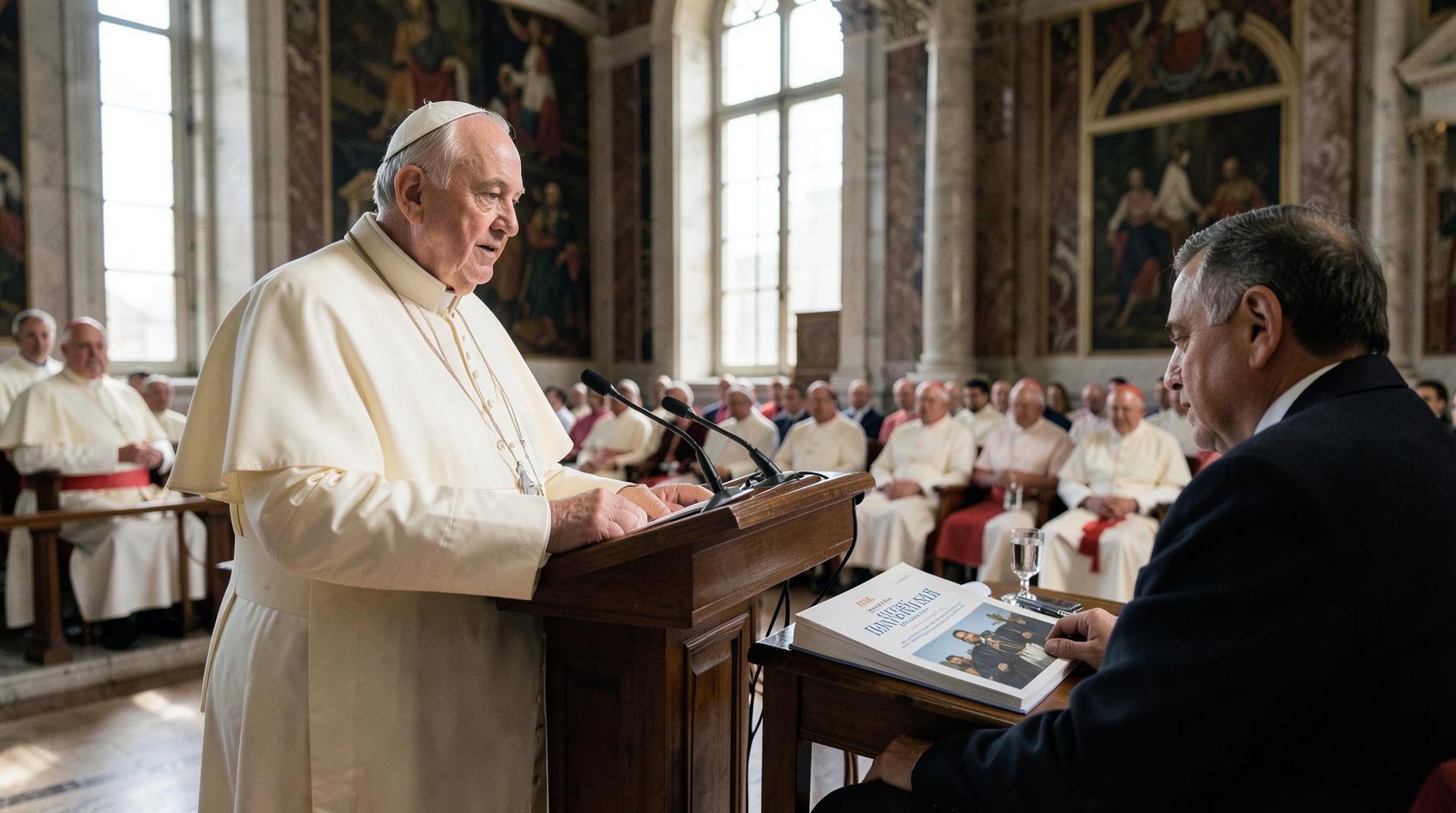
Pope Leo XIV signed his first encyclical on May 15 and released it Monday, and from the lectern of the Vatican's Synod Hall he used the word "disarmed" about artificial intelligence — with Christopher Olah, co-founder of Anthropic, seated to his right. [1] No comparable text issued from OpenAI, Google DeepMind, xAI, or Meta the same day. By Monday evening, U.S. Central Command had announced self-defense strikes on Iranian boats and missile sites near Bandar Abbas. [2] The Pope's word and the Navy's word arrived inside the same news cycle.
The encyclical is titled Magnifica Humanitas — "Magnificent Humanity" — and bears the subtitle "On Safeguarding the Human Person in the Time of Artificial Intelligence." [3] It is, by the count of Vatican press officers, the first papal encyclical addressed primarily to AI. The paper had spent the week before publication tracking the retirement of the lab-silence frame, after Anthropic's May 19 post broke the silence the paper had earlier described; today, with Vice President JD Vance flagging the document's likely influence on the same Monday, the question is no longer whether the frontier labs will respond, but which one already has.
One has. The other four have not.
That asymmetry is the news. It is also the structure of the day: a Pope wrote a document, an AI co-founder accepted an invitation to read the document aloud beside him, four other AI co-founders did not.
The text and the word "disarmed"
In Magnifica Humanitas, Pope Leo writes that AI "is not a morally neutral tool" and that "it matters not only how it is used, but how it is designed." [3] He warns of "a more moral AI" that is "not enough if that morality is determined by a few," and identifies the deeper danger as the temptation to treat human beings as "projects to be optimized." [4] The document covers education, the economy, unemployment, war, and the dignity of suffering. It cites Rerum Novarum, the 1891 social encyclical of Pope Leo XIII published 135 years to the day before the present pontiff signed his own. [5]
The word that travelled fastest was disarm. From the Synod Hall the Pope called on AI developers to implement "shared standards of social justice" and addressed the question of autonomous weapons directly. [3] Vatican News carried his thanks to Olah on X within minutes of the presentation: "I accept his invitation to walk together, to listen and to speak, and together to find a path for humanity in this time of artificial intelligence." [6]
To use "disarmed" of a software category is to say something specific. Disarmament is a verb of states. It implies an armed party and a peace. The encyclical's grammar suggests that the labs occupy the position of states — which is, in turn, a description of who has the power.
Olah's confession
Olah's speech is the document Anthropic posted to its website the same afternoon. [4] What he said from the Vatican lectern was not a defense of his industry but a confession on its behalf:
"Every frontier AI lab — including Anthropic — operates inside a set of incentives and constraints that can sometimes conflict with doing the right thing. The pressure to stay commercially viable and to stay at the research frontier. Geopolitical pressure. And the older, plainer pressures of pride and ambition. No matter how sincerely any of us intend to do the right thing — and I believe many of us do — we will always be influenced by those incentives." [4]
He continued: "That is why, if we want this technology to go well, it is enormously important that there be people outside those incentives — people who care about things going well and insist on safety, who are paying close attention, who are willing to say hard things, who are willing to be our earnest, thoughtful, critics." [4]
A reader of Hannah Arendt will recognize the structure: power requires a position outside itself in order to be answerable. Olah did not call for regulation by name; he called for interlocutors. The Pope's encyclical is precisely such an interlocutor. The fact that an Anthropic co-founder named the dependency aloud, from inside the room where the Pope was speaking, is what makes the day a publication and not a press release.
Who was not there
The Vatican panel included Cardinal Czerny, Cardinal Parolin, Archbishop Fernández, and theologians Anna Rowlands and Léocadie Lushombo. [3] Olah was the only representative of a frontier AI laboratory. OpenAI, Google DeepMind, xAI, and Meta produced no Monday statement on Magnifica Humanitas — not a press release, not a comment from a chief executive, not a tweet from a founder. The U.S. Conference of Catholic Bishops wrote that the Pope had urged the world to "disarm AI amid increased reliance." [7] Vatican News carried the line in English and Italian by mid-morning Rome time. [6] The four labs were silent through their respective time zones.
This silence is not a small fact. The paper has tracked, since Anthropic's May 19 wisdom-traditions post, the proposition that the frontier-lab industry was not engaging the religious and philosophical frames in which the encyclical was being prepared. Monday's evidence is now mixed and asymmetric. One lab now publicly accepts the framing — accepts it from the lectern, accepts it on its corporate blog, accepts it in the words of a co-founder using the language of moral incentive failure. Four labs remain in the prior position. The asymmetry was not the prediction. The prediction had been silence from all five. The result is silence from four.
The same day in the Persian Gulf
By Monday evening, CENTCOM had announced "self-defense strikes" on Iranian missile launch sites and Iranian boats "attempting to emplace mines" near Bandar Abbas. [2] A U.S. official described the scope as "very small." [8] The Iranian Revolutionary Guard Corps reported three explosions in the southern port city. [2]
A pope used the word disarmed about machine intelligence in Rome at 11 a.m. local time. A naval power used kinetic force against another navy in the Strait of Hormuz nine hours later. The encyclical does not name CENTCOM. It does not need to. Magnifica Humanitas devotes an entire register to autonomous weapons, the militarization of decision-making, and what Leo calls the "culture of power" enabled by digital systems. [3] The Bandar Abbas strikes are not the encyclical's subject; they are its implicit setting.
This is not coincidence. It is timing. The Vatican knew the encyclical's date when it set it. The encyclical was signed on the anniversary of Rerum Novarum — Leo XIII's intervention into the labor relations of the second industrial revolution, in which he argued that workers were not merely factors of production. Magnifica Humanitas makes the analogous argument about humans and computation. The instrument has changed. The structural worry — that capital and machinery will treat persons as objects of optimization — has not.
The financial-layer evidence
The same week, Anthropic is closing a $30 billion round at a valuation north of $900 billion, reported as the largest AI raise in history. [9] Sequoia, Dragoneer, Altimeter, and Greenoaks are co-leading. The pre-money valuation more than doubled in fourteen weeks. [10] The encyclical's warning — "AI tends to amplify the power of those who already possess economic resources, expertise and access to data" [3] — could be read as a description of the round, except that the encyclical was signed before the round closed.
There are three possible readings of this simultaneity. The first is that the Vatican is naïve about commerce. The second is that the Vatican is precisely aware of commerce and chose its date accordingly. The third is that the simultaneity is structural: when a frontier industry consolidates capital this fast, the institutions with long memories — universities, churches, courts — produce responses on the same calendar. The paper inclines to the third.
What this changes
For thirty years the dominant frame for "religion and technology" stories has been one of mutual irrelevance. The religious tradition has its sphere; the technologists have theirs; the meeting between them is ceremonial. Monday's document is not ceremonial. The Pope named a person. The person named his industry's incentive problem. The industry produced one statement and four silences. The Navy fired.
Olah's closing line was the most quiet thing he said: "It is through dialogue and mutual effort, through the push and pull, that humanity will achieve great things." [4] Dialogue requires two voices. The Pope spoke. Olah answered. The other four labs have a question to address by Tuesday.
The MSM coverage will read this as a religion-page story crossed with a technology-page story. It is neither alone. Magnifica Humanitas enters the record as the first papal document to assume that AI labs are the addressable counterparties of the Church on a matter of human dignity. Olah's presence is the first practical confirmation that one of them agrees.
The other four can disagree. They can also stay silent. The encyclical is now, in either case, part of the literature against which their decisions will be read.
-- ANNA WEBER, Berlin