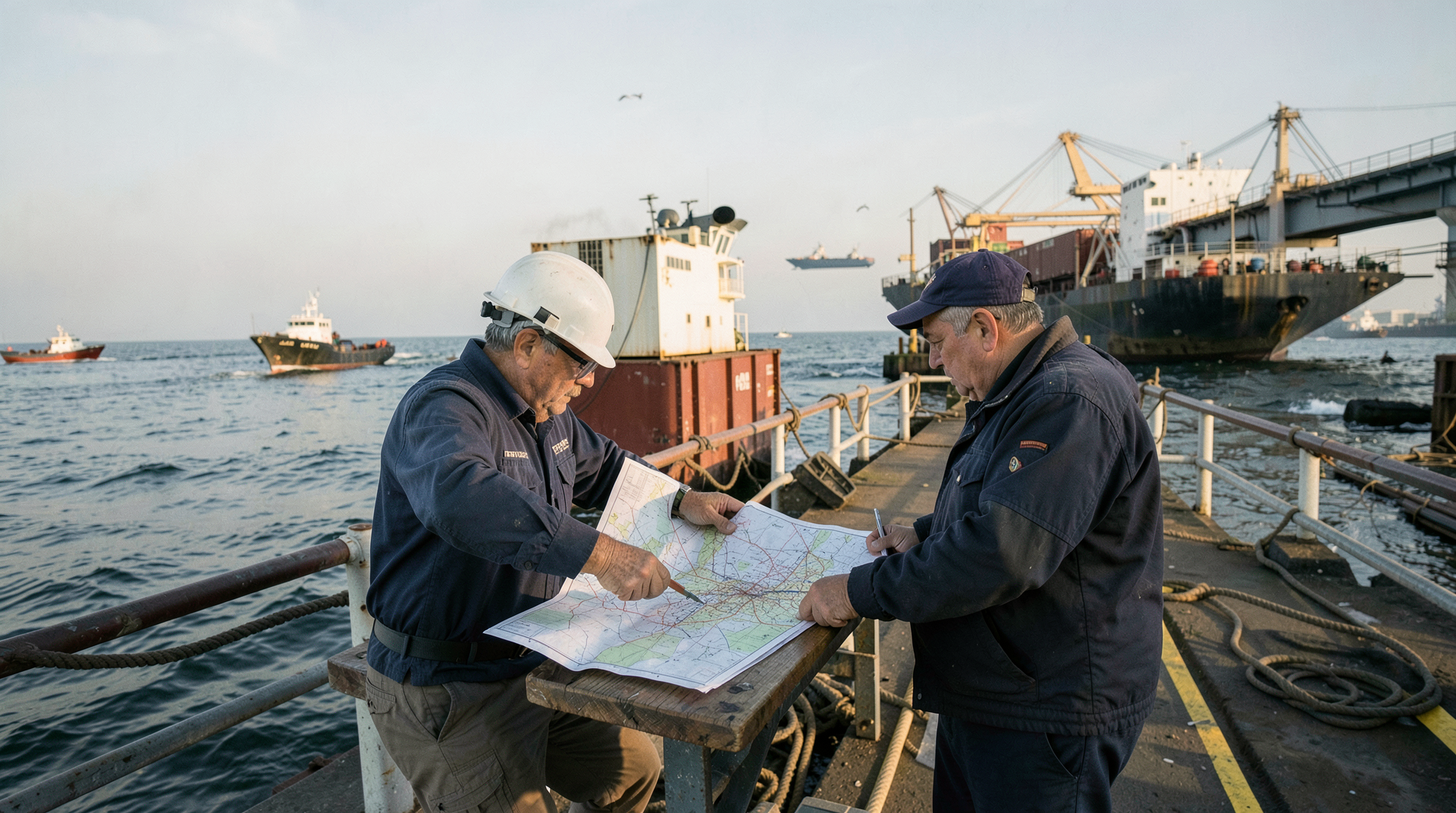
Hormuz is not reopened by an adjective. It is reopened by a document a shipowner, captain, insurer, bank and sanctions lawyer can all read without guessing. The BBC reported that a possible U.S.-Iran framework could allow unrestricted passage through the Strait of Hormuz and give Iran 30 days to remove mines from the narrow shipping passage. [1] That sounds like a breakthrough until it meets Thursday's paper, which said ships were moving while Iran left the protocol unpublished, and Trump rejected an Iran-Oman control plan in public. Friday's question is no longer whether diplomats can say open. It is whether the word can survive contact with mines, routing authority, fees, sanctions exposure and war-risk insurance.
Vice-President JD Vance told reporters the United States and Iran were "very close" but "not there yet." He said negotiators were going back and forth on language points, including enrichment. [1] Earlier, U.S. officials had told the BBC that the two sides had agreed to a framework pending approval by Trump and Iran's leadership; Iranian semi-official reporting said it had not been finalized or confirmed. [1] In ordinary diplomacy, that distinction is normal. In Hormuz, it is the difference between a tanker sailing and a tanker waiting.
The proposed framework, as described by the BBC, would reportedly extend the ceasefire for 60 days, launch talks on Iran's nuclear program, allow unrestricted Hormuz passage, give Iran 30 days to remove mines, lift the U.S. blockade and issue sanctions waivers so Iran could resume selling oil. [1] It is an enormous list. Its size is the warning. A phrase such as unrestricted passage has to absorb each item it touches: naval forces, mine clearance, traffic separation, port access, insurance, sanctions, fees and the authority of Iran, Oman and the United States.
Treasury has already made that authority legally dangerous. On May 27, OFAC added the Persian Gulf Strait Authority to the Specially Designated Nationals List, naming it as an Iran-based entity linked to the Islamic Revolutionary Guard Corps and carrying secondary sanctions risk. [2] The listing does not read like diplomatic atmosphere. It reads like a compliance trap. A shipowner can listen to the diplomatic optimism and still ask whether communicating with, paying, obeying, or supplying vessel information to the authority creates exposure.
China Daily's Xinhua account, citing the Treasury release, said the authority was overseeing shipping control in the Strait of Hormuz and that Treasury accused it of imposing illegitimate tolls on commercial traffic and forcing vessels to follow Iranian direction in return for safe passage. It also quoted Treasury's warning that anyone cooperating with the authority may face sanctions risk. [3] That is the operating contradiction. The same passage regime that diplomats may need to stabilize is now the same regime Washington is trying to criminalize.
The Treasury press release, styled as part of Economic Fury, described the authority as Iran's latest attempt to extort global maritime trade. [4] The rhetoric matters less than the mechanics. If Iran's safe-passage process requires a vessel to coordinate with the authority, and U.S. sanctions treat the authority as an IRGC-linked object, the open-passage promise is incomplete until the deal says exactly how ships avoid both Iranian coercion and U.S. penalties.
This is where X's harsher frame has a useful function. The platform will call the arrangement a toll, a shakedown, humiliation, or fake peace. That language can be crude, but it asks the commercial question faster than diplomatic prose does. If a vessel must obtain authorization, accept routing, disclose information, pay a fee, sail with escort, or wait while mines are removed, then openness is not an announcement. It is a procedure.
Mainstream coverage is more cautious and, in many respects, more responsible. The BBC distinguishes a framework from a finalized deal and notes that Trump had not immediately signed off. [1] It also reports that both countries contradicted each other's claims and offered few details. [1] That caution should not become anesthesia. A commercial sea lane is not safe because the article says officials are close. It is safe when the operating parties publish rules that reduce risk for actual vessels.
The insurance baseline remains brutal. CNBC reported in March that the benchmark rate for Very Large Crude Carriers hauling oil from the Middle East to China hit an all-time high of $423,736 per day after the conflict disrupted shipping, a jump of more than 94 percent from the prior Friday's close. It also reported that major marine war-risk providers had dropped cover for vessels operating in the Persian Gulf. [5] Those figures are older than Friday's framework talk, but they explain the test. Insurers do not price adjectives. They price hazards, documents, exclusions and claims.
CNBC quoted freight analyst Sheel Bhattacharjee saying charterers avoided securing vessels as threat levels rose around Hormuz, even while the waterway was not officially closed. He added that most shipowners were avoiding transits after insurers cancelled war-risk coverage in parts of the region. [5] That is the gap between diplomatic vocabulary and commercial behavior. A waterway can be not officially closed and still commercially unavailable to many vessels.
The same CNBC account said one-third of seaborne crude oil trade, 19 percent of global liquefied natural gas flows and 14 percent of refined products trade move through the Strait of Hormuz. [5] BBC puts the figure for oil and LNG normally passing through Hormuz at one-fifth of the world's total. [1] The exact category differs; the significance does not. Hormuz is where maritime law, energy prices, insurance and military power meet inside a few nautical miles.
The predecessor file explains why the paper is not satisfied by movement alone. On Wednesday, the article about 32 ships crossing Hormuz said vessels could move before the public rules existed. It treated movement as a market receipt, not a settlement. The fee/toll article made the same point from another angle: Iran could deny tolls while acknowledging fees tied to maritime safety and environmental monitoring, leaving shippers to ask what the invoice actually bought. Friday's framework talk does not close either question. It raises them to a higher level.
The Oman problem is still unsolved. The earlier BBC account of a purported draft said Iranian state media described management and routing of vessels by Iran and Oman; the White House called that draft a complete fabrication. [1] Trump's public rejection of control language may be politically useful, but commercial routing does not vanish because a president dislikes the word control. Somebody has to administer warnings, lanes, mine information, vessel queues and emergency messages. If the deal rejects Iranian or Omani control, it must say what replaces it.
Mine removal is the clearest example. A 30-day mine-removal period is not self-executing. It requires maps, verification, route notices, liability rules and a definition of who certifies a cleared passage. If Iran says a lane is clear, will U.S. commanders accept it? If U.S. commanders say a lane is unsafe, will Iran call that a blockade? If an insurer demands an independent notice, which institution supplies it? A shipper needs those answers before the first premium quote.
Sanctions waivers are no easier. BBC reports that the United States would issue sanction waivers to allow Iran to resume selling oil. [1] But the PGSA listing remains a separate object unless it is waived, licensed, narrowed, or bypassed. OFAC's notice names the authority itself. [2] A waiver for oil sales does not automatically solve a vessel's interaction with a sanctioned strait authority. That is why the document, not the mood, is the story.
There is also a political temptation to treat falling oil as proof of progress. The market can move on the headline because markets trade probability. Shipowners do not get to sail on probability alone. A captain entering Hormuz needs route guidance, threat advisories and emergency rules. A bank financing the cargo needs sanctions clarity. An insurer needs to know whether war-risk cover applies and at what price. A charterer needs delay, force majeure and cost allocation language. Each actor reads the deal through a different clause.
Diplomats are allowed to celebrate early. Newspapers should not. The record now contains a close-but-not-final BBC report, an OFAC designation of the authority that claims to manage the strait, Treasury rhetoric about extortion, China Daily's account of sanctions risk, and a prior insurance shock that showed how quickly Hormuz becomes expensive. [1] [2] [3] [4] [5] Put together, they say one thing: passage is not only a promise between capitals. It is a compliance product.
The useful protocol would be boring. It would define transit lanes, mine clearance, inspection authority, fee prohibitions or fee schedules, radio procedure, emergency escort, sanctions waivers, insurer recognition, Omani role, Iranian role, U.S. naval posture and dispute resolution. It would say whether the Persian Gulf Strait Authority is suspended, bypassed, licensed, or tolerated. It would tell ships whether they are dealing with a port-state process, a military deconfliction process, or an Iranian permission regime under another name.
Until such a text appears, the phrase unrestricted passage is an aspiration. It may be a sincere aspiration. It may even become reality. But the commercial world cannot load a tanker with sincerity. It needs the route, the rule and the risk allocation. Hormuz deal talk still has no usable protocol because the public record still contains more verbs than instructions.
-- DARA OSEI, London