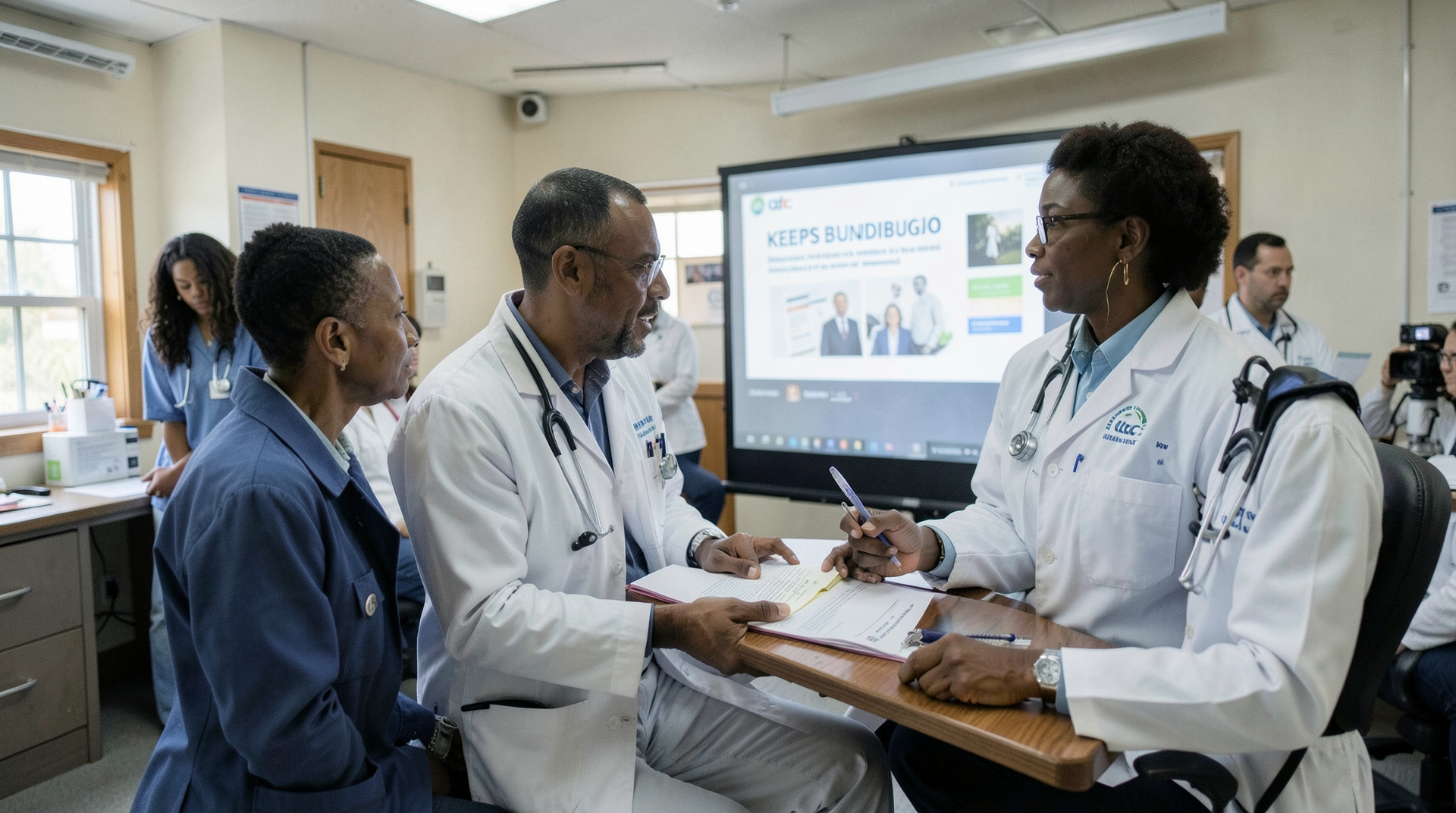
CDC Keeps Bundibugyo Screening In Clinician Hands follows Saturday's cdc turns ebola entry rules into a four airport service story by taking the next public health document literally. CDC's May 19 Health Alert Network advisory is addressed to clinicians, public health practitioners, laboratories, healthcare workers, and travelers. It says the outbreak in the Democratic Republic of the Congo and Uganda is caused by Bundibugyo virus, and it says the risk of spread to the United States was considered low at the time of the alert. [1]
The service conclusion starts there: low risk does not mean no instructions. CDC reports that DRC confirmed an outbreak in Ituri Province on May 15, with 246 suspected cases and 80 deaths reported as of May 16. Laboratory analysis by the National Institute of Biomedical Research confirmed Bundibugyo virus infection in eight of 13 samples from suspected clusters in the Mongbwalu and Rwampara health zones. The advisory names symptoms among patients, including fever, generalized body pain, weakness, vomiting, and in some cases bleeding, and says several patients reportedly deteriorated rapidly and died. [1]
CDC's clinician instructions are more useful than public panic because they define when suspicion should begin. The advisory says clinicians should systematically assess patients with compatible symptoms for exposure risk and possible viral hemorrhagic fevers through triage and travel history. It says Bundibugyo virus disease belongs in the differential diagnosis only when compatible symptoms are joined to epidemiological risk factors within 21 days before symptom onset. Those risks include direct contact with a symptomatic person with suspected or confirmed disease, a breach in infection prevention precautions, funeral exposure, healthcare or laboratory visits in an outbreak area, or contact with bats. [1]
That structure is the article's main correction to rumor. Fever alone is not the story. Travel alone is not the story. CDC tells clinicians to combine symptoms, exposure, timing, and travel history, while still considering more common diagnoses such as malaria, COVID-19, influenza, or other causes of gastrointestinal and febrile illness. It explicitly says a history of being in DRC or Uganda during the past 21 days should not be a reason to defer routine laboratory testing or other measures necessary for standard patient care. That is a practical instruction, not a headline built to frighten. [1]
The isolation rule is equally specific. CDC says patients who have both an exposure risk and compatible symptoms should be immediately isolated and hospitalized until they receive a negative Bundibugyo test on a specimen collected at least 72 hours after symptom onset. If a specimen collected earlier than 72 hours is negative, CDC says the patient should remain isolated and receive another test on a new specimen taken at least 72 hours after symptom onset. It also says not to delay Bundibugyo diagnostic testing while waiting for other diagnostic tests. [1]
WHO's May 17 statement explains why the outbreak drew international attention without justifying indiscriminate travel restrictions. WHO determined that Ebola disease caused by Bundibugyo virus in DRC and Uganda constituted a public health emergency of international concern, but did not meet the criteria of a pandemic emergency. As of May 16, WHO listed eight laboratory-confirmed DRC cases, 246 suspected cases, and 80 suspected deaths in Ituri Province, plus two laboratory-confirmed cases in Kampala, Uganda, including one death, among two people traveling from DRC. It also noted that a reported Kinshasa case had tested negative on confirmatory testing and was not considered confirmed. [2]
WHO's reasons are not vague. It cited unusual clusters of community deaths, suspected cases across Ituri and North Kivu, at least four deaths among healthcare workers in a clinical context suggestive of viral hemorrhagic fever, uncertainty about the true number of infected people and geographic spread, insecurity, humanitarian crisis, high population mobility, urban or semi-urban hotspots, informal healthcare facilities, and the lack of approved Bundibugyo-specific therapeutics or vaccines. That list supports seriousness. It does not support claiming that ordinary U.S. readers face high current risk. [2]
The travel advice is where public health discipline becomes visible. WHO says no country should close its borders or restrict travel and trade, calling such measures fear-driven, scientifically unsupported, and potentially harmful because they push movement to unmonitored informal crossings and can compromise response operations. WHO also says entry screening at airports or other ports of entry outside the affected region is not considered needed for passengers returning from areas at risk. That directly supports the headline's point: screening and judgment remain in the hands of health systems and clinicians, not broad border theater. [2]
CDC's vaccine and treatment language also narrows what readers should believe. The U.S.-licensed Ebola vaccine ERVEBO is indicated for Ebola disease due to Zaire ebolavirus only, and CDC says animal studies suggest it is not expected to protect against Bundibugyo virus or other orthoebolaviruses. CDC says there is currently no FDA-approved or authorized treatment for Bundibugyo virus disease, though some therapies have shown efficacy in animal models, and that intense supportive care and fluid replacement may lower mortality. The article should not imply a ready vaccine solution where the advisory says there is none. [1]
The FDA recall page belongs in this service story only as a household-practice analogy, not as Ebola evidence. FDA's page lists recalls, market withdrawals, and safety alerts from public notices for FDA-regulated products, warns that not all recalls have press releases or appear on that page, and shows recent entries such as Dexcom G7 sensors identified as scrap and diverted for sale, dietary supplements with undeclared kratom compounds, fruit popsicles with undeclared milk, nuts, and dyes, and products with possible Salmonella or Listeria contamination. [3]
The reason to cite FDA is not to confuse a product recall list with an outbreak bulletin. It is to keep the reader in the habit of checking official notices rather than forwarding claims. For a recall, the action may be to check a brand, product description, company, reason, and date. For Bundibugyo, the action is different: know symptoms, know exposure history, call a health department when disease is suspected, isolate the right patients, protect healthcare workers, and avoid inventing travel bans that WHO does not recommend. The sources are different, but the public-service rule is the same: act on the document, not on the panic. [1] [2] [3]
The article's narrow conclusion is therefore supportable. CDC reports a serious Bundibugyo outbreak in DRC and Uganda and gives U.S. clinicians a triage, testing, isolation, and notification pathway. WHO calls the event a public health emergency of international concern while rejecting broad border closures and outside-region entry screening. FDA's recall page shows how official safety notices organize reader action in another domain. None of those sources supports saying Bundibugyo is airborne, that U.S. spread is likely, that ERVEBO protects against Bundibugyo, or that ordinary airport closures are recommended. [1] [2] [3]
The next question for readers is concrete and modest: whether CDC or WHO updates the case numbers, expands travel notices, changes the risk assessment, or identifies additional confirmed spread. Until then, the useful response is not theatrical certainty. It is clinician-led screening, travel-history discipline, symptom-and-exposure matching, and attention to official notice pages that say exactly what they know and what they do not. [1] [2]
The service claim stays with clinicians because CDC and WHO place the first response work there. [1] [2]
-- NORA WHITFIELD, Chicago