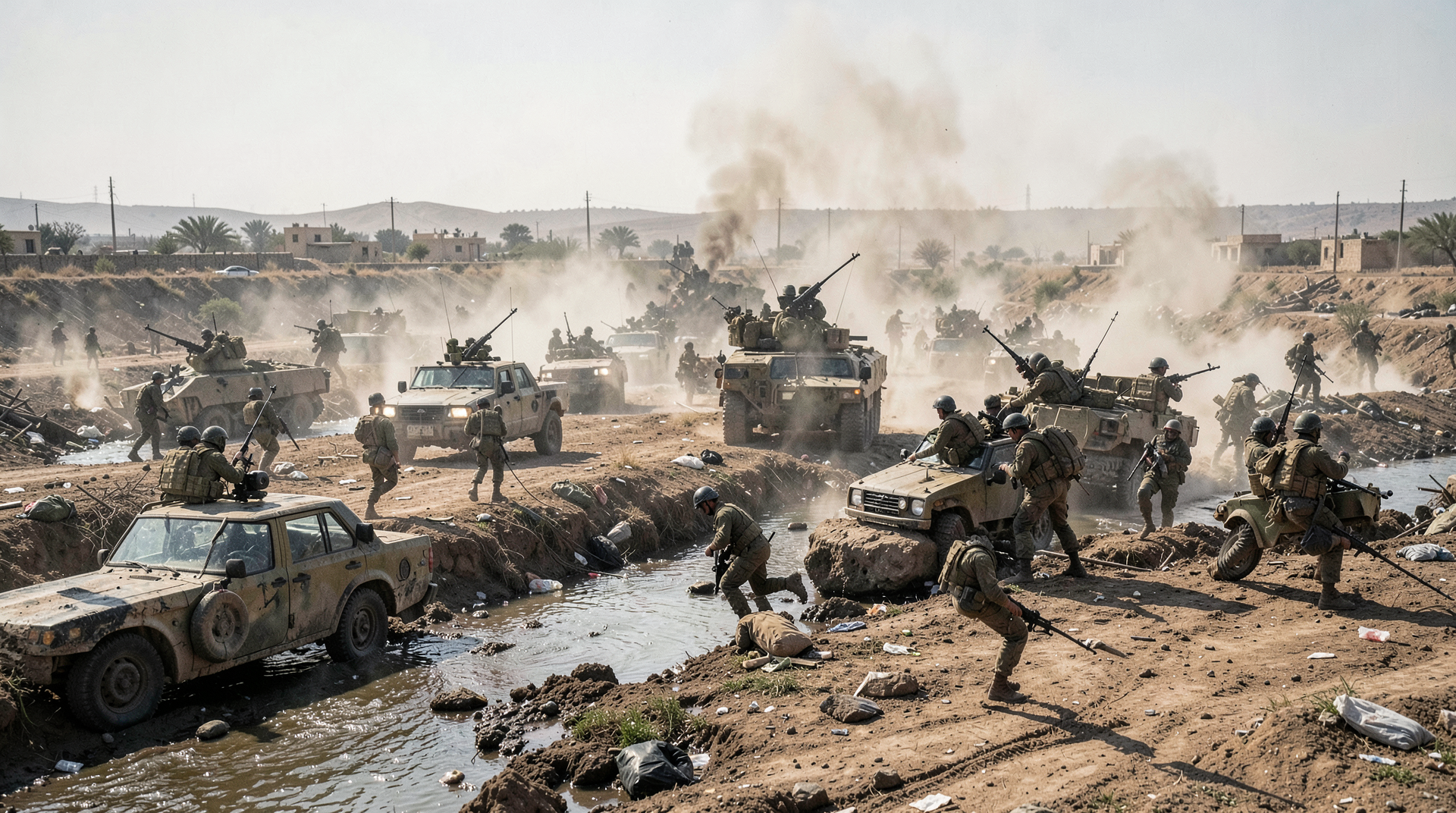
IDF Advances North Of Litani While Deal Text Lags follows Saturday's lebanon is now in the iran deal room with a map rather than a mood. The prior article's claim was that Lebanon had stopped being a side theatre in the Iran diplomacy story. Sunday's ABC record supports the narrower version of that claim: the Israel Defense Forces said troops in southern Lebanon crossed north of the Litani River, secured Beaufort Ridge, and were operating near Nabatieh while U.S.-Iran talks still lacked a completed settlement. [1]
ABC's live file puts the two lanes on the same page. At 6:54 a.m., it carried Mohammad Bagher Ghalibaf's statement, via IRNA, that Tehran does not trust the enemy's words and promises and will not approve any agreement until it is sure the rights of the Iranian people have been secured. At 4:21 a.m., it carried the IDF's Lebanon update: troops crossed the Litani, expanded strikes on Hezbollah north of the river, and were prepared to expand the attack as required. That timing does not prove coordination between the two developments. It does prove that readers following the public record cannot separate negotiation language from battlefield movement. [1]
The Litani matters because it is a line with a diplomatic history, not just a river on a locator map. This article does not need to restate that history beyond what the cited sources show. It can say that Sunday's ABC item treated the crossing as newsworthy in its own right, that the IDF identified Beaufort Ridge as secured, and that the operation was described as near Nabatieh, a city the IDF called a significant Hezbollah power center in southern Lebanon. The claim supported by the source is operational: Israel said the campaign was expanding north of the river while the peace-talk file remained unresolved. [1]
ABC also records how Israeli officials framed the move. Defense Minister Israel Katz said the advance came at Prime Minister Benjamin Netanyahu's direction and wrote that the campaign was not over, adding that the mission was to crush Hezbollah's power and ensure security for residents of the North. The IDF spokesperson Avichay Adraee issued an evacuation order for southern Lebanon, particularly for residents south of the Zahleh River. Those facts do not support a prediction about how far Israel will go. They do support the headline's core claim that the military text on Sunday was stronger than the diplomatic text. [1]
The civilian record is part of the same constraint. ABC reports the Lebanon Health Ministry's figure of 3,371 killed and 10,129 wounded by Israeli strikes since March 2, and it quotes Lebanese Prime Minister Nawaf Salam accusing Israel of a scorched-earth policy and collective punishment. This paper should not turn those accusations into adjudicated legal findings. It should keep them as reported claims inside the source record, because they show why the Lebanon front cannot be treated as a footnote to Iran talks. A deal that speaks only in Washington and Tehran terms still has to coexist with Lebanese casualty claims, evacuation notices, and active strikes. [1]
Times of Israel's May 31 liveblog shows the Israeli news environment receiving the same event as a broader escalation. Its page lists a UN Security Council meeting on Israel's Lebanon operation after a French request, two Hezbollah rockets fired at a border community and shot down, IDF strikes on Hezbollah arms depots and command centers in southern Lebanon, and articles on schools and nature parks in the north being shut amid Hezbollah fire. It also points to the Beaufort Castle story and the killing of Staff Sgt. Michael Tyukin in a Hezbollah drone strike. [2]
That source stack lets the article say something precise: the Lebanon story is no longer only about whether Hezbollah remains capable of firing, or whether Israel remains capable of striking. It is about the daily administrative and military consequences of both. Schools and nature parks close. Air-defense systems intercept rockets. IDF statements name command centers and arms depots. The UN Security Council schedules a meeting. The public record is not the same as battlefield omniscience, but it is enough to show that the northern front is producing diplomatic, civilian, and military facts faster than any Iran deal text has been published. [2]
Times of Israel also keeps Iran's own military infrastructure in the same live file. The May 31 page's headline says Iran has reopened most entrances to 18 underground missile sites struck in the war, citing a CNN report that the regime has dug out buried arsenals and is poised to fire long-range missiles again. This article should not convert that into a direct claim about missile readiness beyond the cited report's framing. The supportable point is narrower: Israeli-facing coverage treated Iranian missile-site recovery as a live matter on the same day it tracked Lebanon operations. [2]
The May 30 Times of Israel live file, reflected in the cited page description, shows that the Sunday advance followed a weekend of northern closures and repeated Hezbollah rocket and drone attacks during Shabbat. It also carried the separate U.S. defense-policy frame, with Hegseth saying he believed Iranians would give up nuclear ambitions over time. That combination matters because it shows the time lag in the public narrative. American officials can speak in terms of eventual Iranian choices while Israeli and Lebanese actors are posting immediate claims about schools, rockets, drones, strikes, and evacuations. [3]
None of these sources proves that Lebanon is formally inside a U.S.-Iran negotiation document. None proves that Ghalibaf's rights condition was written in response to Beaufort Ridge. None proves that a final deal is impossible. The clean claim is smaller and stronger: ABC and Times of Israel both place unresolved Iran diplomacy beside active Israel-Hezbollah operations; ABC names the crossing north of the Litani and the approach to Nabatieh; Times of Israel tracks Beaufort, Hezbollah fire, northern closures, UN attention, and reports on reopened Iranian missile-site entrances. [1] [2] [3]
The practical reading is that the map is now disciplining the rhetoric. If Washington or Tehran says a deal is close, the reader needs to ask what that means for the blockade, for Iranian missile infrastructure, for Hezbollah's fire, and for Israel's stated mission in southern Lebanon. If Israel says the northern operation is expanding, the reader needs to ask whether that expansion hardens Tehran's public rights condition or remains outside the talks. Sunday's sources do not answer those questions. They make them unavoidable. [1] [2]
The article therefore leaves Monday with a testable list, not a prophecy. Look for a draft text, an Iranian institutional response, an Israeli statement on the Litani operation's scope, a Lebanese or UN response to the southern evacuation and strikes, and any confirmation or denial of the Iranian missile-site reopening report. If those do not arrive, the responsible conclusion remains limited: the IDF's public movement north of the Litani is better documented than the diplomatic endgame it is supposed to fit inside. [1] [2] [3]
The source discipline also protects the article from a tempting overstatement. ABC says an April ceasefire between Israeli and Lebanese leaders existed while the Israeli offensive and airstrike campaign continued, and Times of Israel tracks the resulting Israeli, Hezbollah, and UN-facing updates. That supports a claim about lag between formal ceasefire language and daily military practice. It does not support saying the ceasefire is meaningless, dead, or universally rejected. The published record is more useful when it stays at that level of proof. [1] [2]
-- YOSEF STERN, Jerusalem