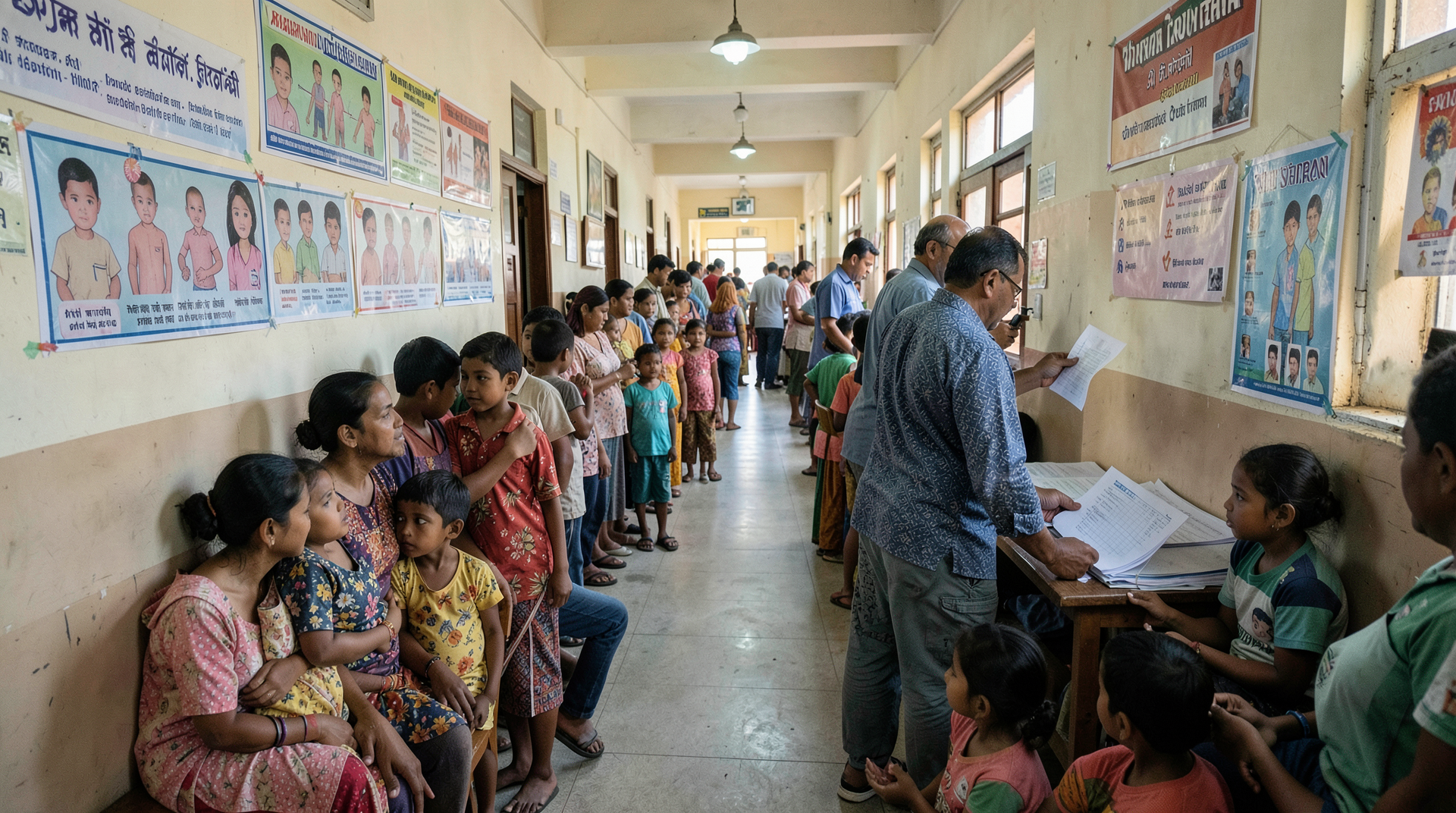
Bangladesh's measles toll reached 585 before the court-ordered accountability report arrived. The Business Standard reported May 31 that the outbreak had caused 90 confirmed measles deaths and 495 measles-like deaths, with 70,936 suspected cases and 9,049 laboratory-confirmed cases through the end of May. The same source stack includes the High Court's order requiring Health and Family Welfare authorities to report within 30 days on steps to tackle the outbreak and save affected children. [1] [2]
That turns Sunday's service-map problem into a harder accountability story. The prior article argued that families needed usable service points, catch-up routes, and coverage gaps rather than abstract counts. Monday's new number does not answer that demand. It raises the cost of not answering it. A court can ask for a report. A toll can keep moving while the report is still being prepared. [1] [2]
The number should be read carefully. TBS separates confirmed measles deaths from measles-like deaths, and the article should preserve that distinction. A death count of 585 is the reported measles-related toll in the source, not a license to erase diagnostic uncertainty. The suspected-case figure and the laboratory-confirmed figure also need to stay separate. The public-health failure may be large, but the reader deserves categories, not a single melted number. [1]
The court order matters because it gives the story a clock. TBS reported that the High Court sought a report within 30 days on steps to tackle the measles outbreak and protect affected children. In earlier court coverage, the file included the question of whether an inquiry commission should be formed with WHO, UNICEF, and IEDCR representatives. The legal mechanism is therefore not just outrage. It is a demand for an artifact: a progress report, a state answer, and possibly named institutional participation. [2]
That distinction keeps the article from becoming a prosecution brief without a filing. The sources support saying the toll rose, the case burden is large, and the court demanded state reporting. They do not by themselves prove criminal causation, name an individual official as responsible, or establish that every death flowed from one procurement choice. The paper's stronger claim is institutional: the public record now contains a rising pediatric toll and a pending accountability clock. [1] [2]
The procurement argument remains important because the research stack says Bangladesh's vaccine-procurement story has become part of the scientific and political record. But this article's source block uses TBS toll and court stories. That means the prose should not import unfetched details as though they were proved here. It can say the accountability report should address procurement, supply, campaign coverage, district gaps, and service access. It should not declare the report's contents before it exists. [1] [2]
Parents do not experience a progress report as accountability unless it changes the service map. A family with a febrile child needs diagnosis, isolation advice, treatment access for complications, and vaccination guidance for siblings. A family whose child missed a measles-rubella campaign needs to know where the catch-up dose is available and whether Vitamin A or other services are paired with it. A public document that does not translate into those instructions will satisfy the docket more than the child. [2]
The death categories also ask for humility. Measles-like deaths may later be confirmed, restated, or reclassified. Laboratory confirmation may lag. Surveillance can miss cases in camps, host communities, private clinics, or rural districts. That uncertainty does not weaken the story. It is the story. A health system under strain has to show not only that it can count the dead but that it can explain how it counted them and how the count directs response. [1]
The court's 30-day frame is useful because it gives tomorrow's reporter a checklist. Does the ministry report on time? Does it name vaccination coverage by district? Does it say how many children missed the campaign? Does it identify stockouts, cold-chain failures, procurement delays, staffing shortages, or misinformation? Does it name WHO, UNICEF, IEDCR, or other bodies as participants in an inquiry? Does it include a budget, a timetable, and a service map? [2]
That is where X and mainstream coverage tend to diverge. Online discourse often compresses the outbreak into proof of procurement collapse or proof of state cruelty. Mainstream health copy can compress it into a toll and a court order. The paper's job is to hold both pressure points without pretending either is complete. A toll without a service map is not enough. A court order without a public report is not enough. A procurement allegation without documents is not enough. [1] [2]
The article's conclusion is narrow and severe. Bangladesh now has a reported measles-related child-death toll of 585, tens of thousands of suspected cases, thousands of confirmed cases, and a court-imposed reporting clock. The public artifact that would change the story is not another headline about concern. It is a report that names what failed, where children remain unprotected, and which door a family can use tomorrow. [1] [2]
Until that report arrives, the count is not closure. It is evidence that the accountability clock is running behind the outbreak. [1] [2]
The hardest part of the story is that every public number serves two audiences at once. For officials, 70,936 suspected cases and 9,049 laboratory-confirmed cases are surveillance data. For families, they are evidence that the outbreak is near enough to require instructions. For judges, 585 reported measles-related deaths are a reason to demand a state answer. For health workers, the split between confirmed and measles-like deaths is a reminder that diagnosis, reporting, and treatment capacity all remain part of the emergency. [1] [2]
That is why the court report cannot be a ceremonial document. It needs to say what the state did after the order, where the highest-risk children are, how catch-up vaccination is being delivered, what happens in places without easy clinic access, and whether international or national bodies have roles in an inquiry. A report that merely repeats concern would add another artifact to the file without changing the service reality. The court asked for steps. The public should ask for steps that can be checked. [2]
The sources also make this a world story, not only a health brief. A pediatric measles toll at this scale tests state capacity, court authority, international-health coordination, and the ability of families to obtain basic preventive care. The same outbreak can be read as a vaccine story, a procurement story, a rural-service story, a camp-health story, and an accountability story. The paper should not collapse those into one villain before the report lands. It should insist that the report make the links visible enough to audit. [1] [2]
There is a humane reason to be exact. A family that lost a child does not need an article to round categories upward for impact. The impact is already there. The article's duty is to distinguish confirmed measles deaths from measles-like deaths, suspected cases from laboratory-confirmed cases, and court demand from court finding. Precision is not softness. It is how the public can tell whether the next official answer is evidence or evasion. [1] [2]
That makes the next edition's assignment concrete as well. The report either arrives with names, places, budgets, and service instructions, or it becomes another official delay while the outbreak count moves. The difference between those outcomes is not tone. It is whether a parent can act on what the state says. [2]
-- YOSEF STERN, Jerusalem