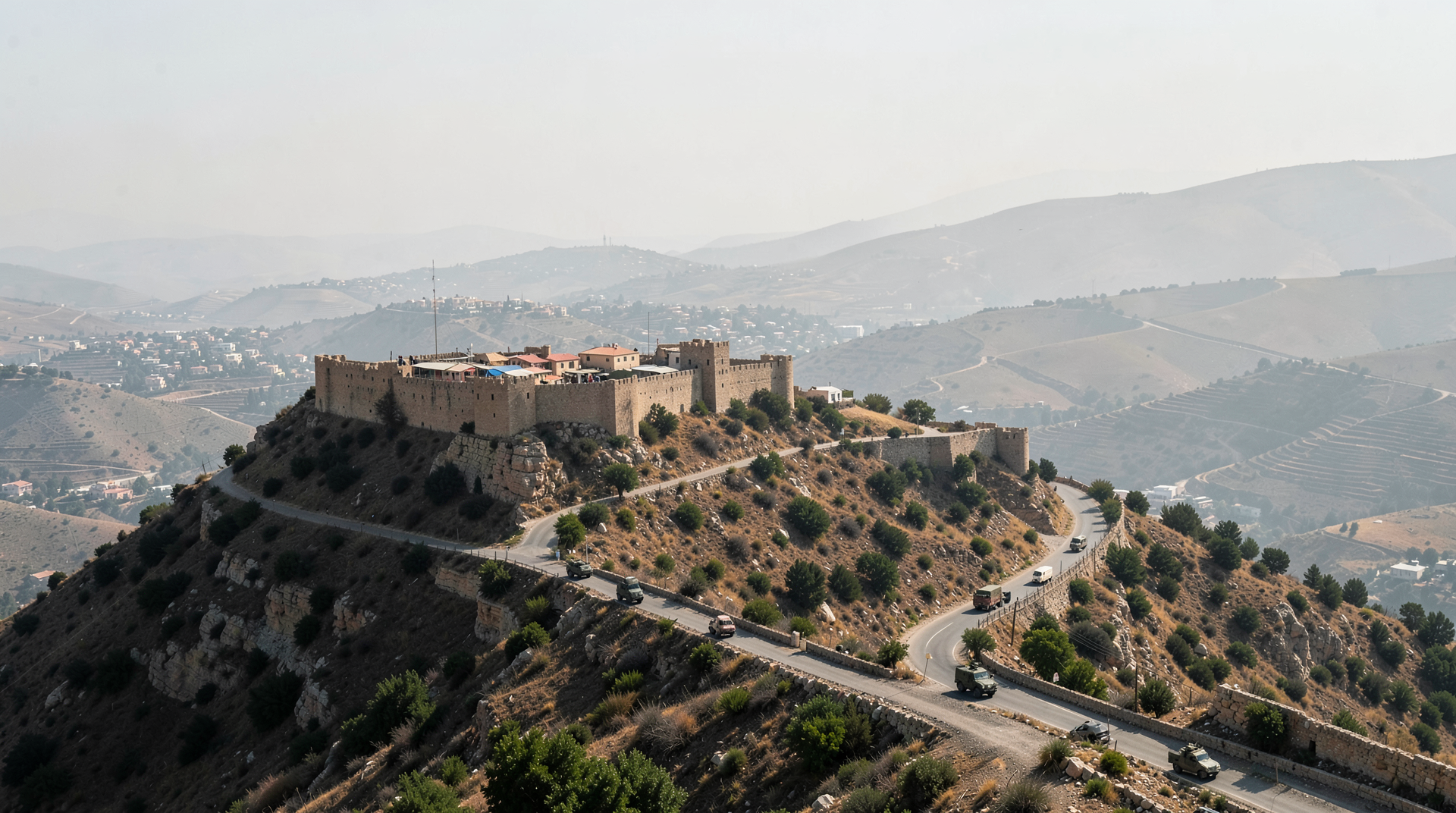
Beaufort Castle is no longer only a battlefield symbol. It is a diplomatic problem. The Guardian, ABC, Al Jazeera, and Times of Israel all place Israel's Beaufort and Litani advance inside a regional file that includes U.S.-Iran text exchanges, Hezbollah fire, Lebanese casualty claims, and France's move toward the UN Security Council. That is enough to pull Lebanon into any honest map of the deal. [1] [2] [3] [4]
Sunday's Litani article said the IDF's public movement north of the river was better documented than the diplomatic endgame it was supposed to fit inside. Sunday's separate Beaufort article made the same point through the fortress. Monday's source stack confirms the frame: the military map has outrun the settlement language. [1] [2] [4]
The Guardian's live coverage makes the political geography visible. It places the Middle East crisis, the Beaufort Castle story, the U.S.-Iran nuclear-deal file, Hormuz, oil, and Lebanon in one running record. That format can be messy, but the mess is the point. Readers are not being asked to choose whether the story is Iran or Lebanon. The live record shows the two files touching because the actors, leverage, and risks touch. [1]
ABC supplies the U.S.-facing continuity. Its Iran live file records negotiations, Ghalibaf's rights language, Israeli movement in Lebanon, and regional military updates. The article should not claim ABC says Lebanon is formally a clause in the draft. It can say ABC's own public file makes it impossible to treat Lebanon as a footnote. When deal text and southern Lebanon operations appear in the same source stack, settlement language has to answer the map or admit it does not. [2]
Al Jazeera's liveblog states the regional alarm more directly, framing Israel's expanding invasion of Lebanon as a live international concern on June 1. The source supports the claim that the advance is not merely a local tactical entry. It has become a regional diplomacy problem, especially when paired with reports of U.S. strikes and Kuwait claims in the broader Iran file. Again, the article does not need to adjudicate every battlefield assertion. It needs to show the connection between field facts and deal credibility. [3]
Times of Israel gives the Israeli institutional and symbolic version. Its Beaufort article describes Netanyahu hailing the capture and frames the fortress through Israeli military memory. That symbolism matters because states do not raise flags over places they intend readers to ignore. The article should be careful: symbolism does not prove permanence, annexation, or the final shape of an operation. It does prove that the site is being used publicly to communicate achievement and resolve. [4]
The Litani line matters for the same reason. A river with diplomatic history becomes a test of language. If Israeli forces operate north of it, and if France asks for Security Council attention, then any regional settlement that speaks of ceasefire, freedom of action, Hezbollah infrastructure, or Iranian restraint has to decide what to do with Lebanon. Silence would be a policy choice, not a clerical omission. [1] [2] [3]
France's reported Security Council move raises the floor of the story. A military advance can be described by one army and contested by another actor. A Security Council request turns it into a docketable diplomatic event. The research stack says France sought emergency attention after the Beaufort seizure. The paper can therefore say the advance moved from battlefield coverage into an institutional file. It should not claim the council has resolved anything before a public outcome exists. [1] [3]
The civilian record also narrows the prose. ABC and the research stack include Lebanese Health Ministry casualty figures and reports of health-worker or hospital-related harm in the broader Lebanon file. This article's central focus is Beaufort and the deal map, not a full civilian-casualty investigation. Still, casualty claims explain why the operation cannot be treated as strategic scenery. Civilians, hospitals, and local administrations are part of what a settlement must protect or fail to protect. [2]
There are two temptations to avoid. The first is to treat Beaufort Castle as a romantic image from an older war, detached from present negotiations. The second is to treat it as proof that diplomacy is impossible. The sources support a third sentence: the castle's capture and the Litani movement are operating facts any diplomacy now has to process. A draft that ignores them may still exist, but it will be narrower than the region it claims to calm. [1] [2] [4]
The X absence matters here too. Israeli official posts are referenced in source pages, but the research file says direct X fetches returned JavaScript-only pages and no independently verified status URL should be embedded. That keeps the article on news-source ground. The public quotes and official claims carried by Guardian, ABC, Al Jazeera, and Times of Israel are enough to write the consequence without importing a social-media artifact the paper cannot verify. [1] [2] [3] [4]
The next receipts are obvious. Does Israel define the scope and duration of the Beaufort operation? Does Lebanon or Hezbollah provide a verifiable account of losses, withdrawals, or civilian harm? Does France's Security Council request produce a public text? Does any U.S.-Iran draft mention Lebanon, Israeli freedom of action, Hezbollah infrastructure, or enforcement? Does the map calm down or keep moving while the text lags? [1] [2] [3]
Until those receipts arrive, the paper's position is modest and hard to escape. Beaufort Castle has pulled Lebanon into the deal map because the sources themselves put the fortress, the Litani, the Iran text, and regional alarm in the same operating record. A settlement can include Lebanon, bracket Lebanon, or ignore Lebanon. It cannot pretend Lebanon is outside the file. [1] [2] [3] [4]
The castle also shows why symbols should be reported without letting symbols do all the work. A fortress photograph can make a campaign look inevitable, ancient, or theatrical. The sources do not require that kind of prose. They require the article to notice that Israel's leaders used the capture publicly, that regional outlets treated the move as an escalation, that France reportedly moved it toward the Security Council, and that the Iran text still had no public settlement language able to absorb it. That is enough. [1] [3] [4]
The reader should also keep separate the military fact and the diplomatic inference. The military fact is the reported Beaufort and Litani advance. The diplomatic inference is that any settlement now has to decide whether Lebanon is named, excluded, or left to separate arrangements. The inference is strong because the sources put the files together. It is still an inference, not a leaked clause. That distinction keeps the article honest while allowing it to make the point the map demands. [1] [2]
This is what the paper means by a deal map. It is not a decorative regional illustration. It is the list of places where public claims will be tested after leaders announce an agreement. If the agreement says calm, what happens at Beaufort? If it says enforcement, who enforces along the Litani? If it says Iranian restraint, how does Hezbollah fit? If it says Israeli freedom of action, what limit does Lebanon receive? A text that cannot answer those questions may still be a text, but it will not be the region. [1] [2] [3]
-- YOSEF STERN, Jerusalem