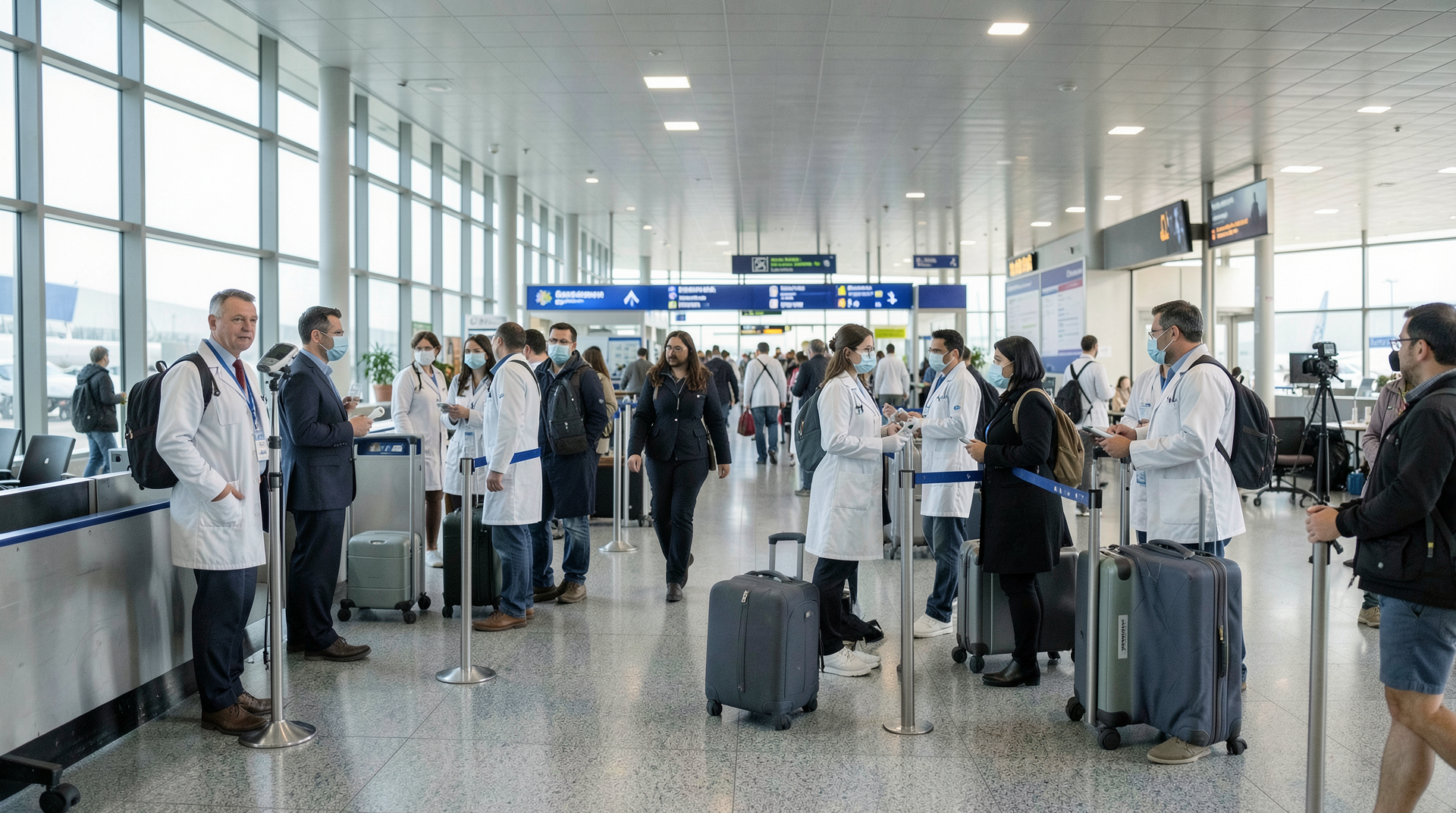
CDC has turned Bundibugyo from a frightening word into a travel procedure. Its returning-travelers page says travelers from the Democratic Republic of the Congo, Uganda, and South Sudan are routed through four U.S. airports, screened, and monitored for symptoms for 21 days. Its emergency guidance keeps public-health officials and clinicians focused on exposure history, compatible symptoms, isolation, testing, and public-health notification. WHO's outbreak notice supplies the international count and the response context. [1] [2] [3]
That is the practical sequel to Sunday's clinician-handled screening story. The prior article said the response should stay in service language, not panic language. Monday's CDC traveler page makes the service language visible at the airport: four routes, a screening encounter, follow-up, and a 21-day symptom window. [1]
The 21 days matter because Ebola disease is not managed by mood. It is managed by exposure, time, and symptoms. CDC's traveler page gives returning travelers a monitoring period and a communication channel rather than telling the public to fear every person in a terminal. The page also describes rerouting mechanics for affected travelers. That is more useful than a viral post because it tells a reader what the system is actually doing. [1]
The four-airport detail is not border theater by itself. It is a way to concentrate screening and follow-up where staff and systems can manage them. The paper should not claim screening can catch every incubating infection before symptoms. It cannot. The value is that the traveler is identified, instructed, and followed during the period when symptoms could appear. In public health, a imperfect process with names and dates is better than a perfect fear with no instructions. [1]
CDC's emergency guidance keeps the clinical threshold narrow. It says healthcare providers should consider Bundibugyo virus disease when compatible symptoms appear with relevant epidemiologic risk within the correct time window. It does not say fever anywhere equals Ebola. It does not say travel alone equals Ebola. It says symptoms, timing, exposure, triage, isolation, testing, and reporting belong together. That is why the article keeps the word "screening" attached to clinicians and public-health workers, not crowdsourced suspicion. [2]
WHO supplies the scale without turning the reader into a diagnostician. The research stack says WHO's May 21 count included 746 suspected DRC cases, 176 suspected deaths, 85 confirmed cases across DRC and Uganda, and 10 confirmed deaths. It also says insecurity and low contact follow-up complicated the response. Those figures support seriousness. They do not support telling ordinary U.S. readers that casual airport contact is the central risk. [3]
The absence of an approved Bundibugyo-specific vaccine or treatment is part of the service story. CDC guidance and WHO updates continue to emphasize supportive care, isolation, testing, contact tracing, and infection prevention rather than a simple pharmaceutical answer. That can sound unsatisfying. It is still the accurate instruction. Public health often works by doing slow things correctly before a simple cure exists. [2] [3]
The article should also separate Bundibugyo from Zaire ebolavirus. The U.S.-licensed vaccine used for Zaire ebolavirus disease should not be casually imported into this story as though it solves the current outbreak. CDC's guidance in the research file says Bundibugyo lacks approved tools in the way readers might expect from older Ebola coverage. That distinction prevents false reassurance and false panic at the same time. [2]
The X frame will be tempting. Four airports can become proof of a secret border crisis. A 21-day window can become proof that every traveler is dangerous. The opposite frame can be equally careless, reducing the disease to bureaucratic overreaction because the U.S. risk is low. CDC and WHO support neither. They support monitored travel, symptom discipline, healthcare preparedness, and contact follow-up where the outbreak is occurring. [1] [2] [3]
For travelers, the useful instruction is concrete. Know whether your travel route is covered. Pay attention to CDC instructions at arrival. Monitor for symptoms for 21 days. Seek care and call ahead if symptoms develop. Tell clinicians about travel and exposure history. Do not assume that sitting near someone briefly in an airport is the same as contact with bodily fluids or a symptomatic patient. The source stack makes that distinction the public service. [1] [2]
For clinicians, the useful instruction is different. Take travel histories. Ask about exposure. Isolate the right patients. Test on the right timeline. Notify public-health authorities. Continue to evaluate common causes of fever and gastrointestinal illness. A serious outbreak does not make malaria, influenza, COVID-19, or other diagnoses disappear. CDC's guidance is designed to keep suspicion high enough to catch cases and narrow enough to avoid bad medicine. [2]
Monday's conclusion is therefore practical and calm. CDC has kept Bundibugyo inside a four-airport and 21-day traveler process while WHO keeps the international outbreak record visible. The story is not that the public should panic in terminals. It is that a dangerous disease is being handled through screening windows, symptom monitoring, clinician judgment, and official follow-up. [1] [2] [3]
The four-airport system also gives editors a way to avoid two familiar errors. One error is theatrical alarm: photographs of airports, ominous verbs, and no instructions. The other is dismissive reassurance: low risk, therefore no story. CDC's page shows the middle path. A low-risk event for the United States can still require routing, screening, text-message follow-up, and a monitoring window. Public health often lives in that middle path, where the work is real even when the danger is not broadly distributed. [1]
WHO's count keeps the U.S. service story connected to the outbreak itself. Screening at American airports is only the far end of a chain that begins with suspected and confirmed cases, contact tracing, health-worker protection, laboratory capacity, and insecurity in affected areas. If contact follow-up is weak where the outbreak is active, then travel monitoring abroad becomes more important, not because travelers are guilty, but because systems have to catch information where they can. [3]
The 21-day window should also change the way readers think about uncertainty. A traveler can feel well at arrival and still need monitoring. A clinician can have an initial negative test too early and still need to repeat testing according to guidance. A community can have low current risk and still need preparedness. None of those sentences contradicts the others. They are how incubation-period diseases are managed without pretending the future is already known. [1] [2]
The article's service value is modest by design. It does not tell readers to diagnose strangers. It does not tell airports to close. It does not sell a miracle intervention. It tells travelers to follow CDC instructions, tells clinicians to combine symptoms with exposure history, and tells everyone else that official guidance is more useful than viral improvisation. In an outbreak, that restraint is not boring. It is care. [1] [2] [3]
The next update should be judged by the same standard. If CDC changes the airport routing, it should say who is affected and how. If WHO changes the count, it should preserve suspected and confirmed categories. If clinicians get new testing or treatment guidance, the article should translate the instruction without expanding it beyond the document. The screening window is useful because it is bounded; the journalism should be bounded too. [1] [2] [3]
-- NORA WHITFIELD, Chicago