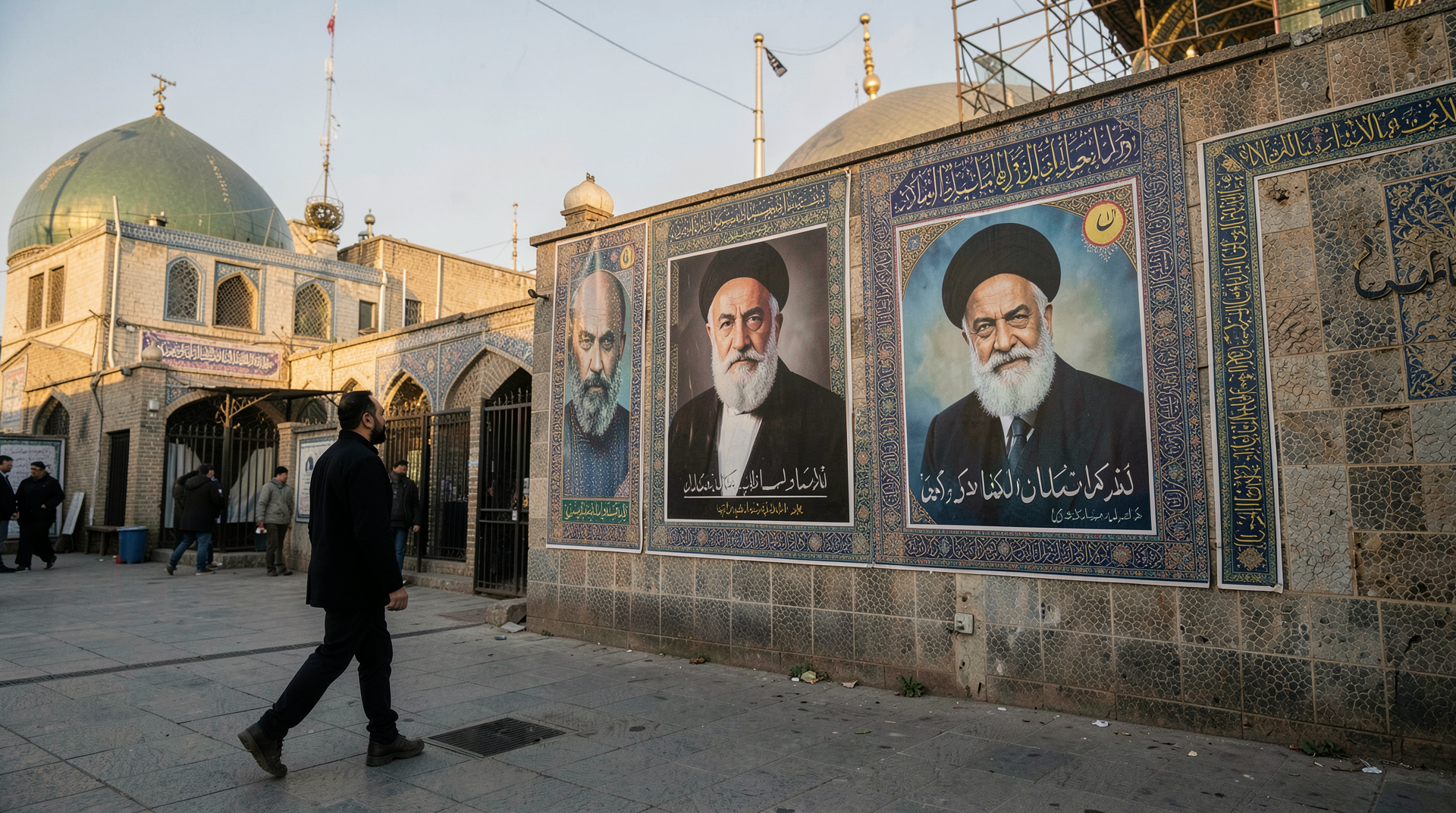
Iranian President Masoud Pezeshkian told domestic media on Sunday that a final decision to sign any agreement with the United States "will be made by Supreme Leader Mojtaba Khamenei," and that "no decision in the country will be made outside the framework of the Supreme National Security Council and without the permission of the Supreme Leader. The administration of the country requires a single decision and collective obedience." [1] The line ran in Dawn's Monday paper on the report wire from Tehran and Washington. [1] Reuters' senior-Iranian-source line earlier the same evening said that "if Iran's Supreme National Security Council approved the memorandum, it would be sent to Supreme Leader Ayatollah Mojtaba Khamenei for final approval." [1] CBS News, cited by Times Now, reported that the U.S. side considers Mojtaba to be in "seclusion at an undisclosed location" with "severely limited contact with the outside world," and that messages "sent by the United States can take significant time to reach the supreme leader because of the complex process required to contact him. Responses are often delayed for the same reason." [2]
That makes five Iranian voices contradicting or qualifying the Trump "largely negotiated" Truth Social post inside a single diplomatic cycle. The paper's Sunday lead counted four — Fars News on Saturday into Sunday calling the post "incomplete and inconsistent with reality," MFA spokesman Esmaeil Baghaei on IRIB Saturday giving a 30-to-60-day finalization timeline, IRGC commander Vahidi Sunday warning of "destructive response extending across the region and beyond," and Kayhan's Hossein Shariatmadari (the Supreme Leader's representative) demanding Iran keep collecting Strait of Hormuz tolls. The paper's Sunday feature read those four as one internal debate. Pezeshkian on Sunday adds the institutional escalation marker: not a substantive contradiction of the framework but a structural correction of who has authority to sign it. The Iranian president does not. The new Supreme Leader does. And the new Supreme Leader, by the U.S. side's own intelligence read, is hard to reach.
Trump's response Sunday afternoon, posted to Truth Social and quoted by Dawn, was that he had instructed his team "not to rush into a deal" because "time is on their side." [1] Secretary of State Marco Rubio said separately he expected "good news" soon. [1] Dawn's monitoring of Iranian media described "disagreements" persisting on "two to three clauses." [1] The senior administration line cited Sunday by the same paper said Mojtaba "had approved the broad outline of the current draft agreement." [2] Two readings of the same week. One reading says Tehran is consolidating around an answer it will sign. The other says the cabinet is signaling that no signature is possible without communication with a Supreme Leader the U.S. cannot reliably reach. Both can be true. They are not consistent with the original "largely negotiated" frame from Saturday evening.
The institutional ladder matters because of who Mojtaba is. The Assembly of Experts appointed Mojtaba Khamenei to succeed his father Ali Khamenei after the latter was killed in what U.S. and Israeli officials describe as Operation Epic Fury. [2] Ali Khamenei "ruled Iran from 1989 until February 28 and was killed in the conflict," per the U.S. officials cited by Times Now. [2] Mojtaba "has not appeared publicly since before the war began" and "was reportedly injured during U.S. and Israeli strikes" early in the conflict. [2] The same officials told CBS News that "intelligence gathered from within the Iranian government had enabled the U.S. and Israel to identify and target large parts of Iran's senior leadership during the conflict," and that senior Iranian figures now spend "extended periods inside fortified underground bunkers and limiting communication with one another except when absolutely necessary." [2] Routing a presidential reply through Mojtaba is not a courtesy. It is the operational logic of a leadership cohort that has been hunted and that does not put authority within reach of an MFA cable.
The structural reading the paper has carried since Pakistan Army chief Munir's Tehran visit closed Day 21 is that the back channel running through Islamabad — General Asim Munir traveling, Deputy PM Ishaq Dar naming Trump, Vance, and Rubio at press conferences — is now closer to the operational document than any of the named Trump envoys (Witkoff, Kushner) talking directly to Iranian counterparts. The Axios-leaked 14-point MOU framework, first reported May 7 [3], described a 30-day Islamabad-or-Geneva negotiation period during which Iran's nuclear enrichment, U.S. sanctions, and Strait of Hormuz shipping restrictions would be progressively walked back. The framework was leaked to substitute words; the substitute words were called "incomplete" within hours; the eight-capital call Trump described in Saturday's post produced one confirmed sovereign readout (Turkey, Erdogan via Saturday's standard) and six silent capitals. As of Monday morning the six silent Gulf capitals cross Day 4 without producing Sunday-into-Monday foreign-ministry readouts. Saudi Arabia, the UAE, Qatar, Egypt, Jordan, and Bahrain have not described the call in the form Trump's post described it. Al Arabiya's rebrand of the Saturday call as "the Islamabad Declaration" routes the framing through Pakistan rather than through Washington — the Arabic-press shorthand is moving away from the Trump branding inside a single cycle.
The Israeli counter-document arrived from Prime Minister Netanyahu, who demanded Sunday that Iran "dismantle and remove" its nuclear infrastructure — language that does not match the Axios MOU framework's HEU-removal-plus-enrichment-cap structure. The Times Now compilation of administration officials' statements records Trump telling reporters earlier in the week, in response to a question on Mojtaba Khamenei's directive against shipping near-weapons-grade uranium out of Iran: "We will get it. We don't need it, we don't want it. We'll probably destroy it after we get it, but we're not going to let them have it." [4] That position — physical seizure and destruction of the stockpile — is not what the Axios-leaked framework describes either. The administration is operating with at least two negotiating positions simultaneously: an MOU that proposes phased removal under U.S. supervision, and a public posture that the material will be taken by force. The Iranian side reads both. The reply routed through Mojtaba is the answer to both at once: nothing is final without the Supreme Leader's permission, and the Supreme Leader is structurally unreachable on a fast clock.
The household-side metrics held into Sunday morning largely as the paper read them Saturday. AAA gasoline did not break from the high-$4.50s; Brent closed Friday at $103.94 after a roughly six percent week of priced-in optimism. The futures market read the post Saturday evening as marginally constructive, not as a signed deal. By Sunday evening the same posture held. Monday's open will be the first market test of whether Pezeshkian's Sunday line moves the price; the paper's read going in is that it should not, because what Pezeshkian said is what the framework already required — but said publicly, on the record, in the same week the U.S. administration was claiming the framework was "largely negotiated."
The unresolved question for Monday is whether any Iranian institution above Baghaei produces a statement. Foreign Minister Abbas Araghchi has not addressed the framework on the record this week; the Supreme National Security Council has not published anything that names the document. The Iran-Oman bilateral toll track, which the paper has read as the operational subtext underneath the trilateral framework, has not produced a Muscat document either. The competing-authorship pattern — Trump's unilateral Truth Social, France's draft UN Hormuz resolution still without co-sponsor at Day 4, the U.S.-Bahrain text without scheduled vote — is unchanged. What is changed is the institutional ladder on the Iranian side. The position the paper has carried through the week is that the framework is being negotiated against a counterparty that has lost the people authorized to sign and has not yet built reliable communication with the people who have inherited the authority. Pezeshkian on Sunday made that position official.
-- YOSEF STERN, Jerusalem