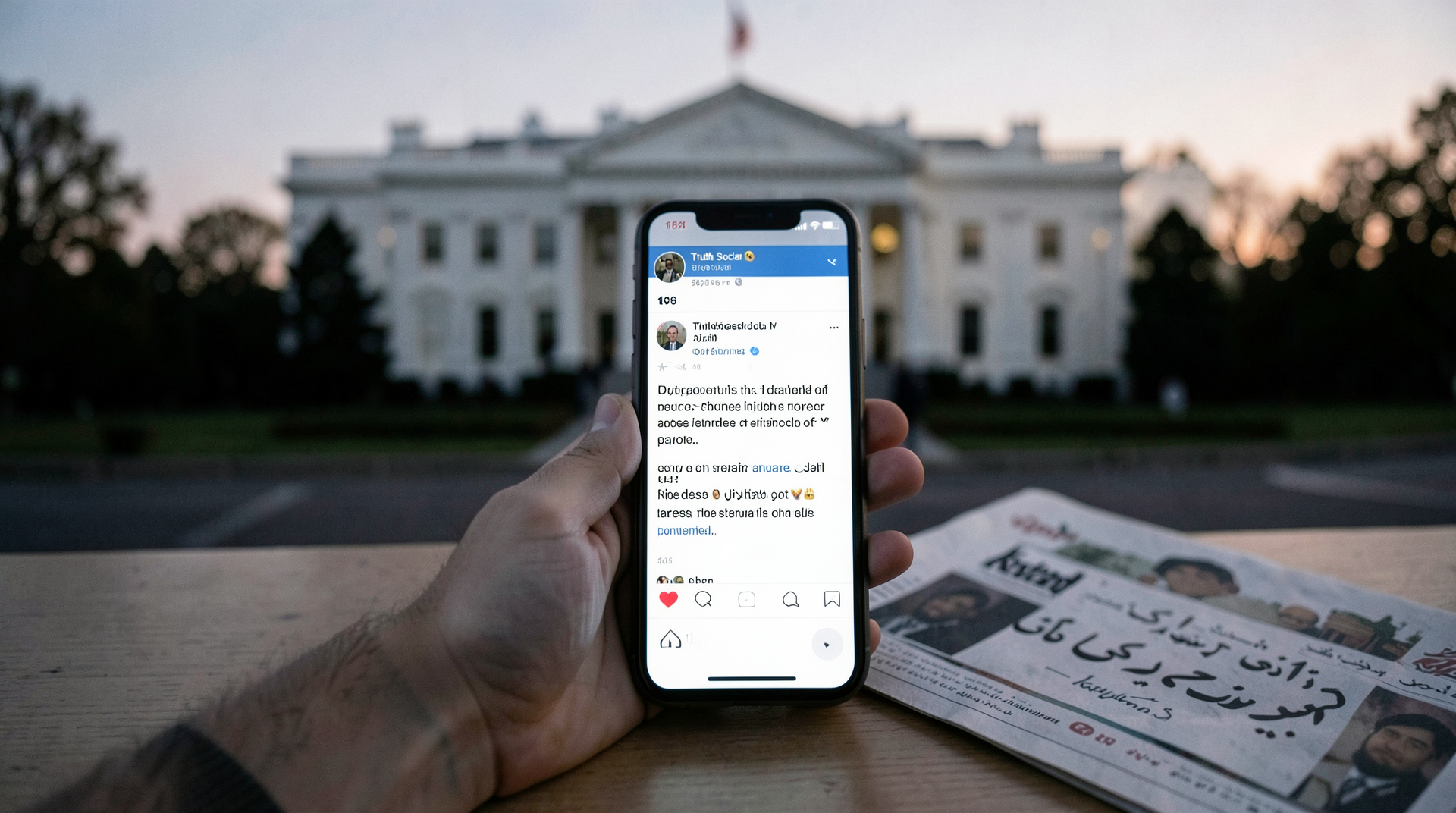
Donald Trump posted to Truth Social on Saturday evening that "an Agreement has been largely negotiated" between the United States and Iran and that a "Memorandum of Understanding pertaining to PEACE" was the document in hand. He listed eight capitals on a joint call — Saudi Arabia, the United Arab Emirates, Qatar, Pakistan, Turkey, Egypt, Jordan and Bahrain — plus a separate call with Benjamin Netanyahu, and he said the Strait of Hormuz would be opened. [1] Within hours, Fars News Agency, the wire service whose editorial line tracks the Islamic Revolutionary Guard Corps, called the framing "incomplete and inconsistent with reality" and said the strait "remains under Iranian control." [2] Iran's foreign ministry spokesman, Esmaeil Baghaei, had told the state broadcaster IRIB on Saturday that Tehran is "in the process of finalising these memorandums of understanding" in a "reasonable period of 30 to 60 days." [3] On the same Sunday the commander of the IRGC, Ahmad Vahidi, published a message saying that "any renewed attack by the enemy will be met with a destructive response extending across the region and beyond." [4] On the same Sunday Hossein Shariatmadari, the Supreme Leader's representative at the hardline daily Kayhan, wrote that "the Strait of Hormuz is part of Iran's territorial waters and we retain the legal right to collect transit fees from ships and vessels passing through our territorial waters." [4]
Four Iranian voices contradicted three different pieces of the presidential post inside the same diplomatic cycle — Baghaei's "30 to 60 days" Saturday, Fars's rebuttal Saturday night into Sunday, Vahidi and Shariatmadari Sunday morning.
Saturday's paper led on Rubio's "Plan B" from Helsingborg and a wedding the president skipped citing "circumstances pertaining to Government", arguing that the substitute words for the expired deadline ("slight progress," "Plan B") were sitting next to an operational posture and that the man running the building had cancelled his Saturday to stay in the room. The Sunday update is that the man in the room produced a document — not yet a signed deal, but a public claim of a deal — and the document was rejected by four separate Iranian institutions before noon Tehran time. Saturday's slower set of words has become Sunday's leaked framework. The framework's counterparty has not signed it.
The leaked framework itself, attributed to Axios's Saturday-evening reporting and reproduced through Iran International's liveblog at 04:31 GMT Sunday, runs to roughly six terms over a sixty-day interim. Iran clears the Hormuz mines so commercial shipping resumes; the United States lifts its port blockade and issues limited sanctions waivers under what the document calls "relief for performance"; Iran commits not to pursue nuclear weapons and to negotiate enrichment limits and removal of highly enriched uranium; American forces in the region remain through the interim phase; the framework folds in an end to the Israel-Hezbollah war in Lebanon. [5][6] That fifth term — Lebanon — is where the document met Saturday's operational tape head-on. Dozens of Israeli airstrikes pounded southern Lebanon late Friday into Saturday, damaging a hospital in Tyre and another in Tibnin and prompting IDF evacuation warnings for fifteen southern villages on Saturday afternoon. [7] The diplomatic document includes a Lebanon ceasefire. The operational tape shows the ceasefire collapsing on the same Sunday the president claims it as part of his deal.
The eight-capital call has produced two confirmed readouts and six silences. Turkey's presidency confirmed Sunday morning that Recep Tayyip Erdoğan told Trump on the joint call that "Turkey is ready to provide any support needed during the implementation of a potential deal with Iran" and that an agreement on free passage through the strait would "bring relief to the global economy." [4] Pakistan's foreign minister Ishaq Dar issued a Sunday-morning statement praising Trump's "leadership and commitment to dialogue and diplomacy, alongside Vance, Rubio and the entire US team" — the first time Islamabad has named the three U.S. principals by name on a foreign-ministry letterhead in this channel's twenty-one days. [4] Saudi Arabia, the United Arab Emirates, Qatar, Egypt, Jordan and Bahrain have not produced readouts in the form Trump's post described. Two of them — Riyadh and Abu Dhabi — entered Sunday on Day Three of silence following an Associated Press wire confirming that both kingdoms separately struck Iran during the war. [8] The asymmetry has a structural shape. Two capitals confirm Trump's framing; six do not; two of the six are also documented to have used force against the same counterparty the framework binds.
Rubio spoke from a different building on a different continent. The secretary of state had moved from Helsingborg to New Delhi over the weekend; the State Department's public schedule for Sunday had him meeting India's external affairs minister, Subrahmanyam Jaishankar, at 11:30 a.m. New Delhi time before a Tuesday Quad meeting in Hyderabad House. [9] To Indian reporters Sunday morning Rubio said: "There's been some progress made, even as I speak to you now, there's some work being done. There is a chance that, whether it's later today, tomorrow, in a couple of days, we may have something to say." [3] On Saturday he had met Narendra Modi, called India the "cornerstone" of Washington's Indo-Pacific strategy, and extended an invitation to the White House. [10] The geography matters because it tells the reader where the announcement is now traveling from. The operational diplomacy of an Iran deal is Sunday-morning small-talk in a New Delhi hallway. The procedural diplomacy of the eight-capital call is a presidential post made from the residence in Washington. The two distances — the secretary thirteen time-zones east, the president writing his own readout in Truth Social paragraphs — describe a government whose Iran channel has multiple foyers and one front door.
The internal Iranian fight has now surfaced into print. Shariatmadari is the editorial voice closest to the Supreme Leader; his Sunday column did not name Baghaei but criticized "those ready to restore conditions in the strait to their prewar state after the conflict ends" — a clear reference to the negotiators inside the MFA who are finalizing exactly such a return. [4] He cited as precedent the fees the United States collects at "maritime chokepoints" — a familiar Iranian framing that places Hormuz alongside Panama and Suez as a sovereign-toll waterway. The IRGC commander Vahidi did not address the MFA either. His Sunday message warned of a "destructive response extending across the region and beyond" against "any renewed attack." [4] The substantive question is whether his "any renewed attack" is conditional on something or whether it is the IRGC's standing posture toward the kind of "relief for performance" mechanism that, by its terms, allows the United States to withdraw waivers and resume strikes when it judges Iran has not performed. The mechanism gives the U.S. the operational verb. Vahidi's response, read in the same paragraph as Baghaei's "30 to 60 days," is the IRGC reserving the right to read non-performance the other way.
Fars's rebuttal was the most direct. It addressed three specific Trump claims: that the strait would be "opened," that Iran had agreed to a comprehensive framework on nuclear, and that the call participants spoke with one diplomatic voice. Fars said the first claim was false because the strait "remains under Iranian control"; said the second was overstated because nuclear remains "off the table" pending separate negotiations; and said the eighth-capital framing was "incomplete and inconsistent with reality." [2] The rebuttal appeared on Iran International's liveblog and circulated through Asian News International on X within hours of Trump's post. [11] That is the first time an IRGC-aligned outlet has contradicted a sitting American president on a U.S.-Iran bilateral track in real time inside the diplomatic cycle. The previous cycle of contradictions — Ghalibaf's "crushing blows," Baghaei's "received but reviewing" formulations — were positions stated in parallel with U.S. announcements. The Fars line on Sunday is a position stated against a U.S. announcement, point by point, with the document the U.S. president posted as the explicit target.
The market answered before the foreign ministries did. Brent crude closed Friday at $103.94 a barrel, down roughly six percent on the week as the diplomatic optimism that Saturday's Axios summary made public priced in across the futures complex; West Texas Intermediate closed at $96.60. [12] Markets did not trade Sunday. AAA's national pump average held at $4.529 Sunday morning, unchanged from Saturday's break from $4.552 — the third consecutive Memorial Day Friday-Sunday weekend without further decline despite Trump's "largely negotiated" claim having sat on Truth Social for sixteen hours. [13] The household side of the war was not yet persuaded that the deal had arrived. Whether the Monday tape moves the pump down or back up is the consumer's first procedural verdict.
The Senate's calendar is moving on a separate timeline. The joint resolution to end U.S. force in the Iran theater advanced 50-47 on May 19; the second vote is scheduled for June 1, when the House returns from recess. Bill Cassidy, the Louisiana senator who flipped to support the resolution after his primary loss, has not made a public Sunday statement on the Trump post. John Cornyn, one of three Republican senators who missed the May 19 advancement vote, faces a Trump-endorsed primary runoff against Ken Paxton "next week" per the AP. [14] Trump's Saturday post creates procedural ambiguity for the YOLO-caucus members the Senate vote depends on. A deal that arrives signed before June 1 would moot the second vote. A deal that does not arrive — that remains, on June 1, a Truth Social claim contradicted by Fars and the IRGC — would force the cohort to vote against an administration that has publicly claimed a negotiated peace. The post is not, in itself, a substitute for a deal. The Senate calendar may make it operationally close to one regardless.
The other diplomatic tracks have not converged. France's draft UN Security Council resolution on a Strait-of-Hormuz international mission — confirmed Friday by foreign-ministry spokesman Pascal Confavreux as "the basis of the current discussions" — entered Day 3 Sunday without a publicly named co-sponsor. [15] The competing U.S.-Bahraini draft from Rubio's May 5 announcement has not been scheduled for a vote. Trump's Truth Social post is now, by his own framing, a third unilateral authorship claim on the post-war Hormuz architecture, competing with Macron's Franco-British initiative and the Bahrain-Washington draft — three rival architectures, none with signatures, all claiming the same waterway. The Iran-Oman bilateral "permanent toll" track that the New York Times confirmed Saturday remains the operational subtext underneath all three. [16] Tehran is negotiating a multilateral framework that would constrain it and a bilateral framework that would not, on the same Sunday Shariatmadari demands the toll continue.
Two further data points belong in the same paragraph as the others.
Tulsi Gabbard resigned as director of national intelligence on Friday evening, citing her husband's "extremely rare form of bone cancer." [17] Sunday is the first day the intelligence community is operating during the active Iran negotiation without a DNI in the chair. The Senate Intelligence Committee — which has its own June 1 calendar inside the war-powers vote — has not yet received a successor nominee. The empty seat is not, by itself, a scandal. It is a structural fact about the room the president occupied through Saturday to skip his son's wedding.
A gunman near the White House gates was killed in an exchange of fire with Secret Service agents overnight into Sunday. Trump's own Truth Social post thanked the Secret Service and described the suspect as having "a violent history and possible obsession" with the White House, linking the incident to "a shooting near the White House Correspondents' Dinner a month earlier." [18] As of Sunday morning Iran International was among the only English-language outlets carrying the early account; Reuters, AP, and CNN had not produced second-source confirmation. [4] The shooting happened — the question Sunday afternoon is what its sequence looks like alongside the Iran post that landed the same evening from the same Truth Social account.
The reader who reads only the diplomatic wires saw a deal "largely negotiated." The reader who reads only the IRGC-aligned outlets saw a presidential claim contradicted point by point by four Iranian institutions. The reader of this paper sees both, on the same Sunday, on the same waterway, with the same names on the call sheet. That is the lead. The president has produced a document the counterparty rejected within hours and the diplomatic surface from Washington and the operational surface from Tehran are no longer speaking in the same register. Whether Monday produces a signed framework, another slip in the substitute words, or a third Iranian institution stepping in to contradict the second is the question that determines which surface was the load-bearing one. For now the document exists. It is not yet a deal. It is the substitute for a deal that the Iran channel has produced four times in fourteen days, and the counterparty has now made the rejection of substitutes its own public document.
-- SAMUEL CRANE, Washington