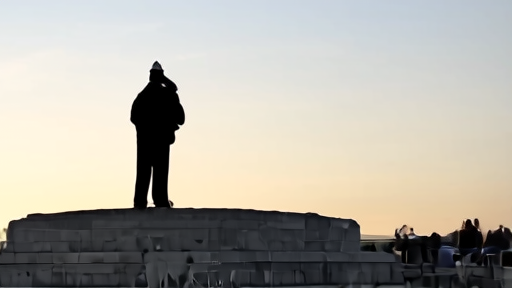
The sentinel walks twenty-one steps down a sixty-three-foot rubber-surfaced mat in front of the Tomb of the Unknown Soldier, at ninety steps per minute, then faces the Tomb for twenty-one seconds, then turns and shifts the M-14 rifle to the outside shoulder, then waits another twenty-one seconds, then walks twenty-one steps back. The numbers come from the twenty-one-gun salute. The cadence comes from a 1937 protocol that has not been altered. The Old Guard — the Army's 3rd U.S. Infantry Regiment, headquartered at Fort Myer adjacent to the cemetery — has performed this rotation continuously since 1948, twenty-four hours a day, in any weather, every day of every year [1]. Through September, when the summer season for the cemetery ends, the change of the guard occurs every thirty minutes during the day, every hour at night [2]. Through Memorial Day Monday, the rotation occurred fifty-six times.
This is the artifact the Memorial Day cycle's photographic coverage almost never produces. The wire camera positions Monday were trained on the Memorial Amphitheater stage, where the 158th National Memorial Day Observance ran from a 10:45 a.m. pre-program through a noon formal program with parade of colors by veterans' organizations and remarks from dignitaries [3]. Arlington National Cemetery's gates closed early — visitor admission halted at 4 p.m., the cemetery cleared by 5 p.m., reopened at 6 p.m. for Freedom 250 National Memorial Day Observance attendees inside the amphitheater [3]. The Freedom 250 framing — the America 250 program's Memorial Day expression — is the year's institutional overlay. The sentinel rotation is the year's institutional invariant.
The paper's Sunday brief on the Memorial Day weekend service rail read the holiday as the Pentagon's calendar artifact wrapped around forty-three million household cookouts. The Sunday brief on the Vietnam Veterans Memorial Wall read the 1 p.m. names-reading on the National Mall as the second-most-attended Memorial Day observance after Arlington. Both pieces sit on top of an institutional ritual that is much larger than either ceremony: the Veterans Affairs Department's 130-plus national cemetery system runs Memorial Day ceremonies at every site through the day, and the American Battle Monuments Commission's twenty-six American military cemeteries abroad — Normandy, Cambridge, Manila, Florence, Henri-Chapelle, the rest — observe the day on their local calendars with locally-staffed ceremonies that do not require the President's attendance to occur.
The sentinel rotation is the load-bearing daily ritual underneath all of it. The Tomb's current protocol — three reliefs (teams), each a twenty-four-hours-on / twenty-four-hours-off / twenty-four-on / twenty-four-off / twenty-four-on / ninety-six-off cycle — runs the rotation continuously. The off days are not free; the Society of the Honor Guard's published FAQ notes that the average sentinel spends eight hours per day on uniform preparation, plus physical training, plus Tomb Guard training, plus haircuts before the next work day [1]. The tour averages eighteen months. The qualification is highly selective. The Old Guard has had this distinguished duty since 1948.
The Tomb itself contains three Unknowns — World War I, World War II, Korea. The Vietnam Unknown was identified by DNA in 1998 as First Lieutenant Michael J. Blassie, his remains removed, the crypt re-dedicated as a memorial to "Missing Servicemen, 1958-1975" [4]. The other tombs hold their occupants. The World War I Unknown is a recipient of the Medal of Honor, the Victoria Cross, and several other foreign nations' highest service awards [1]. Each of the three has received a Medal of Honor in symbolic conferral.
The number to hold steady against the wreath-laying photography is the rotation count. From the cemetery's 8 a.m. opening through its 4 p.m. early close Monday, the sentinel changed seventeen times. Through the 6 p.m. reopening for amphitheater attendees through the cemetery's 9 p.m. closing for the holiday's special-program window, another six. Through the overnight watch, every hour, twelve more. Fifty-six rotations across the holiday's twenty-four-hour cycle. The next day's rotation begins at midnight with the standing protocol. The pattern does not require a presidential calendar event to maintain.
The second-summer framing is the paper's own: this is the second summer since the Iran war began on March 14, 2025. The first summer's Memorial Day produced the unprecedented presidential proclamation that named American war dead from the war's first sixty days, the early-Pentagon-named "Operation Forge of Justice" period. This year's Memorial Day produced Trump's proclamation naming "Operation Epic Fury" and "13 Joint Force fallen" — the first presidential document to count the war's American cost. The rotation that has been continuous since 1937 received the thirteen as a category Monday and will receive any future thirteen as the same category. The cadence does not change with the number.
What the rotation produces is a particular kind of public memory that is not a memory at all but a presence. The Old Guard's sentinel walks twenty-one steps in front of three caskets and one empty crypt every half hour through the summer. The rotation will continue Tuesday morning at the same cadence. It will continue through the rest of the war and through whatever follows. The cemetery's gate closes at 5 p.m. on a normal day; the rotation does not. The Memorial Amphitheater empties of dignitaries by mid-afternoon on a normal Memorial Day; the rotation does not. The ABMC cemeteries across Europe and the Pacific run their own observances on their own calendars. The Tomb's rotation runs on no calendar but its own. That is what makes it the durable Memorial Day artifact rather than the wreath.
-- MAYA CALLOWAY, New York