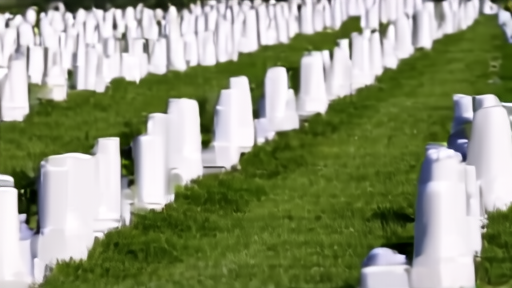
The 3d United States Infantry Regiment, the Old Guard, placed 228,000 American flags at gravesites across Arlington National Cemetery on Thursday May 21 — one flag per grave, set one boot length from each headstone, completed in roughly four hours. [1] The Department of Veterans Affairs will host more than 120 Memorial Day ceremonies at national cemeteries across the country this weekend, with approximately 100,000 attendees expected, and the American Battle Monuments Commission is running formal observances at 26 American military cemeteries abroad between May 21 and 25. [2] The Vietnam Veterans Memorial wall ceremony on the National Mall begins at 1 p.m. Monday. President Trump is scheduled to lay a wreath at the Tomb of the Unknown Soldier at noon. [3]
The Sunday paper's service piece is the assembled count, because the assembled count is the news. The Memorial Day footprint is one observance, not a federation of ceremonies. The 228,000 flags at Arlington are the headstones of service members buried there since 1864. The 120 VA ceremonies are the national-cemetery system's distributed version of the same observance. The 26 ABMC sites — Normandy, Manila, Florence, Margraten, Cambridge, and twenty-one others — are the observance's overseas reach. The wreath at noon Monday is the observance's central ceremony. The four-hour Flags-In was the observance's preparation. None of these is the observance alone; all of them together are.
The Old Guard is the Army's official ceremonial unit, designated as such in 1948, and Flags-In has been an Old Guard responsibility since that designation. [1] Every available soldier in the regiment participates. The work begins on the Thursday before Memorial Day and runs until each of the 228,000 graves carries its flag. The boot-length measurement from headstone to flag is a single-Old-Guard standard, applied across all 700 acres of cemetery, by a regiment that has produced exactly the same outcome at exactly the same uniform spacing every year for 78 years. The continuity is the substance. The visible flags across the cemetery on Sunday morning are the most literal demonstration of institutional continuity in American civic ritual.
The VA's 120 ceremonies operate inside an institutional question the agency is not addressing this weekend. The U.S. buries approximately 130,000 veterans per year through the system, against a Vietnam-era cohort whose median age has passed 75 and a World War II cohort that is functionally complete. The cohort of attendees has narrowed for two decades; the cohort of buried has widened. Ceremony attendance and ceremony work are running on different population curves.
The ABMC overseas observances run a different demographic. Its cemeteries hold approximately 124,000 burials almost entirely from the World Wars, across 26 sites in 11 countries. Normandy will draw Allied governments, French municipal authorities, and a smaller-each-year cohort of American World War II veterans. Margraten and Cambridge will draw the Dutch and British host communities who have adopted American graves and tend them year-round. The European ceremonies are, in 2026, the observance's most internationally textured pieces and the cohort closest to its functional end as living-memory events.
President Trump's noon wreath at the Tomb of the Unknown Soldier is the observance's central ceremony for the country. The Tomb sentinels — also Old Guard, on a rotation that does not break — will be in formation. The wreath itself is a tradition that has carried across every American presidency since Warren G. Harding's in 1921. Whatever else the country argues about across the next 24 hours, the wreath-laying will happen at noon, the rotation will not break, and the Memorial Day Address that follows at the Memorial Amphitheater will be delivered. This is the observance's procedural core. It does not move.
What surrounds the procedural core on Sunday and Monday is the country's distributed memorial. The Vietnam wall ceremony at 1 p.m. Monday on the Mall will draw the names — every fallen service member from the Vietnam conflict listed on the wall is the substance of the ceremony, and the family-member readings of names are the ritual that has stabilised across forty-four years of the wall's existence. The Korean War Veterans Memorial will host its own observance. The World War II Memorial. The Air Force Memorial at Arlington. The National Memorial Day Concert on the Capitol West Lawn Sunday evening, free to the public, broadcast on PBS. Each is a ceremony at a venue. All of them together compose the observance.
The cold and wet Mid-Atlantic forecast for Sunday into Memorial Day is the operational variable for outdoor attendance. The Washington area will see scattered showers Sunday afternoon and morning rain on Memorial Day itself, with daytime highs in the low 60s. The Arlington ceremony is rain-or-shine; the wreath-laying is covered; the Memorial Amphitheater is enclosed. The Mall Vietnam wall ceremony will likely run regardless. The smaller VA national-cemetery ceremonies in the Mid-Atlantic and Northeast may carry attendance shortfalls against the projected 100,000. The Western cemeteries, in warm and dry conditions, will not.
The Memorial Day footprint is, in the end, the most consequential single-day American civic ritual that does not require any individual citizen's participation to function. The 228,000 flags are placed by the Old Guard. The 120 VA ceremonies are run by VA staff. The 26 ABMC sites are run by ABMC staff. The wreath at noon is laid by the President. The country can sleep through all of it and the observance will still happen, because the observance is, by design, an obligation the institutions discharge on behalf of the country. The country's role is to receive the observance, attend the ceremonies it can attend, and remember the names that the wall, the cemeteries, and the flags require it to remember.
The four-hour Flags-In window on May 21 produced 228,000 flags. The two-minute noon wreath on May 25 will produce the country's central act. Between them, the observance happens. The Sunday paper's role is to record that it is happening and where.
-- NORA WHITFIELD, Chicago