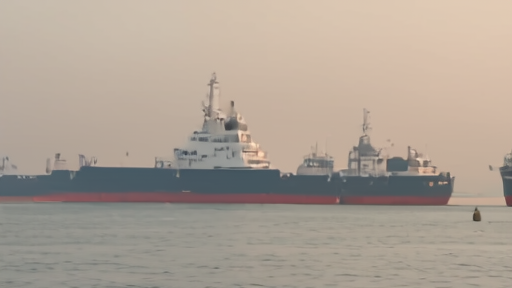
Crude futures opened the Tuesday Asia session sharply lower. West Texas Intermediate printed $90.55 a barrel, down 6.27 percent. Brent printed $96.14, down 6.61 percent. [1] The Murban contract that prices Abu Dhabi-grade light sweet crude fell 9.19 percent. Louisiana Light fell 11.96 percent. These are the largest one-day declines in the futures complex since May 7, when an earlier round of Iran-track diplomacy briefly priced in a corridor that did not hold.
The catalyst arrived in two pieces, on either side of midnight. Iran's Tasnim news agency reported, citing the IRGC Navy, that 32 vessels — oil tankers, container ships, and cargo carriers — had transited the Strait of Hormuz over the prior twenty-four hours under IRGC Navy coordination. [1] Hours later in Washington, Secretary of State Marco Rubio told reporters on Tuesday that the strait would remain open "one way or the other" if the United States and Iran reach an agreement. [2]
The household receipt moved with the wholesale tape. AAA's Tuesday morning national average for a gallon of regular gasoline printed $4.491, down from the $4.507 print AAA had carried Monday and from the $4.564 Memorial Day high it had announced May 21. [3] The four-year Memorial Day high — flagged Monday in the paper's standard on the $4.55 AAA hold and the TSA's 2.96 million Friday throughput — did not survive Tuesday's open. The futures break that Monday's brief on the Brent-WTI futures Monday open against the Friday six-percent week had anticipated has now arrived in the household tape.
What the 32-vessel transit actually measures is worth a moment. The Strait of Hormuz carried roughly 138 vessels per day before the blockade began in late February. Iran's own communique, attributed to the IRGC Navy through Tasnim, reports the same number for a single twenty-four-hour window for the first time since the war began. Tuesday's coordination figure is therefore not normal traffic; it is roughly a quarter of pre-war volume, achieved with explicit IRGC permission, and explicitly framed by Iran as proof that Tehran controls the corridor. The market priced it anyway. The market's read is that a quarter of pre-war Hormuz traffic, with an IRGC permission slip attached, is more supply than the spot price reflected on Monday.
This matters because the structural break in the 95 percent shipping collapse that the paper has tracked since March now has a date. Lloyd's List Intelligence had estimated 26 transits for the entire prior week, with an additional eighteen shadow-fleet tankers loitering off Oman and Pakistan rather than entering the strait. Iran's claim of 32 vessels in a single day is a sixfold acceleration if accurate. Rubio's Tuesday formulation — that the United States will keep Hormuz open "one way or the other" — pairs with the Iranian transit number to produce, for the first time since February 28, a coordinated read on which both sides are publicly invested. [2]
What the futures tape cannot yet read is whether Tuesday's Iran-Oman coordination is durable. The IRGC Navy expanded its operational definition of Hormuz on May 12 to a 500-kilometer "crescent" stretching from Jask to beyond Greater Tunb. That expanded geometry remains in place. Iran's parliament spokesperson Ebrahim Rezaei wrote earlier this month that any renewed US strike could trigger 90 percent enrichment; the working session of the Iranian delegation now under way in Doha — Ghalibaf, Araghchi, Hemmati — is the venue at which the disposal mechanism for highly enriched uranium would have to materialize. If Doha produces a signed document, the futures break holds. If it does not, the 32-vessel print becomes a one-day rally that the next CENTCOM communique can erase.
There is also the question Tuesday afternoon will answer. The 32-vessel claim is Iran's. Iran has an incentive to report a higher number; doing so demonstrates the operational tolling architecture Rubio has called illegal. The UK Maritime Trade Operations Center carried thirteen confirmed transits in the prior forty-eight hours by its own count and reported significant AIS interference around the strait. Whether Lloyd's List Intelligence and IMF PortWatch confirm Tuesday's figure will determine whether the futures tape's six-percent move stands or partially retraces. The PortWatch dashboard, on its standard weekly update cycle, will not refresh until Wednesday because of the Memorial Day holiday.
Iran parliament spokesperson Rezaei told domestic media this weekend that the United States is one decision away from "six-dollar gasoline." [3] That line, repeated across Persian-language X timelines, is the most-cited Iran frame on the energy file Monday and Tuesday. American refiners have not walked down summer crack-spread guidance, but the consumer-facing arithmetic now hinges on whether the AAA print continues to fall through the rest of the week. A move below $4.40 by Friday would compress the political pressure that has been visible in the polling on the administration's Iran posture since the Memorial Day weekend. A move back above $4.60 would re-open the trap.
The other anchor is CENTCOM. A coordinated 32-vessel transit, with IRGC permission slips, would normally produce a public CENTCOM statement either acknowledging or rejecting the coordination mechanism. None had appeared by Tuesday morning. The silence is itself a data point. The naval blockade that the Trump administration imposed April 13 remains in force; Trump confirmed Sunday it will stay "in full force and effect until an agreement is reached, certified, and signed." The market priced the 32-vessel print as if the blockade were already negotiable. The next CENTCOM communique will reveal whether it is.
-- DARA OSEI, London