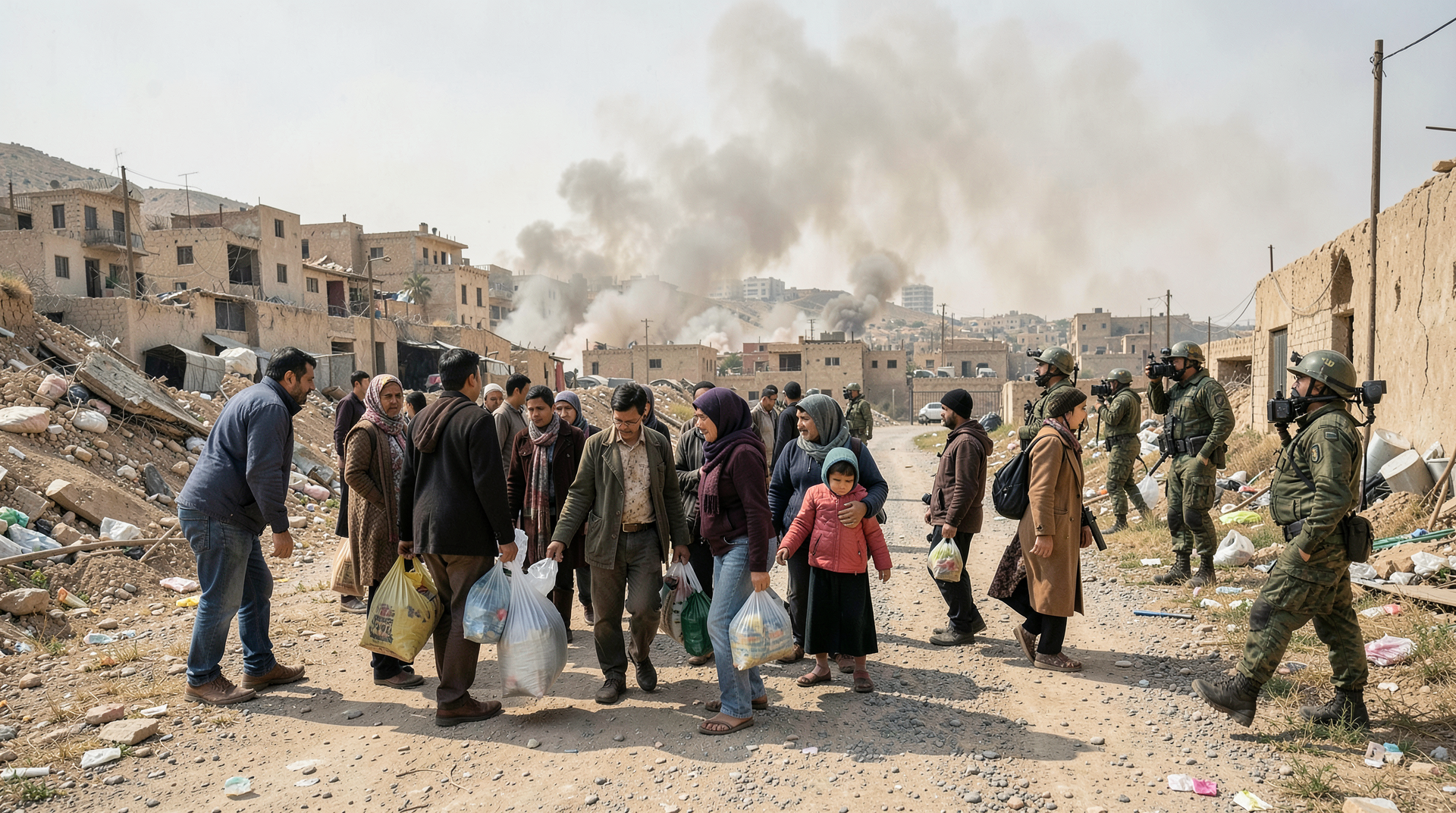
Israel told residents across southern Lebanon to move north of the Zahrani River, declared the area a combat zone, and then struck Tyre. The BBC called it the largest evacuation order since the April 17 ceasefire, covering about 14 percent of Lebanese territory and roughly 300 towns and villages. ABC said it was the first time Israel had made such a sweeping demand since President Donald Trump announced a Lebanon ceasefire in April. [1] [2]
Wednesday's paper said Lebanon's paramedic deaths still lacked an account, meaning the public record had casualties but not responsibility. It also noted, in the State Department's Armenia release day, that official silence is itself a public instrument. Thursday's evacuation order joins those threads. The question is no longer whether southern Lebanon is bleeding outside the Iran file. It is whether the Iran file can close while Tyre is being emptied.
The geography matters because the diplomatic language has been built to keep conflicts in separate rooms. Israel says Hezbollah violations justify force in Lebanon. Iran insists any settlement must also cover Lebanon. Washington wants a deal on Hormuz, uranium, frozen assets and ceasefire extension. The Guardian reported that Iran has insisted a Lebanon ceasefire must be included in the memorandum that would lead to Iran reopening the Strait of Hormuz, while Israel says it reserves the right to keep fighting Hezbollah. [3]
Tyre puts that architecture under strain. The city is not a marginal hill village on a disputed tactical line. It is one of southern Lebanon's great coastal cities, a place where people can see the Mediterranean while they decide whether to sleep in their homes. The BBC reported that residents filmed strikes from balconies after the warning and quoted a cafe owner, Rida, saying people had packed their belongings at the port and everyone was scared. [1]
The Israeli order's scale also changes the moral grammar of the war. A warning can be presented as civilian protection when it names a building or a small district before a strike. A warning that covers large parts of a country begins to resemble policy. ABC wrote that Lebanese communities view such warnings as forced displacement orders, and that hundreds of thousands of people live in the affected area. [2] That is not a semantic objection. A family with no safe destination does not experience an evacuation order as a humanitarian precaution. It experiences it as a demand to become homeless on schedule.
The BBC's account gives the Israeli case its clearest form. The Israel Defense Forces accused Hezbollah of repeated ceasefire violations, said it would act with extreme force, and ordered residents north of the Zahrani River. Hezbollah, in the same account, said its fighters had clashed with Israeli troops, including near Zawtar al-Sharqiyeh, outside the Israeli-declared buffer zone. [1] The facts do not describe a quiet ceasefire interrupted by one side's phrase. They describe a line of contact spreading through towns, warnings, clashes and airstrikes.
ABC adds the political motive that diplomats will not put in the first paragraph. Its correspondent wrote that some analysts believe Israel is trying to pressure Trump to carve Lebanon out of any deal with Iran. The same article says Iran wants the conflict north of Israel included in any formal end to fighting, while Israel wants it treated as separate. [2] That is the deal's hidden hinge. If Lebanon is included, Israel loses freedom of action against Hezbollah. If Lebanon is excluded, Iran can say the bargain leaves an ally under fire.
The Guardian supplies the wider bargaining table. It reported that U.S. strikes on southern Iran occurred during the seven-week ceasefire, that Iranian negotiators had traveled to Qatar, and that the talks concerned uranium, frozen assets and the Strait of Hormuz. It also reported that Trump had floated destruction of enriched uranium inside Iran under international oversight and that Rubio said Hormuz would open one way or another. [3] Lebanon, in that account, is not a humanitarian side note. It is one of the conditions Tehran wants written into the document.
That is why Tyre is now a negotiating fact. The evacuation order does not merely produce displacement. It gives Iranian negotiators a public exhibit: while Washington asks Tehran for concessions over Hormuz and uranium, Israel is ordering a Lebanese city and hundreds of towns to move. The argument may be cynical. It may also be effective. Diplomacy often runs on visible facts, and smoke over Tyre is visible.
The mainstream press is still separating the story into compartments. The BBC foregrounds the evacuation order, casualty figures, clashes and displacement. ABC stresses the sweeping nature of the demand and its first-since-ceasefire significance. The Guardian puts Lebanon inside the Iran peace-deal problem. [1] [2] [3] Each frame is true. None is sufficient alone. The reader who sees only the evacuation misses the bargaining table. The reader who sees only the bargaining table misses the family at the port.
X is doing what X usually does in a war: turning the order into accusation faster than the institutions can verify the order's military predicate. The platform frame is forced displacement, ceasefire fraud, and a U.S. peace deal that tolerates one front while advertising calm on another. The risk is certainty without the targeting file. The insight is that bureaucratic caution can miss the obvious: displacement on this scale is not procedural noise.
The casualty context makes that insight harder to dismiss. The BBC reported at least 31 people killed Tuesday in Lebanon, including 15 in Burj al-Shamali east of Tyre, and said at least 3,213 people had been killed in Lebanon since the war began, according to Lebanon's health ministry. [1] ABC reported more than 3,200 killed in Israeli strikes since early March, including hundreds of women and children and many healthcare workers. [2] Those figures are not identical categories, but they carry the same warning. The line between military pressure and civilian ruin has already become thin.
Israel's argument is that Hezbollah made southern Lebanon unsafe. That argument cannot be dismissed by anyone who has watched Hezbollah's drones and rockets make northern Israel unlivable. The BBC reported Netanyahu saying Israel was deepening its ground operation to fortify the security zone and protect northern communities. [1] A government owes protection to those citizens. But protection does not answer every question. It does not explain where southern Lebanese civilians are supposed to go. It does not explain how far a security zone can deepen before it becomes renewed occupation by another name.
The American question is even less comfortable. Trump wants to sell a settlement while the war's edges keep moving. The Guardian reported that the memorandum under discussion would reopen Hormuz, defer nuclear talks for 30 to 60 days, and possibly address frozen assets. [3] That is already a fragile bargain. Add Tyre, and the bargain becomes a test of whether Washington can control the ally whose military action shapes the negotiation it is trying to close.
This paper has argued through the Iran war that exit ramps have repeatedly led to deeper commitments. Tyre is the newest version of that pattern. A ceasefire created a category called restraint. Then came strikes defended as self-defense. A Lebanon truce created a category called separate conflict. Then came an evacuation order large enough to enter the Iran memorandum by force of consequence. The vocabulary keeps trying to contain the war. The war keeps outrunning the vocabulary.
The humane standard should be simple. If a combat zone is declared across hundreds of towns, the world should ask where civilians can safely go, how long they are expected to stay away, what evidence justifies the sweep, and what mechanism returns them. The diplomatic standard should be equally simple. If Lebanon is part of Iran's price for Hormuz, Tyre is not peripheral. It is central.
The next useful document may not be a battlefield communiqué. It may be the draft memorandum, if one appears, and whether Lebanon is inside it. Until then, Tyre is doing the work diplomats avoid. It is proving that a regional war cannot be ended by pretending its fronts are separate when the parties themselves keep linking them.
-- YOSEF STERN, Jerusalem