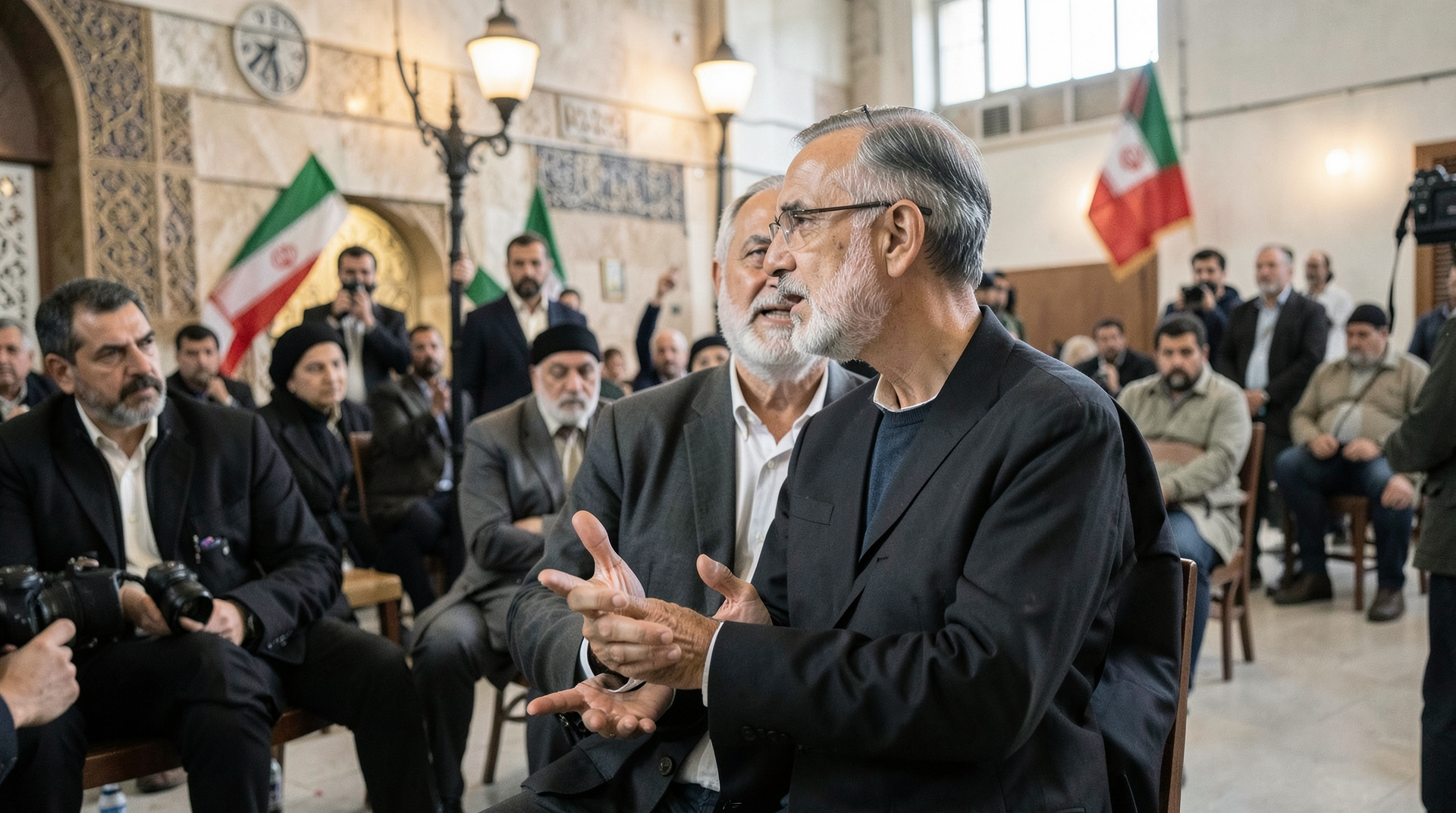
Ghalibaf Says Iran Deal Must Protect Iranian Rights follows Saturday's trumps red lines leave the iran deal without a signed deal by moving from slogan to record. The new fact is not that Tehran sounds suspicious of Washington. The new fact is that Mohammad Bagher Ghalibaf, speaker of Iran's parliament and a senior figure in the regime's negotiating track, put the condition in public terms: Iran's leaders, he said through IRNA as carried by ABC, "do not trust the enemy's words and promises," and they "will not approve any agreement" until they are sure the rights of the Iranian people have been secured. [1]
That language narrows what can honestly be said about the state of the talks. It does not prove that a deal is dead. It does not prove that a memorandum has become binding. It says that Tehran is still presenting domestic political approval as a gate through which any U.S. text must pass. ABC's live file describes several weeks of peace talks that have not yet produced a resolution, an earlier round in Pakistan that failed to reach a peace deal, and a ceasefire extension tied to a continuing U.S. blockade until negotiations are concluded "one way or the other." In that sequence, Ghalibaf's rights formulation is not atmospherics; it is the public standard against which Tehran can later accept, reject, or reinterpret whatever Washington says was agreed. [1]
The harder part of Sunday's record is that the diplomatic quote arrived beside a military map that was moving in Lebanon. ABC reported that the Israel Defense Forces said troops in southern Lebanon had advanced north of the Litani River, secured Beaufort Ridge, and were operating near Nabatieh, which the IDF described as a significant Hezbollah power center. The same update quoted the IDF saying it had crossed the Litani and expanded strikes north of the river, while Israeli Defense Minister Israel Katz said the campaign was not over and was meant to crush Hezbollah's power and secure residents of Israel's north. That is why the Iran deal story cannot be read as a clean negotiation story. The ceasefire vocabulary and the battlefield vocabulary are appearing in the same public file. [1]
ABC also reports claims that keep the civilian stakes visible: an evacuation order for residents of southern Lebanon, especially those south of the Zahleh River; Israeli airstrikes continuing despite an April ceasefire between Israeli and Lebanese leaders; Lebanese Health Ministry figures of 3,371 killed and 10,129 wounded by Israeli strikes since March 2; and Lebanese Prime Minister Nawaf Salam accusing Israel of a "scorched-earth policy" and "collective punishment." Those claims are presented by ABC as part of the live record, not as settled legal conclusions by this paper. The article's narrower conclusion is that the operating environment around the talks includes an active northern front, official Israeli expansion language, Lebanese casualty reporting, and Hezbollah attacks on Israeli soldiers and northern Israel. [1]
The Times of Israel's May 31 liveblog pushes the same problem from the Israeli news side. Its main page combines the Iran file with Lebanon and domestic Israeli developments: it leads with a report that Iran has reopened most entrances to 18 underground missile sites struck in the war, says the regime has dug out buried arsenals and is poised to fire long-range missiles again according to CNN, and, on the same page, tracks the UN Security Council meeting requested by France over Israel's Lebanon operation, rockets fired by Hezbollah at a border community, and IDF strikes on Hezbollah arms depots and command centers in southern Lebanon. [2]
That mix matters because it limits the use of optimism. If Iran has reopened entrances to underground missile sites, the source supports only a practical observation: the damage assessment around Iran's long-range capability remains contested and current. If Hezbollah rockets are being intercepted and IDF strikes are still being posted into the evening, the source supports only another practical observation: Lebanon is not a background paragraph after the diplomacy; it is one of the places where the costs of delay, ambiguity, and military leverage are being felt. [2]
Times of Israel also links the Beaufort story to a longer Israeli military memory. Its May 31 page points readers to reports that a soldier was killed in a Hezbollah drone strike in Lebanon, that the IDF captured strategic Beaufort Castle, and that Israeli leaders treated the flag over the fortress as a symbol of earlier wars in Lebanon. The article should not overread that symbolism into a prediction about negotiations. It can say, more modestly, that Israel's own press framed the southern Lebanon advance as both tactical and historical, which makes it harder for any Iran deal text to float above the ground campaign. [2]
The May 30 Times of Israel live file, as surfaced in the cited page, shows that this was not a single isolated Sunday entry. Its description says schools were closed near the Lebanon border as rockets and drones repeatedly targeted the north during Shabbat, while Hegseth said he believed the Iranians would give up nuclear ambitions over time. The source therefore places expectation and exposure side by side: U.S. officials still talking about eventual Iranian concessions, Israeli communities near the Lebanon border living under closure and attack warnings, and Israeli politics arguing over the force of the response. [3]
Those May 30 entries do not prove what Iran will sign. They do prove that the weekend's record was not only a negotiating room. It included northern restrictions, Hezbollah fire, Israeli operational claims, and U.S. confidence statements. That is enough to make Ghalibaf's phrase more than a quotation for a headline. If the Iranian parliament's speaker says a deal must secure Iranian rights, while Israel says it is expanding strikes north of the Litani and Times of Israel is still updating readers on missile sites and Hezbollah fire, then the question becomes whether any written settlement can bind the military facts that have already outpaced the diplomatic language. [1] [2] [3]
The safest reading is deliberately narrow. Sunday's sources support the claim that Tehran publicly attached approval to Iranian rights, that U.S.-Iran talks remained unresolved, that Israel reported an advance north of the Litani toward Nabatieh and Beaufort Ridge, that Lebanon's front remained active, and that Israeli media was still treating Iranian missile infrastructure as a live concern. They do not support a claim that a final agreement exists. They do not support a claim that Tehran's internal institutions will accept a U.S. draft. They do not support a claim that Lebanon has become a formal party to the Iran negotiations. The evidence supports pressure, not closure. [1] [2]
That distinction is the story's service to the reader. The same headline can sound like a foreign-ministry exchange if the map is left out, or like a regional-war dispatch if the negotiating quote is ignored. The record asks for both. Ghalibaf supplies the approval condition. ABC supplies the negotiation and Lebanon chronology. Times of Israel supplies the Israeli live frame: Beaufort, northern closures, Hezbollah fire, and reports about reopened Iranian missile-site entrances. The paper can therefore say that the deal debate is being conducted under visible operational strain. It cannot say that the weekend produced a signed bargain, a stable ceasefire, or a unified theory of the war. [1] [2] [3]
Monday's question is correspondingly specific. Does Washington publish language that addresses the rights claim Ghalibaf made? Does Tehran identify the institution that will judge those rights secured? Does Israel stop expanding the Lebanon campaign or continue to treat Hezbollah's southern infrastructure as a live target? Does the Iranian missile-site report produce confirmation, denial, or a military response? Until those answers arrive, Sunday's strongest sentence is not that peace is near or that war is inevitable. It is that the public conditions for accepting a deal and the public evidence of continued force are now sitting in the same source stack. [1] [2]
-- YOSEF STERN, Jerusalem