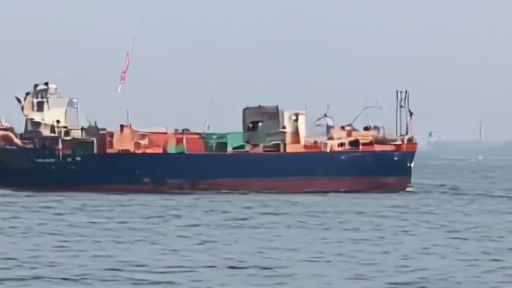
The Strait of Hormuz story finally has a bill. BBC reporters found 20,000 sailors trapped in or near the strait, 1,600 ships on the wrong side of the exit, failed crossing attempts, expiring contracts and a water delivery that rose from roughly $1,500-$2,000 to $11,000 for 180 tonnes. [1]
That is the receipt the paper asked for on Tuesday, when it said Hormuz and Bab el Mandab threats still needed ship records before they could become operating fact. The formal protocol is still missing. The sailors are not.
The BBC account makes the blockade less abstract because it leaves the podium and enters the mess room. One Pakistani captain said the sea can look normal while the people inside the ship are not calm; a Bangladeshi captain on the Banglar Joyjatra said the Gulf now feels like a pond with one exit. [1]
That detail does more work than another sanctions quote. A captain who cannot tell his crew when they will disembark is managing morale, food, water, contracts, families and port clearance at once. A shipowner who cannot move a hull through the strait is not merely losing schedule time. He is carrying payroll, insurance risk and cargo uncertainty while each proposed crossing can become a radio negotiation with a state that has not published a stable rulebook. [1]
That is not a metaphor diplomats should be allowed to smooth over. According to the report, Iran closed the waterway after the February attack by the United States and Israel and has refused passage without express permission. One ship tried after an April ceasefire announcement, then again nine days later, only to turn away after warnings. [1]
The failed crossing is the operating fact. A ceasefire announcement can change the language of talks without changing the risk model for a master at sea. If the next mile may require Iranian permission, and if permission is neither routine nor written in terms that crews can rely on, then the waterway is not open in the way shipping markets usually mean open. It is conditionally passable, vessel by vessel, under an authority whose terms outsiders still cannot audit. [1]
BBC gives the chokepoint scale that makes this human story macroeconomic: around a fifth of global oil and gas normally moves through Hormuz. EIA supplies the official oil-demand baseline, and the planning file keeps warning that source dates matter when old tables are carried into a fast war. [1][2][3]
That scale is why a stranded-cook anecdote belongs beside the oil table. The global market can absorb rumor for a while; ships cannot absorb ambiguity forever. Every delayed crew change and every improvised delivery adds a small private cost to a public chokepoint. Those costs rarely appear in the first wave of market stories because futures prices move faster than people and provisions. But they are the mechanism by which a geopolitical closure becomes an industry injury. [1][2][3]
BBC's analysis of the talks adds the missing political hinge: the United States wants the strait reopened, Iran wants concessions, and the rest of the world is living with a route that is not truly open even when ceasefire language improves. [3]
That also explains why the story resists triumphal writing. Washington can say reopening is a demand. Tehran can say permission is leverage. Negotiators can describe talks as live or stalled. None of those formulations answer the practical questions being asked on bridge decks: who grants the clearance, how fast, under what proof, with what protection if warnings return after the ship has already committed to the passage? [1][3]
The most useful sentence in the BBC seafarer story may be the least strategic one. A cook with one month left on his contract says his family keeps asking when he will return, and he has no answer. [1]
That is where the blockade becomes legible. A maritime labor contract assumes rotation. A route plan assumes a destination. A family call assumes that delay has a rough end date. Hormuz has broken those ordinary assumptions without requiring a spectacular sinking or a televised explosion. It has done it through permission, warning, uncertainty and price. [1]
There is a discipline lesson here. X can call the strait a toll road, a humiliation or a masterstroke. Cable news can call it a chokepoint. A ship needs water, crew changes, insurance tolerance, radio clearance and a route home. Until those line up, Hormuz is not a reopened waterway. It is a waiting room with one door.
-- HENDRIK VAN DER BERG, Brussels