Yesterday, this paper published how Trump told the Financial Times he wants to take the oil. "To be honest with you, my favourite thing is to take the oil in Iran," the president said, adding that seizing Kharg Island — the hub through which 90 percent of Iran's crude exports flow — "could be done very easily." That was Sunday. On Monday, the Wall Street Journal reported that Trump told aides he is willing to end the military campaign against Iran even if the Strait of Hormuz remains largely closed. [1]
The distance between these two positions is not a policy evolution. It is a contradiction that cannot be resolved by sequencing or context. You cannot simultaneously want to seize Iran's oil export infrastructure and accept a peace that leaves the world's most important oil chokepoint under Iranian control. One of these is not true. Possibly neither is.
This paper argued last week that the war is one month old and nobody can say what it is for. That analysis catalogued at least five distinct stated aims since Operation Epic Fury began on February 28. The Hormuz reversal makes six. To understand how the administration arrived at this point requires tracing the full arc of a war whose purpose has never held still long enough to be tested.
The Six War Aims
The first stated objective, articulated on March 1, was the complete degradation of Iran's missile capability. Trump told reporters the campaign would take "four weeks — or less" and compared it to a surgical operation. [2] The Pentagon briefed reporters on a target list focused on missile production facilities, launch sites, and the defense industrial base.
The second emerged within days: the destruction of Iran's navy and air force. This was folded into the original framing as though it had always been there, but the initial briefings had not mentioned naval operations as a primary objective. By the end of the first week, the administration was describing a four-pillar military campaign: missiles, nuclear infrastructure, the navy, and the air force.
The third appeared on March 8, when Trump began describing regime change as an accomplished fact. "There has already been regime change," he told reporters aboard Air Force One. [3] This was a novel formulation — claiming the objective had been achieved before it was publicly stated as an objective. The Iranian government, whatever one thought of its legitimacy, was still functioning in Tehran. Trump appeared to be defining "regime change" as something closer to psychological defeat than actual governmental collapse.
The fourth was the nuclear dimension. By mid-March, securing Iran's enriched uranium stockpile — which the administration claimed had reached weapons-grade levels — was promoted to the foreground. This had been an implicit element from the start, but its elevation to the primary stated rationale coincided with growing international pressure to justify the scope of the bombing campaign. [4]
The fifth arrived Sunday via the Financial Times: take the oil. This was the most candid statement of war purpose any American president had offered in a generation. Trump did not describe it as a strategic necessity or a byproduct of the campaign. He described it as his "favourite thing." He mentioned Kharg Island by name. He acknowledged that seizing it would require ground forces and constitute a significant escalation. [5]
The sixth landed Monday via the Wall Street Journal: end the war without reopening Hormuz. The operation to reopen the strait, the Journal reported, would likely prolong the conflict beyond the four-to-six-week window the president had promised. Trump was willing to accept that trade-off. [1]
Why the Hormuz Reversal Matters
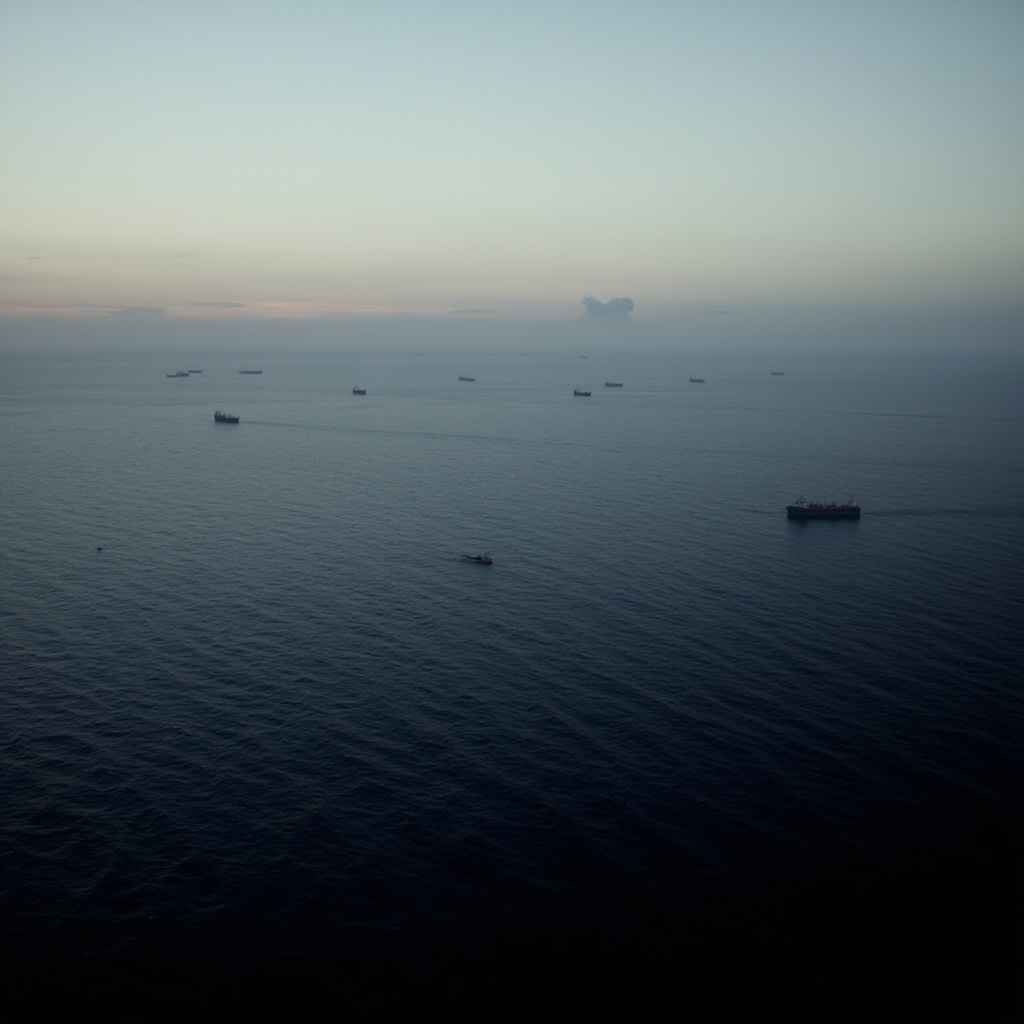
The Strait of Hormuz was, from the war's first hours, the single most consequential fact on the ground. Iran sealed the waterway within days of the first American strikes. The blockade collapsed roughly 95 percent of maritime oil traffic through the Persian Gulf. It sent global energy prices into a spiral that has not abated — Brent crude has not closed below $100 since March 4. [6]
Every war aim before this one was, at some level, compatible with reopening Hormuz. Destroying Iran's missiles would degrade its ability to enforce the blockade. Eliminating the navy would remove the mine-laying and fast-boat harassment that supplements the shore-based missile threat. Even "taking the oil" implied establishing control over the waterway through which that oil would need to move.
Accepting a closed Hormuz is different. It means the war's most visible economic consequence — the one that American consumers feel every time they fill their gas tanks, the one that has driven global recession fears for a month — would persist after the shooting stops. It means the tactical reality that prompted the war has been quietly redefined as an acceptable outcome.
The Pentagon's assessment, according to the Journal's sources, is straightforward: a dedicated operation to reopen Hormuz — involving minesweeping, suppression of shore-based anti-ship missiles along the Iranian coast, and possibly amphibious landings on the islands Iran uses as fire bases — would take weeks. [1] The mines alone present an enormous challenge. Iran has deployed thousands of them, including advanced influence mines that are extremely difficult to detect and neutralize. The U.S. Navy's mine countermeasure fleet is small and aging.
An operation of that scale would extend the war well past Trump's self-imposed timeline. And the timeline matters to Trump more than almost anything else. The WSJ separately reported last week that Trump told associates he wants to avoid a protracted war, aiming to end the conflict within four to six weeks. [7] That window closes around mid-April.
The Gulf's Opposite Demand
On the same day the Journal reported Trump's willingness to abandon Hormuz, the Associated Press reported that Gulf allies are privately urging exactly the opposite. Saudi Arabia, the United Arab Emirates, and other Gulf states are "privately making the case to Trump to keep fighting until Iran is decisively defeated." [8]
The UAE has emerged as perhaps the most hawkish of the Gulf states, pushing hard for a ground invasion, according to a diplomat cited by the AP. Saudi Arabia has urged Washington to intensify strikes. The fear among Gulf capitals is not that the war will drag on but that it will end too soon — that Trump will cut a deal with Tehran that leaves Iran's ballistic missile production capability intact and its proxy networks operational. [8]
This is the strategic trap the administration now occupies. Its regional allies want escalation. Its domestic political calendar demands de-escalation. The president's own statements ricochet between the two on a daily cycle.
The White House response to the Gulf demands was characteristically transactional. Press Secretary Karoline Leavitt told reporters Monday that "the president would be interested in calling on Arab countries to pay for the cost of the Iran war." [9] The war's estimated cost has reached approximately $35 billion in the first month. The framing was unmistakable: if the Gulf states want continued fighting, they can pay for it.
The Obliteration Threat
Between the "take the oil" interview and the "leave Hormuz closed" report, Trump issued a third statement that complicates the picture further. On his Truth Social platform Monday morning, the president threatened to "completely obliterate" Iran's electric plants, oil wells, and the Kharg Island export hub if a deal is not "shortly reached" and if the Strait of Hormuz is not opened "immediately." [10]
The threat sent Brent crude above $116 per barrel intraday. It was, in its specifics, an escalation threat targeting civilian infrastructure — power plants and desalination facilities whose destruction would affect tens of millions of Iranian civilians. [11] It was also, logically, incompatible with the WSJ report that appeared hours later: you do not threaten to obliterate a country's energy infrastructure to reopen a waterway you have already decided you can live without.
The most charitable reading is that these are negotiating positions aimed at different audiences: the obliteration threat for Tehran, the Hormuz concession for domestic consumption. The least charitable reading is that there is no coherent strategy and the statements reflect whoever last had the president's ear.
The Pattern
Thirty-one days into this war, the pattern is clear enough to describe with precision. The administration states an objective. It pursues the objective for several days. Complications emerge — military, diplomatic, political. The objective is quietly redefined or replaced. A new objective is announced with the same confidence that accompanied the last one. Reporters who note the shift are accused of bias or defeatism.
This is not unusual in wartime. Wars frequently outrun their stated purposes. The Iraq War began with weapons of mass destruction and ended as a nation-building exercise. The Afghanistan War began as a counterterrorism operation and became a 20-year occupation. What is unusual here is the velocity of the cycling. The aims are not drifting over years. They are lurching over days.
The velocity matters because it corrodes the two things a wartime president needs most: allied confidence and domestic support. Gulf allies cannot plan their own military posture around a strategy that changes with each news cycle. European allies — some of whom, like Spain, have already closed their airspace to American warplanes — cannot calibrate their own positions against a target that moves daily. [12] Congressional leaders cannot write authorization legislation for a war whose purpose will have shifted by the time a bill reaches the floor.
And the American public cannot evaluate whether the war is succeeding if success keeps being redefined. When the goal was degrading Iran's missiles, success meant counting destroyed launch sites. When the goal was regime change, success meant a new government in Tehran. When the goal was taking the oil, success meant controlling Kharg Island. When the goal is ending the war without Hormuz, success means — what, exactly? That the bombing stopped?
What Happens Next
The WSJ report contained one detail that may prove more significant than the headline. Trump's willingness to abandon Hormuz is conditioned on his desire for speed. The four-to-six-week timeline is the governing constraint. Everything that falls outside it — including the single objective that matters most to the global economy — is expendable.
This creates a strange inversion. The war's most tangible failure (a closed Hormuz) becomes the price of the war's declared success (ending it quickly). The administration's metric for victory has narrowed to one dimension: calendar time. Not objectives achieved, not threats eliminated, not stability restored. Just speed.
Meanwhile, the Gulf states are pushing for deeper commitment. Iran is targeting shipping in Dubai's harbor. [13] Spain is closing its airspace. And the president is simultaneously threatening total escalation and signaling total retreat, sometimes within the same 24-hour period.
The war is still one month old. Nobody can still say what it is for. But we now know something the prior month could not tell us with certainty: the president himself may not know either. He is not choosing between strategies. He is cycling through them, and each cycle moves faster than the last.
If the four-to-six-week clock is real — and there is every reason to believe Trump takes it seriously — then the war's endgame is not a question of Iranian capitulation or American victory. It is a question of what the president is willing to call victory on the day the clock runs out. Based on the last 31 days, the answer is: whatever he said most recently.
-- YOSEF STERN, Jerusalem