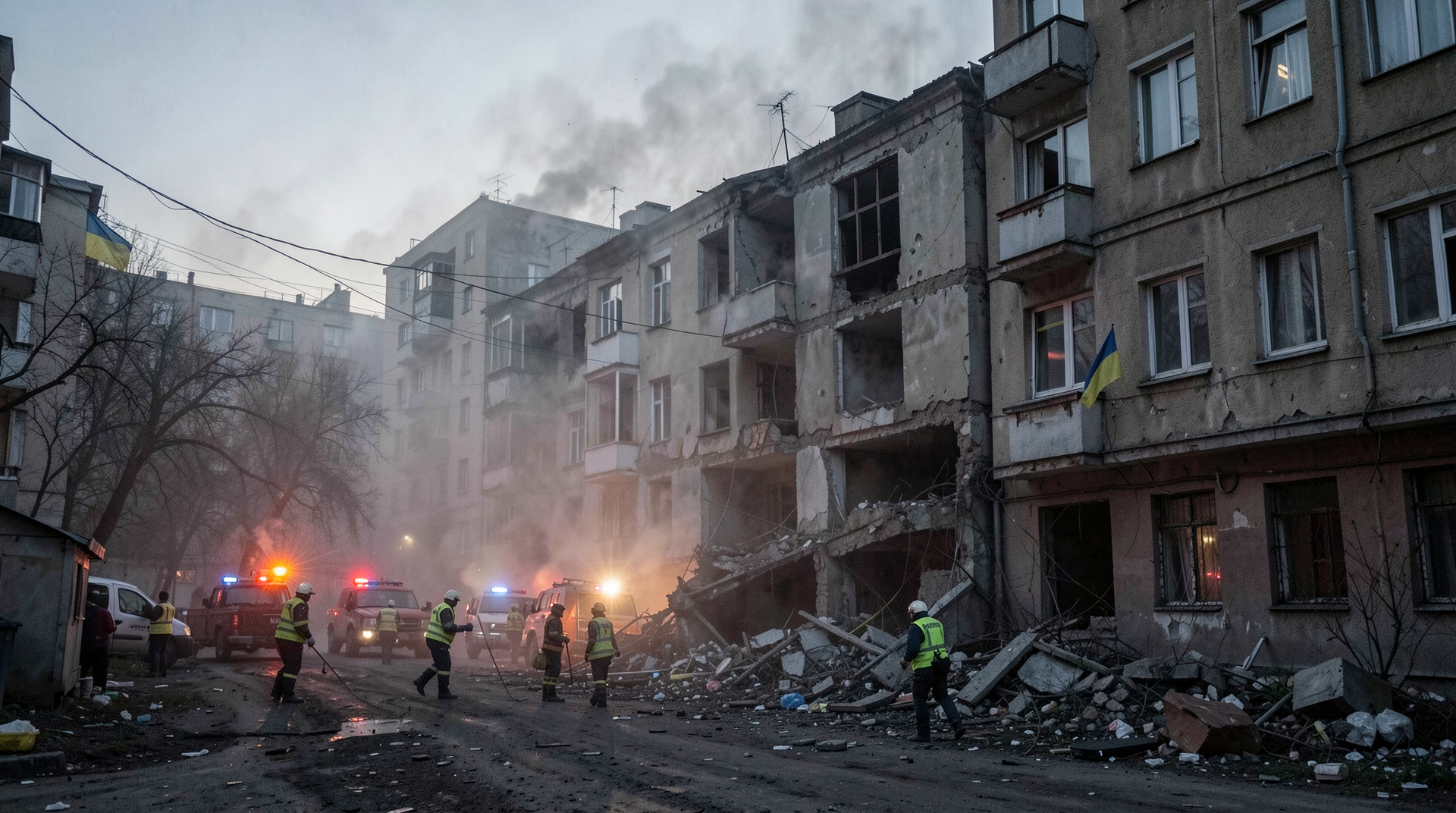
Russia launched a large-scale combined missile and drone attack on Kyiv overnight Sunday, with Ukraine's Air Force reporting ninety missiles and almost seven hundred drones in what the Kyiv Independent called "one of the largest mass attacks over the last year." [1] At 12:55 a.m. Ukrainian time the air force posted a public warning on Telegram that Russia might be preparing to launch an Oreshnik medium-range ballistic missile. [2] Within the hour explosions were ringing across every district of the capital. A nine-story residential building in the central Shevchenkivskyi district was hit; floors one through five sustained structural collapse, killing at least two people; over eighty others were injured across the city; people were trapped inside an air-raid shelter at a school after a strike blocked the entrance with debris, Mayor Vitali Klitschko reported. [2] President Volodymyr Zelensky confirmed Russia used an Oreshnik missile in the attack — the third time the weapon has been deployed against Ukraine — and said the strike landed on Bila Tserkva, a town fifty miles south of the capital. [1] Poland scrambled Polish and allied fighter jets to protect Polish airspace. [1] The same Sunday Donald Trump posted to Truth Social that an Iran "Memorandum of Understanding pertaining to PEACE" had been "largely negotiated."
Two wars produced two surfaces on the same Sunday. The paper's Saturday lead read Rubio's "Plan B" from Helsingborg as the NATO ministerial closed with Mark Rutte stressing Hormuz and Sweden's foreign minister saying Stockholm was "open to discussing different formats" for a NATO role in the strait. Saturday's brief on the Ukraine weekend tape noted that Russia's grinding civilian-casualty number had reached 15,800 since February 2022 — a Friday administrative figure that needed Sunday's operational tape to make sense. The Sunday tape arrived in the form of explosions over a capital where a presidential schedule did not include a stop. The diplomatic discussion of conventional deterrence in Helsingborg has been answered by a missile-and-drone wave on Kyiv inside seventy-two hours.
What landed in Kyiv overnight had a structural shape MSM has not yet assembled. The drone count of nearly seven hundred is one of the largest single-attack figures since the May 14 raid that killed twenty-four and partially collapsed an apartment block in the Shevchenkivskyi district — the same district struck again Sunday. [3] The missile count of ninety is roughly three times the average mass-strike total of recent months. The Oreshnik warning issued at 12:55 a.m. local was the public acknowledgment by Ukraine's air force that Western and Ukrainian intelligence had assessed a launch as possible — the same warning President Zelensky had issued in plain language Saturday afternoon, citing intelligence reports of a possible Russian Oreshnik strike. [4] The warning was followed by an actual launch: Zelensky confirmed Sunday morning that the missile struck Bila Tserkva, the third operational use of the system. [1] A warning issued before the wave, in public, with the missile type named, by the air force of the country under attack, and followed by a confirmed launch is not the standard Russian-strike communications cycle.
The Oreshnik question matters because the missile is a credibility instrument for both governments. Russia tested the system against Dnipro in November 2024 and Vladimir Putin claimed at the time that Western air defenses could not intercept it. The system is medium-range and conventional — outside the New START framework, inside the bracket of weapons NATO has assessed Russia as fielding for a peer-on-peer fight. The Sunday strike on Bila Tserkva is the third confirmed operational use; the warning produced by the Ukrainian air force forty minutes before impact is a precedent — the first time a public Telegram channel of a NATO-aligned military named an inbound Oreshnik in advance and was right. The strike landed on a town fifty miles south of Kyiv rather than the capital itself, which suggests either targeting limitations or a deliberate signalling choice by Moscow. Either reading puts the Helsingborg ministerial's conventional-deterrence discussion into operational terms inside a single weekend.
Klitschko's accounting was the night's primary documentation. The mayor reported through Telegram channels that water service was disrupted in the eastern (left-bank) part of the city; that fire crews were extinguishing blazes in residential buildings hit by drone debris in the Obolonskyi, Pecherskyi, Dniprovskyi, Solomianskyi, and Holosiivskyi districts; that several people were trapped under rubble in Shevchenkivskyi; and that two people had died with the injured count rising past eighty as Zelensky updated the figure Sunday morning. [2][1] The State Emergency Service confirmed structural collapse of floors one through five of the Shevchenkivskyi residential building, with rescue work continuing through dawn. Three additional injured were reported in the broader Kyiv region, according to governor Mykola Kalashnyk. [2] Reuters and the AP both carried the wire Sunday morning. The structural number — two killed, more than eighty injured, every district damaged — is a casualty floor for a wave of this size, not a ceiling. Rescue work was active at dawn; the count will move.
The Polish scramble is the Helsingborg footnote that now sits at the top of the page. Poland's Air Force reported scrambling Polish and allied fighter jets to protect Polish airspace from the wave; the country's Operational Command had issued a similar scramble during the May 14 attack and another after a September 2024 incident. [1] On Friday Polish deputy prime minister Radosław Sikorski had told the Helsingborg ministerial that Warsaw was "satisfied" with Trump's announcement of continuing U.S. military presence in Poland. The Sunday answer to Sikorski's satisfaction is that the U.S. military presence in Poland was operationally engaged on the morning of a presidential post that did not mention Ukraine. NATO's eastern flank has been doing the alliance's air-defense work for three years; on Sunday the work was conducted while the public-facing presidential business in Washington was about a different war on a different waterway. The conventional-deterrence question that Helsingborg framed in terms of Hormuz mine-clearing is also a question about Polish airspace at one o'clock in the morning.
The diplomatic asymmetry is the Sunday paper's structural point. Trump posted on Truth Social that the Iran deal was "largely negotiated" and listed eight capitals on a joint call; he did not, as of Sunday morning, post on Ukraine. The Ukrainian foreign ministry had no Sunday-morning readout of any call with the U.S. president. The Russia track and the Iran track have been moving on different timelines for the entire current Iran negotiation. The Sunday tape made the timeline-difference operational: the Russia track produced fifty missiles and seven hundred drones, and the Iran track produced a Truth Social paragraph. Two superpower-adjacent counterparties are operating in two registers. Both are accountable to the same NATO infrastructure Helsingborg discussed.
Zelensky's Saturday Telegram, before the wave, said Ukraine "liberated 590 square kilometers of territory this year, forcing Russia toward diplomacy." [5] Russia's Saturday-night answer was the wave. The two surfaces — Kyiv's claim of operational momentum forcing Russian diplomacy, and Russia's actual response in the form of fifty missiles — describe a pattern the paper's lost-science and gaza-access threads have tracked in other theaters: every claim of progress has produced an answering disproof inside the same news cycle. The Friday-into-Sunday cycle is now the Ukraine version. Zelensky claimed forcing-toward-diplomacy on Saturday; Russia launched its largest mass attack in over a year that night.
What did not happen Sunday is also documentation. The U.S. State Department's public schedule for Marco Rubio Sunday in New Delhi listed bilaterals with India's external affairs minister and previewed Tuesday's Quad meeting; it did not list any Ukraine touchpoint. [6] No senior Trump administration official has produced a Sunday-morning statement on the Kyiv attack as of this writing. The Senate's June 1 war-powers vote concerns Iran, not Ukraine; the $400 million Ukraine aid package that a bipartisan group of senators urged defense secretary Pete Hegseth to release in a May 23 letter remained delayed Sunday morning. [5] Trump's last public Ukraine-related post on Truth Social addressed European spending posture rather than the operational tempo. The institutional silence on Ukraine sits next to the institutional volume on Iran — two surfaces, one administration, one Sunday morning.
Western boxer Oleksandr Usyk defeated Rico Verhoeven in the early hours Sunday to retain his world heavyweight title in a fight broadcast from London. [5] The country's most visible export-grade celebrity received a victory at 2:42 a.m. local that landed an hour after a missile destroyed a residential block in his capital. The juxtaposition is what Ukraine produces routinely. The country is sustaining a public-information infrastructure under live attack that competes against its own civilian casualties for column inches abroad. Sunday morning's MSM packages — the Reuters wire, the US News reproduction, the Turkiye Today aggregation, the Kyiv Independent's own breaking news box — all carried the Klitschko numbers, the school-shelter detail, the Polish scramble. None placed the wave on the same page as Trump's Iran post. That separation is the divergence the paper's foreign desk has been pointing at since the Iran channel reopened in March.
There are three questions Monday will answer.
The first is whether the Pentagon and NATO's military committee corroborate Zelensky's Oreshnik confirmation independently. Zelensky's Sunday-morning attribution of the Bila Tserkva strike to a third operational Oreshnik makes the public warning a precedent for NATO-aligned air-defense communications under attack. Independent Western corroboration would graduate that precedent into a doctrinal data point for the alliance's eastern-flank planners.
The second is whether NATO's North Atlantic Council convenes any consultation on the Sunday Polish scramble. The Article 4 mechanism — formal consultations among allies when one feels its territorial integrity threatened — has not been invoked through Sunday morning. Polish foreign minister Sikorski's Helsingborg "satisfaction" comment Friday is the closest thing to a NATO-position document the alliance has produced this week. Article 4 was invoked after the September 2024 Polish incident and is the obvious procedural lever. Whether Warsaw pulls it Monday is the institutional test.
The third is whether the U.S. administration produces a Ukraine post on Truth Social or any other administration platform within forty-eight hours of the wave. The silence Saturday into Sunday is, by itself, the answer to the Senate's $400 million package question. A presidency that finds words for Iran inside the same forty-eight-hour window in which it has not found words for Kyiv has produced a position by what it has not said.
The paper's Friday position — that Helsingborg discussed Hormuz freedom of navigation in the abstract — has its Sunday answer in concrete terms. The freedom of navigation that mattered overnight was Ukrainian airspace, and Polish jets were doing the work the alliance's foreign ministers had been discussing under fluorescent light two days earlier. The structural reading is that NATO's eastern flank is now an alliance's standing answer to the question that Helsingborg framed in Persian Gulf terms. Kyiv has been the answer to the question every morning for three years.
-- KATYA VOLKOV, Moscow