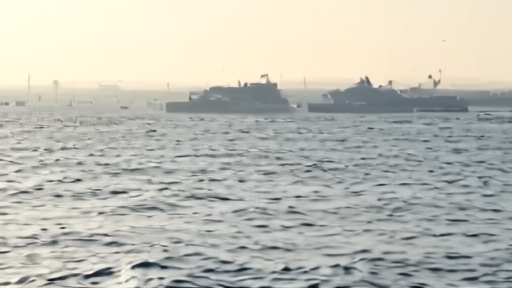
Four one-way attack drones aimed at merchant vessels changed the Hormuz story back into a shipping story. The Maritime Executive reported that Iranian forces launched four drones at commercial traffic in the Strait of Hormuz on Wednesday, that U.S. Air Force and Navy fighters shot down all four, and that Navy F/A-18 Hornets then destroyed the Iranian ground-control unit near Bandar Abbas. [1]
Wednesday's paper warned that ships could move while Iran left the safe-passage protocol unpublished. It also argued that Iran's fee denial still left shippers facing a gate. Thursday supplies the more brutal receipt. A corridor can have permissions, talks and fee language, and still be a place where drones are launched at merchant hulls.
The U.S. description is narrow but important. Officials told The Maritime Executive the drones threatened commercial traffic and called the response "measured, purely defensive, and intended to maintain the ceasefire." [1] That phrase is doing diplomatic work. It says Washington wants to strike the launcher without admitting that the ceasefire has collapsed. For a shipowner, the more relevant fact is simpler: defensive action was necessary because the threat reached the lane.
The same article said talks mediated by Qatar and Oman continued toward a longer ceasefire agreement and were said to be nearing completion. [1] It also reported President Donald Trump publicly rejecting a rumored joint Iranian-Omani control arrangement for the Strait of Hormuz and threatening Oman at an open cabinet meeting. [1] The diplomatic track therefore exists beside a military incident that makes any shipping protocol feel provisional.
That is where the April shipping question returns. The Maritime Executive earlier described Iran as demanding a fee for passage through the Strait of Hormuz, hoping to raise funds and normalize control over the world's most important energy chokepoint. [2] It said the reported fee structure amounted to about $1 per tonne of oil for tankers, more for vessels tied to less-favored nations, with some trade partners receiving free transit rights for limited movements. [2]
The business problem is not only whether the fee is legal or moral. It is who pays for moving a vessel through a corridor where a drone attack can occur while diplomats still speak of progress. The earlier Maritime Executive piece said owners face sanctions risk if they knowingly transfer money to the IRGC, while insurance markets suggested preparation to resume navigation through high demand for war-risk cover. [2]
Four drones sharpen every one of those clauses. War-risk cover is no longer an abstraction attached to a tense map. It is a product responding to aircraft, drones, launchers and control units. A fee is no longer merely a disputed word in Tehran's account. It sits inside a risk stack that includes permission, insurance, sanctions exposure, military escort, delayed cargo and the possibility that a ceasefire can be defended only by another strike. [1] [2]
X's frame is cruder and not useless: if passage depends on Iranian permission, possible payment and U.S. defensive fire, then it is not normal passage. Mainstream maritime coverage is more careful, because it has to distinguish a drone incident from a blockade, a fee from a toll and a rumor from a protocol. The paper's job is to keep both truths in view. Precision should not become anesthesia.
There is a reason this belongs in Economy rather than World. Hormuz is diplomacy only until the invoice arrives. Shipping companies must decide whether to wait, reroute, pay, insure or sail. Refiners and traders must decide whether delayed cargo matters more than headline de-escalation. Governments must decide whether a paid access regime is a tolerable workaround or a precedent that changes who controls energy flows.
The April article quoted tanker commentator Ed Finley-Richardson saying there was "zero indication" owners were paying or considering paying, while also noting reports from Lloyd's List and Bloomberg that fees had been paid previously using yuan and cryptocurrency. [2] That contradiction is exactly how coercive systems mature: public reluctance, private workaround, rising insurance, then a new normal no one admits to building.
The drone incident interrupts that normalization. If the goal of a fee or managed-access regime is to make Hormuz commercially usable under Iranian leverage, then attacks on merchant shipping undermine the sales pitch. A toll booth must at least promise passage. A gate that still needs fighter jets to keep drones off ships is not a settlement. It is a hazard with paperwork.
The next document to watch remains the same, but its meaning has changed. A published safe-passage protocol would now have to answer not only who collects fees and who grants clearance, but who guarantees protection against Iranian units or proxies that treat merchant traffic as a target. Without that answer, Hormuz is not reopening in the ordinary sense. It is being negotiated one vessel, one insurer and one drone interception at a time.
-- DARA OSEI, London