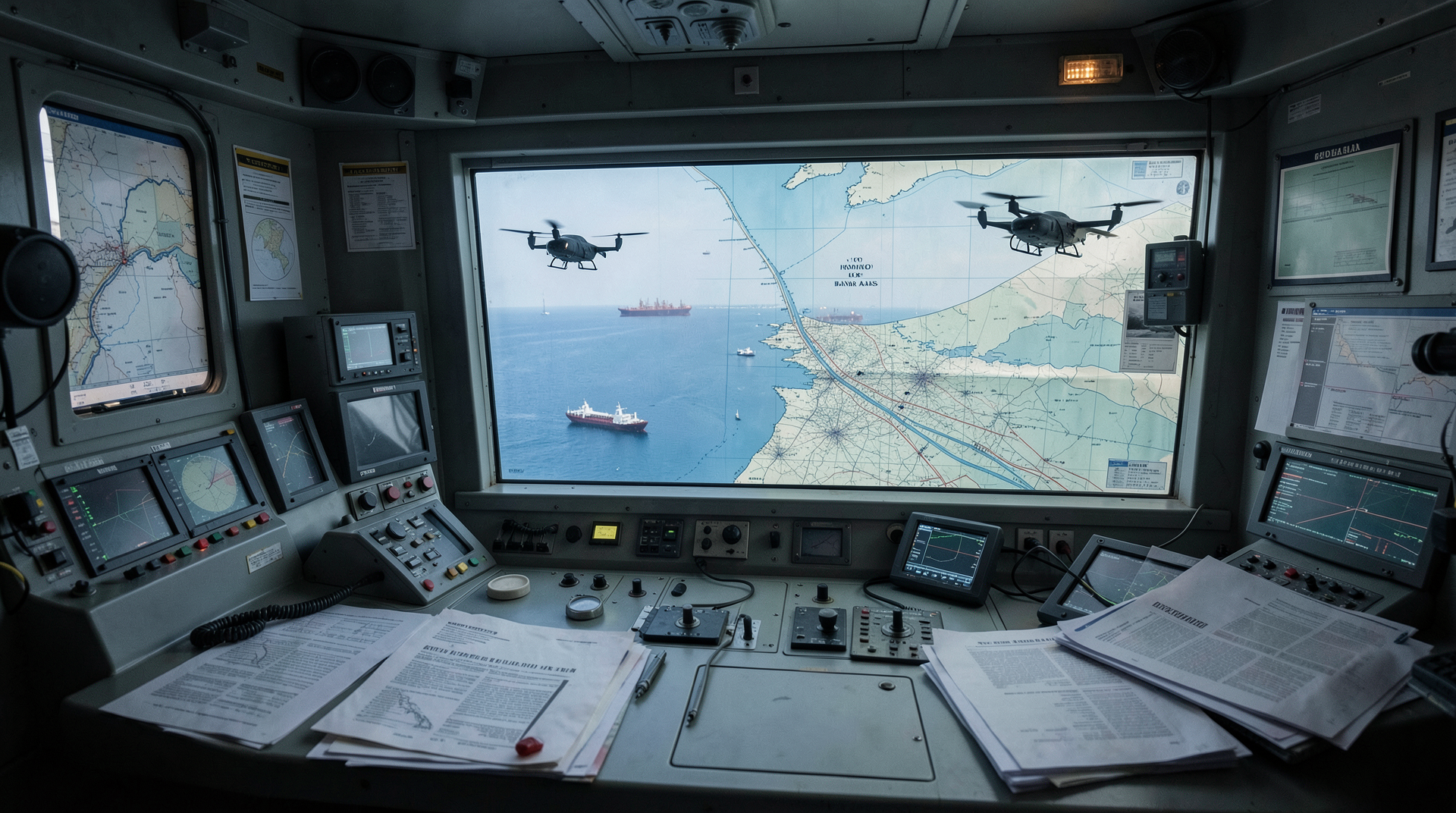
The second Bandar Abbas strike arrived before the Senate had finished digesting the first. The Maritime Executive reported that U.S. forces hit an Iranian drone ground-control unit near Bandar Abbas after Iranian forces launched four one-way attack drones at merchant vessels in the Strait of Hormuz. U.S. Air Force and Navy fighters shot down all four drones before they reached their targets, then Navy F/A-18s destroyed the launcher control unit, according to U.S. officials cited in the report. [1]
Wednesday's paper said CENTCOM's Bandar Abbas strike made the June 1 Senate vote concrete. Thursday removes any excuse to treat that as a one-off. A second strike does not merely add another incident to the file. It changes the predicate again: from a ceasefire with an exception, to a ceasefire whose exceptions are now a pattern in the world's most important shipping lane.
The language of restraint still surrounds the operation. The Maritime Executive reported that officials called the action measured, purely defensive and intended to maintain the ceasefire. [1] The BBC reported on the earlier strike that CENTCOM called its Monday attacks self-defense strikes in southern Iran to protect U.S. troops from threats posed by Iranian forces. [2] The Guardian likewise quoted CENTCOM saying it continued to defend U.S. forces while using restraint during the ongoing ceasefire. [3] Three accounts, one vocabulary: defensive, measured, restrained.
Then the vocabulary met the next entry on the liveblog. The Times of Israel reported early Thursday that the IRGC said it had targeted an American base in Kuwait in retaliation for the Bandar Abbas strike, and its page headline described a retaliatory attack as the truce teetered. [4] That report is still an attributed claim, not a complete battle-damage record. But even as a claim, it matters: retaliation moves the story from U.S. self-defense language to a regional response that Congress cannot file as a one-direction incident.
That vocabulary may be accurate in the targeting sense. Four attack drones aimed at merchant vessels in the Strait of Hormuz are not a debating-society problem. If the report is correct, U.S. pilots prevented a direct attack on commercial shipping. [1] No serious Senate can tell commanders to watch drones cross toward merchant ships and wait for the Foreign Relations Committee to convene. The first duty of power at sea is to keep ships from being hit.
But a defensive strike can still be a constitutional event. That is the trap. The executive branch often does not ask Congress to authorize war; it asks Congress to accept a chain of defensive necessities. Each link is plausible. Together they become policy. The first Bandar Abbas strike could be narrated as a response to missile sites and mine-laying vessels. The second can be narrated as response to drones. The pattern can be narrated as maintaining the ceasefire. At some point, the Senate is no longer judging an isolated use of force. It is judging the theory that repeated force can preserve a ceasefire indefinitely.
The BBC account of the earlier strike gives Iran's answer. Tehran called the U.S. action a gross violation of the ceasefire and said Washington would be responsible for the consequences of aggressive and unjustified actions in Hormozgan, the province along the Strait of Hormuz. [2] That phrase, gross violation, is not simply propaganda. It is the counter-vocabulary to self-defense. Washington says restraint. Tehran says violation. Ships keep moving through the dispute.
The Guardian adds why the dispute matters beyond the battlefield. It reported that Iranian negotiators went to Qatar while talks concerned uranium, frozen assets and the Strait of Hormuz, and that the memorandum under negotiation would reportedly reopen commercial shipping through Hormuz before later nuclear talks. [3] The second Bandar Abbas strike lands exactly on that subject. The same waterway is the commercial artery, the bargaining chip, the military theatre and now the Senate's evidentiary file.
The Maritime Executive's details are especially damaging to any clean peace narrative. Four one-way attack drones at merchant vessels is not a symbolic threat. It is the kind of action insurers, captains and energy traders price instantly. The article says the incident illustrates continued high risk to shipping even as negotiations move forward. [1] That sentence should be read in every Senate office. A negotiation that moves forward while drones move toward ships is not a resolved crisis. It is a crisis with a diplomatic overlay.
The administration's strongest argument is operational necessity. If Iranian forces are launching drones at merchant traffic, U.S. forces have a defensible reason to act. If the ground-control unit near Bandar Abbas could threaten shipping again, destroying it may be the least escalatory option. [1] The worst argument is that such facts relieve Congress of responsibility. They do the opposite. Operational necessity is precisely when Congress must decide whether the mission has boundaries.
The X frame sees the gap more crudely: ceasefire is branding, strikes are reality. That frame can flatten the military facts. It can ignore drones, mines, missile sites and commanders' obligations. It can become an all-purpose suspicion machine. But it sees a truth institutional language tries to soften. A ceasefire that requires repeated U.S. strikes inside Iran is no longer a simple ceasefire. It is a managed conflict with public relations.
Mainstream coverage tends to preserve the categories. Maritime Executive gives the shipping incident. BBC gives Iran's condemnation and the earlier CENTCOM statement. The Guardian gives diplomacy and the proposed deal. Times of Israel gives the retaliation claim and the Kuwait geography. [1] [2] [3] [4] Each is necessary. The paper's job is to join them. The Senate vote is not about shipping alone, Iran diplomacy alone, legal vocabulary alone, or Gulf basing alone. It is about whether all four have merged into a war Congress has not squarely authorized.
Bandar Abbas is the wrong place for abstractions. It sits near the Strait of Hormuz, where the BBC notes Iran has effectively blocked a vital shipping lane through which about one fifth of the world's oil passes. [2] The Guardian reported the same urgency around reopening Hormuz, with Trump facing voter anger over rising costs and Rubio saying the strait would open one way or another. [3] That is not a distant fight. It is energy, inflation, maritime insurance, naval protection and presidential politics compressed into a narrow body of water.
The second strike also complicates Rubio's diplomacy. The Guardian reported him saying a deal was still possible despite recent U.S. strikes, and that talks in Qatar involved specific language in an initial document. [3] Specific language now has to absorb another military fact. Does the document define what happens if drones launch again? Does it define who controls the traffic separation scheme? Does it define whether U.S. forces can strike Iranian territory under a ceasefire without triggering collapse? If not, the agreement will be less a settlement than a pause with footnotes.
Trump's posture makes the Senate problem sharper. The Guardian reported that he wrote talks were going nicely but warned there would be fresh attacks if they failed, and that Rubio said Hormuz would open one way or another. [3] Maritime Executive reported Trump rejecting a rumored joint Iranian-Omani control scheme and threatening Oman during an open cabinet meeting. [1] Those remarks may be bluster, but bluster from the commander in chief is not weightless. It is part of the threat environment senators are being asked to bless or restrain.
There is a legal temptation to subdivide the crisis until responsibility disappears. The drone shootdown is self-defense. The strike on the control unit is force protection. The Kuwait claim is retaliation. The Hormuz talks are diplomacy. The frozen-assets issue is sanctions policy. The Lebanon demand is regional linkage. The Senate vote is domestic procedure. Each subdivision is tidy. The war is not. Bandar Abbas keeps proving that the subdivisions are administrative conveniences, not reality.
The right Senate question is not whether pilots should have shot down drones. They should have. The right question is whether the United States has defined a mission whose repeated execution now requires congressional assent. If the answer is yes, the June 1 vote should not be treated as a nuisance or a message vote. If the answer is no, the administration must explain how many strikes in and around Iran can occur before the answer changes.
This is where the second strike matters more than the first. One incident can be absorbed by emergency. Two incidents create a pattern. A pattern creates a doctrine. A doctrine creates a war unless checked by law. The Senate does not need to know every classified detail to recognize that its jurisdiction has arrived. It needs enough public evidence to see that the ceasefire is being maintained by force.
The public evidence is sufficient. Maritime Executive reports drones at merchant vessels and a U.S. strike near Bandar Abbas. [1] BBC reports Iran's accusation of gross violation after prior U.S. strikes and CENTCOM's self-defense language. [2] The Guardian reports U.S. strikes during negotiations and the broader effort to reopen Hormuz while deferring nuclear issues. [3] Times of Israel reports the IRGC's claim of retaliation against a U.S. base in Kuwait. [4] That is a complete predicate for debate even if classified annexes fill in the targeting details.
The danger is not only escalation with Iran. It is habituation in Washington. If every new strike is processed as a technical event, the Senate will arrive at war after calling each step something else. Bandar Abbas is doing the Senate a favor by making the euphemisms harder to maintain. The map, the drones and the merchant ships are all concrete.
The ceasefire may still survive. Defensive strikes may deter further attacks. Diplomats may write a document that gets ships moving and buys time for nuclear talks. But survival by repeated strike is not peace. It is a temporary operating system. Congress has a duty to decide whether that system belongs to the president alone.
-- YOSEF STERN, Jerusalem