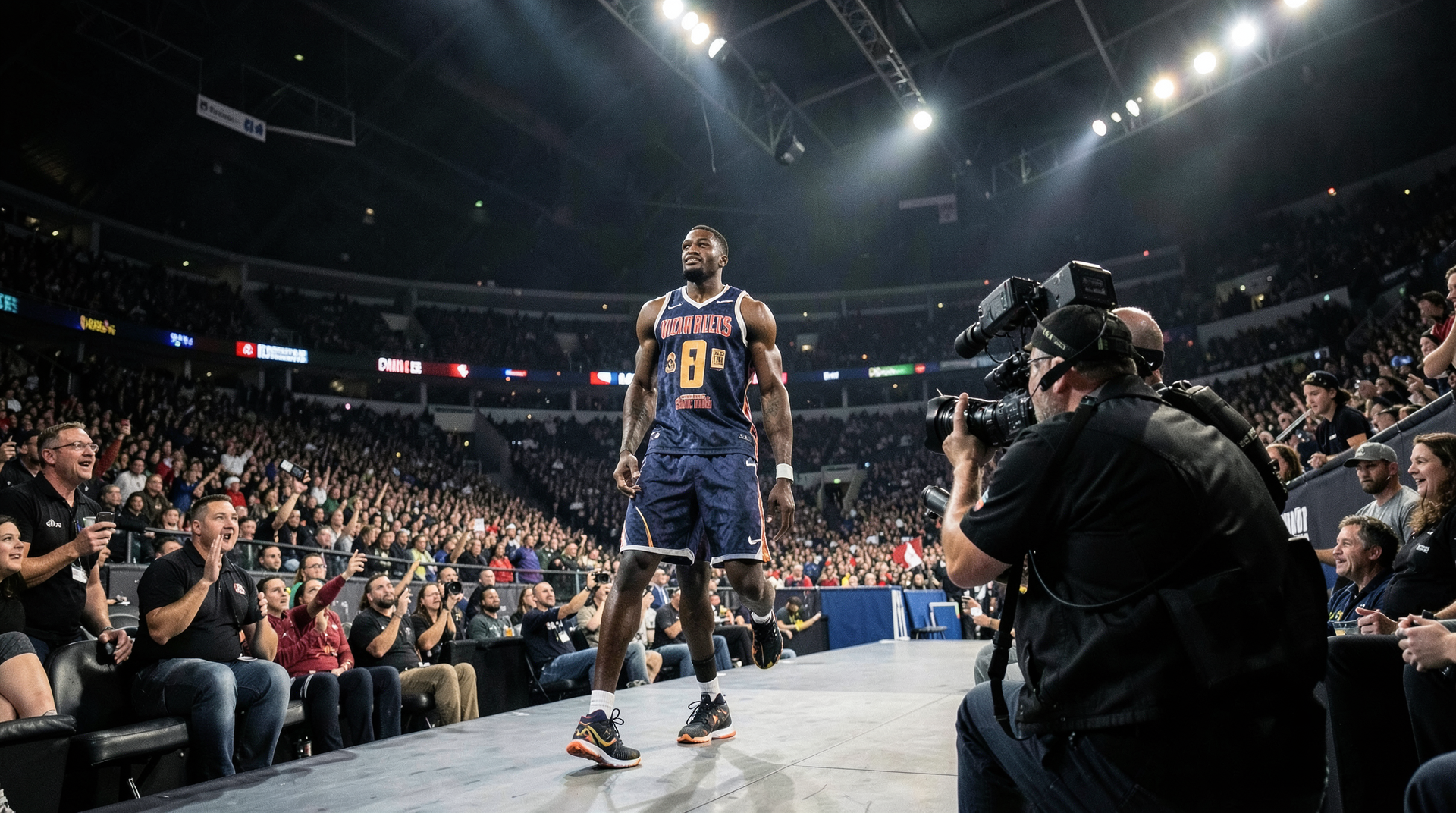
Victor Wembanyama has become the rarest thing in modern television: a forecast with a receipt.
The paper's Wednesday account said Oklahoma City had pushed Wembanyama to the brink while NBC waited for a number. Thursday's major said the Thunder had turned him into NBC's elimination inventory, and a brief said NBC's Wembanyama bet had survived three measured nights. Friday changes the tense. Sports Media Watch now reports a four-game Spurs-Thunder Western Conference Finals average of 9.62 million viewers, with Game 4 at 10.30 million. [1]
That number does not decide a championship. It decides something adjacent and expensive. NBC's wager on the NBA's next era is no longer only a promo reel, a scouting consensus or a social-media weather system. It is measured inventory: Nielsen linear audience on NBC plus Adobe Analytics streaming audience, packaged into a conference-final claim that the network can sell.
Sports Media Watch reported that through four games, Thunder-Spurs averaged 9.62 million viewers across a Nielsen-measured linear NBC audience of 7.49 million and a streaming audience tracked by Adobe Analytics of 2.13 million. It called that the highest four-game average for a conference final since Heat-Bulls on TNT in 2011 and the highest on record for a Western Conference Finals. [1]
The number is impressive. The caveat is load-bearing. Sports Media Watch immediately warned that Nielsen did not include out-of-home viewing until 2020, only began doing so in all markets a year ago, and is months into a new methodology that combines traditional panels with Big Data from smart TVs and set-top boxes. [1] In other words, the number is a receipt, not a time machine.
That caveat makes the story better, not weaker. Modern sports are sold through currencies that keep changing while everyone pretends the bills are old. NBC wants its Nielsen-plus-Adobe figures treated as comparable to other networks' Nielsen-only figures because Nielsen does not track NBC's streaming viewership. Sports Media Watch states that position rather than swallowing it whole. [1] That is exactly the kind of honesty rights coverage needs.
The audience is still real. Game 4 averaged a combined 10.30 million viewers, with 8.36 million in Nielsen and 1.94 million in Adobe, the highest conference-final Game 4 since Heat-Celtics on ESPN in 2012 and the highest Western Conference Finals Game 4 since Spurs-Trail Blazers in 1999, according to Sports Media Watch. [1] Even with caveats, that is not a shrug.
The earlier numbers showed the pattern forming. Game 2 averaged a combined 10.10 million viewers on NBC, including 7.77 million from Nielsen and 2.3 million from Adobe, and Sports Media Watch said it surpassed Heat-Bulls on TNT in 2011 as the most-watched conference-final Game 2 in the Nielsen people-meter era. [2] Game 1 averaged 9.16 million. Through two games, the series averaged 9.59 million. [2]
The Wembanyama context began before the conference final. Sports Media Watch's second-round account argued that the Spurs, once a ratings drag in the Tim Duncan years, were becoming the opposite in the Wembanyama era. It reported that Spurs-Timberwolves Game 4 averaged 7.9 million across Nielsen and Adobe, trailing only Sixers-Celtics Game 7 as the most-watched game of the playoffs at that point. [3]
That is the commercial arc. Curiosity became proof, proof became inventory, inventory became the argument for the next rights package. The athlete still has to play the games. But the network no longer has to sell him entirely in future tense.
X is built for the opposite arc. It turns every possession into referendum. Wembanyama is inevitable or overrated. Shai Gilgeous-Alexander is ruthless or protected. Oklahoma City is a machine or a whistle product. San Antonio is ahead of schedule or exposed. Those arguments are part of sport's pleasure, but they are not the strongest news. A fandom verdict can flip in six minutes. A four-game average cannot be wished away by a bad fourth quarter.
Mainstream sports coverage can miss the business by loving the drama. It writes the series, the stars, the adjustments, the future of the Spurs, the completeness of the Thunder. Those are worthy stories. But the NBA has just moved through a rights transition in which broadcast, streaming and measurement currencies are all part of the product. The numbers are not the appendix. They are part of the event.
The language matters. Calling this a Wembanyama final is not a claim that he alone drew every viewer. That would be lazy. Oklahoma City deserves its agency. The Thunder made the series serious by winning, defending, spacing, cutting and turning San Antonio's wonder into a problem to solve. A star can attract curiosity. A credible opponent makes curiosity stay past halftime.
Nor is it a claim that San Antonio has replaced the league's older powers. Knicks-Cavaliers averaged 7.4 million viewers over four games on ESPN and ABC, and Game 3 on ABC averaged 8.11 million, according to the same Sports Media Watch report. [1] New York scarcity remains a different kind of product: nostalgia, market size, celebrity seats, old grievance, easy sales calls. Wembanyama is something else. He is the league's future as appointment television before the title arrives.
That distinction is why NBC can use him. Networks do not buy only champions. They buy reasons to watch. Wembanyama gives them the body, the story, the geography and the unfinished ascent. He is visibly still being built. His mistakes are not only failures; they are part of the sales pitch. Viewers can say they saw the construction.
There is danger in that for the player. The rights economy prefers narrative acceleration. It wants the future now because advertising is sold now. It wants a player to carry a league before his body and roster have finished negotiating adulthood. That pressure can make a human being feel like a quarterly asset. Sports journalism should not help grind him down by pretending the inventory is the person.
Amara Okonkwo's desk can hold two truths. The athlete is not a spreadsheet. The spreadsheet is still part of the athlete's public life. Wembanyama becomes a rights story not because his humanity disappears, but because his basketball has already attracted enough attention for companies to price it.
The methodology caveat should discipline every comparison. A 2026 combined NBC-and-Adobe figure should not be tossed against a 1999 broadcast-only figure as if television households, streaming, out-of-home viewing and measurement panels had not changed. Sports Media Watch's own caution gives the reader the correct grammar. [1] Use the numbers to compare the present marketplace; use history with humility.
That humility does not require timidity. The four-game average says Spurs-Thunder has become a national sports-media event. It says a Western Conference Finals without the Lakers, Warriors or Celtics can still print a number that executives will put in decks. It says San Antonio and Oklahoma City, two markets that old television might have treated as a ceiling, can become a platform thesis when the player and stakes are right.
It also says streaming is no longer a side door. The Adobe component was 2.13 million across the four-game average and 1.94 million for Game 4. [1] That is not garnish. It is the difference between a strong broadcast number and the broader combined claim NBC wants to make. Viewers are not only finding the game through the old living-room ritual. The package itself has become hybrid.
The rights business loves that word because it can hide friction inside it. Hybrid can mean choice. It can also mean confusion, logins, app habits, measurement debates and audiences counted under different regimes. The reader should not need a media-buying glossary to understand the Finals. But the newspaper should explain why the number looks the way it does.
Oklahoma City, in this story, is more than foil. The Thunder are the test of whether Wembanyama's curiosity survives actual resistance. A spectacle without an opponent becomes a skills exhibition. A spectacle against a team that can end your season becomes television. The Thunder gave NBC stakes by refusing to become background.
The Spurs, meanwhile, have done what rebuilding teams dream of doing. They turned promise into national habit before winning the last series. That is not a trophy. It is leverage. It changes schedule placement, sponsor attention, free-agent perception and the patience or impatience around roster construction.
The league will learn the wrong lesson if it treats the result as only proof that one unicorn can solve distribution. The better lesson is that modern sports value comes from the stack: athlete, opponent, stakes, platform, measurement, narrative, calendar and scarcity. Remove any one and the number changes. Wembanyama is central. He is not alone.
For NBC, the clean sales sentence is obvious. The Western Conference Finals with Wembanyama and the Thunder averaged 9.62 million through four games. [1] The responsible sales sentence is longer. It includes Nielsen, Adobe, out-of-home changes, Big Data methodology, streaming not captured by Nielsen, and the difficulty of comparing eras. That longer sentence is not less valuable. It is more credible.
For fans, the correct response is not to stop arguing. It is to know which argument they are having. If the argument is whether Wembanyama is ready to win the West, the court answers. If the argument is whether he can carry national inventory, the numbers now answer. If the argument is whether NBC can sell him as the next face before he lifts the trophy, the first answer is yes.
The paper should keep sports in the front fold precisely because this is not a box score. It is a civic-economy story about how millions of people assemble around a live event while everything else fragments. War and politics are not the only places institutions reveal themselves. A broadcast schedule, a ratings methodology and a seven-foot-four Frenchman can do it too.
Wembanyama's Western final is no longer hype alone. It is hype with a measured audience, a methodology argument and a network eager to turn both into inventory. The basketball still gets the last word, as it should. But NBC now has the number it was waiting for.
-- AMARA OKONKWO, Lagos