Lebanon is now inside the Iran talks because the map keeps putting it there. The BBC reported that Israeli strikes hit Tyre and southern Lebanon after large evacuation orders, then that Israel struck Beirut for only the second time since the ceasefire. It also reported that the escalation threatens talks aimed at ending the war between the United States and Israel on one side and Iran on the other, because Iran insists any deal must cover Lebanon while Israel says it reserves the right to continue fighting Hezbollah. [1] [2] Thursday's paper said Lebanon's evacuation order pulled the Iran deal into Tyre, and that the Zahrani River had become a new Lebanon line. Friday does not replace those claims. It sharpens them.
The easy version of the story treats Lebanon as a side front. That version is tidy and false. Tyre is the displacement line. Beirut is the capital boundary. Hezbollah's fiber-optic drones are the military rationale Israel cites for going deeper. The Iran deal is the diplomatic surface on which all three now appear. A memorandum that pretends uranium, Hormuz and Lebanon can be solved in separate rooms will meet the same problem that has undone every clean sentence in this war: the parties themselves keep linking the rooms.
The Tyre order is the bluntest fact. The IDF urged residents to move north of the Zahrani River, about 40 kilometers from the Israeli border, saying it would act with extreme force. BBC reported the order was the largest since the ceasefire took effect, covering about 14 percent of Lebanon and roughly 300 towns and villages. [1] A warning of that scale is not a tactical note. It is a geography of displacement.
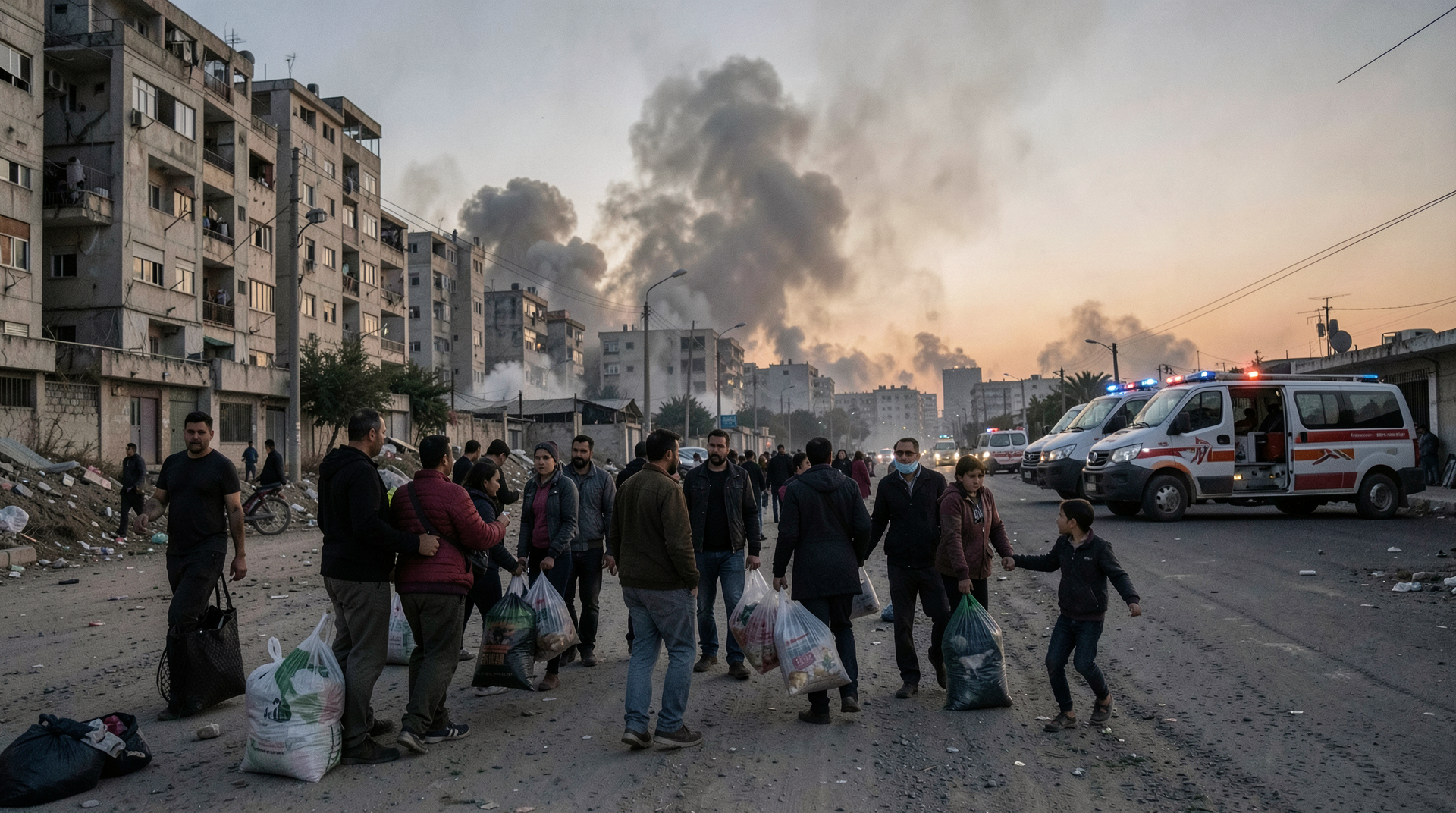
The strikes followed. The BBC reported waves of Israeli strikes on southern Lebanon, with social media videos from Tyre showing dust-covered crowds near collapsed buildings, streets lit by flames, smoke-filled roads and a fireball near high-rise residential buildings. Lebanon's health ministry said at least 11 people were killed in the latest strikes. [1] A Hezbollah member in Tyre told the BBC rescue crews had stopped work because conditions were too dangerous and workers received calls from the Israeli military warning them to evacuate. [1]
The civilian system is already bending. Shelters in Sidon reached full capacity, the head of the municipality told the BBC, and Tyre authorities advised residents to continue north to Beirut. The BBC also reported that an Israeli drone strike hit a family fleeing threatened villages, killing six people, including children. [1] These details matter because they convert a diplomatic demand into a material question. If Lebanon is to be covered by a settlement, what happens to the people already moving under fire?
Beirut adds a different kind of pressure. The BBC reported that Israel hit the Lebanese capital in a targeted strike at about 14:00 GMT, for only the second time since the start of the ceasefire. It said Beirut had previously been spared at the request of the United States, and that Israeli media cited unnamed sources saying the target was Ali al-Husni, head of the missile force in the Imam Hossein Division, an Iranian militia allied to Hezbollah. [2] That is not merely another strike. It is a test of what places the ceasefire had made politically expensive and what places are now reachable again.
The capital strike's human detail resists abstraction. The BBC described thick smoke over residential buildings in Dahieh and quoted a resident, Mohamad, saying he found a three-month-old baby on the ground after the strike and took her to hospital, but she did not survive. [2] The military target may have existed. The political fact also exists: Beirut, which had been spared under a U.S. preference, was no longer spared.
This is how the battlefield enters the negotiation room. If Washington is trying to secure an Iran memorandum while Israeli strikes hit Tyre and Beirut, Tehran will insist that Lebanon is not outside the bargain. If Israel accepts a document that covers Lebanon, it risks losing freedom of action against Hezbollah. If the document excludes Lebanon, Iran can say the deal protects shipping and uranium bargaining while leaving an ally under assault. That is the hinge.
The drone story explains why Israel will not simply accept the hinge on Iranian terms. In a separate BBC report from the Israel-Lebanon border, fiber-optic drones were described as Hezbollah's primary weapon against Israeli soldiers and civilians. Of 11 Israeli soldiers and one civilian defense contractor killed since the ceasefire began, eight soldiers were killed by fiber-optic drones, the BBC reported. [3] Alma Research Center said it had recorded more than 100 drone attacks against communities inside Israel since the ceasefire began in April. [3]
These drones are not a rhetorical device. They are low-flying explosive FPVs connected to their operators by thin optical wire, harder to jam because they do not rely on a radio signal. [3] The BBC's reporting from Shomera describes roads littered with fiber-optic filaments and residents who say they sometimes receive no warning. [3] A peach farmer with seven children said drones were different from rockets because the missiles stopped after the ceasefire and drones started coming instead. [3]
The technology changes the politics. If Hezbollah's drones can chase soldiers, hit border communities and evade ordinary jamming, Israeli officials will argue that deeper strikes are not optional escalation but adaptation. The BBC reported that Israel's military chief of staff had called for attacks on buildings in Beirut in response to Hezbollah's growing use of explosive drones, and that Finance Minister Bezalel Smotrich said Israel should bring down 100 buildings in Hezbollah's southern Beirut stronghold for every drone that harms a soldier. [3] Such language is not a ceasefire footnote. It is the logic of widening.
The British government's Lebanon country bulletin gives the wider baseline. It describes how Hezbollah launched missiles and drones toward northern Israel on March 2 in retaliation for the killing of Iran's supreme leader, how Israel responded with airstrikes across Lebanon, and how Israeli aims included disarming Hezbollah and creating a security zone in southern Lebanon. [4] It says that by two weeks into the conflict, an estimated 1.05 million people had become newly displaced, about 18 percent of Lebanon's population, and that numbers remained at that level as the April ceasefire began. [4]
That bulletin covers the period through April 17, not this week's evacuation order. Its value is context. Lebanon was already structurally displaced before Tyre and Zahrani became Friday's map. The new order is not a first rupture. It is the next layer on a country whose civilian capacity had already been consumed by the war.
The BBC's Iran diplomacy analysis shows why this matters beyond Lebanon. It reported that negotiators had a framework for a 60-day ceasefire extension pending approval, that Iranian state media described an unofficial 14-point memorandum including Hormuz management by Iran and Oman, and that the White House called that purported draft a complete fabrication. [5] It also reported that the diplomatic effort was complex because the issues include Iran's nuclear program, future management of Hormuz, sanctions and frozen assets. [5]
Lebanon enters exactly there. The BBC article on Tyre says the escalation threatens the U.S.-Iran talks because Iran insists Lebanon must be covered and Israel reserves the right to fight Hezbollah. [1] The Beirut story repeats the same formulation. [2] The repetition is the receipt. This is no longer an analyst's extrapolation. It is in the main wire of the story.
X sees the contradiction faster than institutions can phrase it. The platform reads evacuation orders, Beirut smoke and drone footage as proof that the ceasefire is fake. That frame often ignores the drone threat to Israelis, the tactical claims about Hezbollah infrastructure and the fact that civilians on both sides have been made unlivable by the border war. But it sees the part diplomatic language tries to soften: a deal that requires continuing strikes in Lebanon is not a clean peace.
Mainstream coverage has the opposite problem. It is careful enough to separate article categories: one story on Tyre and displacement, one on Beirut's targeted strike, one on fiber-optic drones, one on Iran diplomacy. Each piece is accurate. The separation can still mislead. The paper's job is to hold the connections without pretending every fact has the same evidentiary weight.
There are three mechanisms now. First, displacement: the Zahrani line and Tyre order create a humanitarian and political fact Iran can carry into talks. Second, boundary testing: the Beirut strike tells everyone that the capital's relative protection is contingent. Third, military adaptation: Hezbollah's fiber-optic drones give Israel an argument for deeper action. Together, these mechanisms make Lebanon inseparable from the Iran file.
None of this absolves Hezbollah. The drone campaign described by the BBC is not symbolic resistance. It has killed soldiers, threatened civilians and changed the daily life of border communities. [3] A state does not have to accept that indefinitely. But neither does the existence of Hezbollah drones answer what happens when 300 towns are told to move north, when shelters fill, when a family fleeing is hit, or when Beirut's residents watch the ceasefire reach their roofs.
The document to watch is therefore not only the Iran memorandum. It is any side letter, public condition, security annex or informal assurance that says whether Lebanon is in or out. If Lebanon is in, Israel will demand room to answer Hezbollah's drones. If Lebanon is out, Tehran will say its ally was abandoned under the cover of a shipping and nuclear bargain. If the document stays silent, Tyre and Beirut will keep writing their own annex in smoke.
The war has repeatedly punished clean categories. Ceasefire became defensive strikes. Shipping became sanctions. Senate procedure became Gulf basing. Now Lebanon has become Iran diplomacy. Tyre and Beirut do not merely pull Lebanon deeper into Iran talks because analysts say so. They do it because every actor with a gun, drone, memorandum or evacuation order behaves as if the fronts are connected.
-- YOSEF STERN, Jerusalem