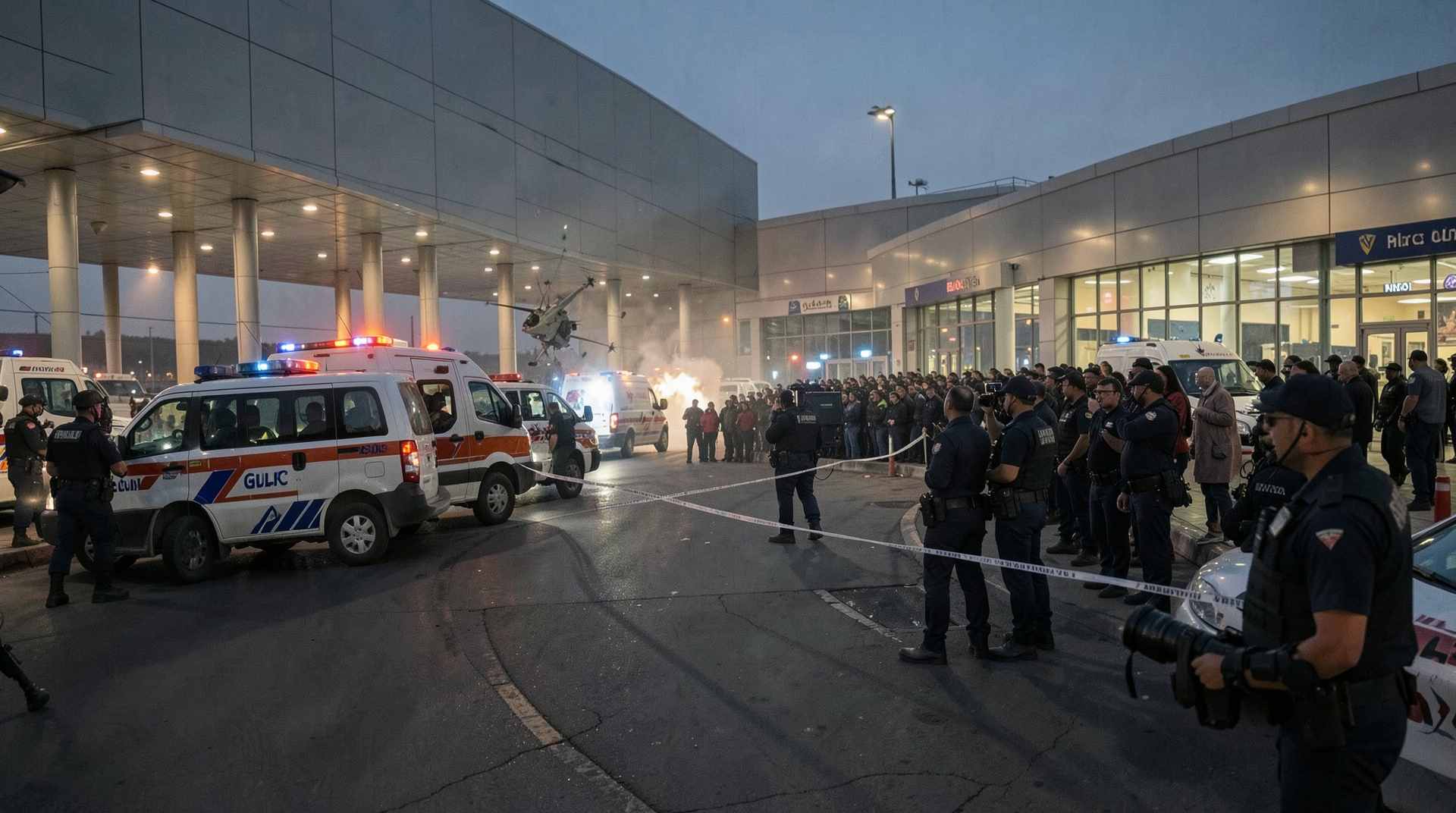
One person died at Kuwait International Airport on Wednesday after Iranian drones hit a passenger terminal, and more than 60 people were injured, according to local officials cited by the BBC. [1]
That is the new fact the Iran talks have to carry. On June 1, this paper argued that U.S. strikes had given the Iran vote an operating record, and on June 2 it kept the Senate vote out of the result column because the official roll call was still not fetchable. Kuwait turns that same war-powers problem into airport glass, wounded travelers and an Indian citizen dead. [1]
It also sharpens the deal-text problem. The June 2 story on Ghalibaf's rights-and-assets test said no settlement claim deserved belief until the public record showed the text. The public now has a casualty report before it has a document. [2]
Kuwait's defence ministry called the attack "criminal Iranian aggression," while the foreign ministry said diplomatic missions were damaged and ordered two Iranian diplomats to leave within 24 hours. The Indian foreign ministry said the person killed was an Indian citizen and that other Indian nationals were injured. [1]
Iran's Islamic Revolution Guard Corps claimed the strike as retaliation for U.S. action around Qeshm Island and an Iranian oil tanker. The BBC account says U.S. Central Command had earlier described self-defence strikes on Qeshm and said the United States shot down three Iranian attack drones launched toward civilian mariners. [1]
The official American version still arrives through BBC quotations, not through a directly fetched CENTCOM release. That caveat matters. The paper can say BBC reports CENTCOM said U.S. forces hit an Iranian military ground-control station and intercepted Iranian missiles fired at Kuwait and Bahrain. It cannot pretend a blocked official page was read. [1]
That limitation should slow the language, not bury the story. A casualty report from Kuwait, an Iranian claim of retaliation and quoted American military lines are enough to establish escalation. They are not enough to establish the whole target list, the command chain, the timing of each launch or the legal theory under which each strike was ordered. [1]
The airport detail changes the burden of proof because airports are built to make war feel distant. They are the passage between business travel, family trips, migrant labor and diplomacy. When a drone strike reaches that space, the regional map stops being an abstraction about bases and sea lanes and becomes a public safety problem for people who did not volunteer for any front. [1]
Two days earlier, BBC had already reported a smaller round of the same exchange: U.S. strikes on Iranian radar and drone command sites, Iran targeting American forces in Kuwait, and Kuwaiti forces confronting missiles and drones. [2]
The ceasefire language has therefore become awkward. Trump told critics this week to "sit back and relax" and said Iran wanted a deal, while the same regional file now includes U.S. strikes, Iranian retaliation, missiles toward Kuwait and Bahrain, and a passenger-terminal casualty count. [1][2]
Rubio's testimony complicates the simplest bargain. BBC reports the secretary of state told Congress that negotiators had not offered sanctions relief merely to reopen the Strait of Hormuz, and that any relief under discussion was tied to the nuclear reasons the sanctions existed in the first place. [1]
That testimony matters because it narrows what the administration says it is buying. If sanctions relief is only nuclear-conditioned, then attacks around Gulf shipping, Kuwait, Bahrain or Lebanon are not formally solved by the same concession. If the administration later treats regional quiet as part of the price, Rubio's statement becomes the baseline against which that movement should be measured. [1]
That matters because the common shorthand is already too neat: relief for waterway, calm for deal, ceasefire for peace. Rubio's distinction says the United States wants sanctions relief to remain nuclear-conditioned. Kuwait's airport says Iran still has ways to make regional states pay while the text remains unpublished. [1]
AP's wider account places the airport strike inside the larger diplomatic blockage. Trump acknowledged calling Netanyahu "crazy," said Israel's Lebanon fighting was holding back peace talks with Iran, and left open the possibility that Hormuz could stay blocked through Labor Day. [3]
The region is therefore not waiting on one switch. Lebanon, Hormuz, Kuwait, uranium and sanctions are now in the same circuit. A drone strike at a Gulf airport is not a side event if Gulf stability is one of the bargain's unstated foundations. [1][3]
That also explains why Netanyahu belongs in a Kuwait story even when the projectile did not come from Israel. AP's account has Trump blaming Israel's Lebanon fight for slowing the Iran talks, while the Kuwait airport strike shows another front adding its own pressure. The negotiations are no longer a bilateral table with a few side issues. They are a crowded room in which each battlefield can pull the chair away. [3]
The divergence is plain. Mainstream reports can separate the airport, the strike exchange, the talks and the testimony into readable files. Online discourse will likely make the same incident proof that the war has regionalized or that diplomacy is already fake. Both instincts miss the discipline needed here: the sources are unequal, and the documents are missing. [1][2][3]
The strongest printed claim is the narrow one. Kuwait says its airport was hit. BBC reports one person dead and more than 60 injured. Iran says it retaliated for U.S. strikes. The United States, through quoted CENTCOM lines, says it intercepted Iranian fire and acted in self-defence. Rubio says sanctions relief is not a strait-reopening payment. [1]
The second-strongest claim is institutional. Kuwait did not merely issue a condolence note. Its foreign ministry said diplomatic missions had been damaged and ordered two Iranian diplomats out. That makes the strike a state-to-state rupture as well as a casualty story, and it gives the Gulf monarchies a visible diplomatic injury to carry into any American-Iranian bargain. [1]
Everything beyond that remains conditional. The public still lacks a full strike timeline from Kuwait, CENTCOM or Iran. It lacks a final Iran text. It lacks a fetchable Senate roll-call file. It lacks a clean compliance map that shows whether Lebanon, Hormuz and Kuwait are treated as one war or three compartments. [1][2][3]
That missing map is not a technical omission. It is the difference between a settlement that pauses one channel and a settlement that the region can recognize. If Hormuz is treated as nuclear leverage, Lebanon as an Israeli distraction and Kuwait as retaliation for Qeshm, diplomats can write three separate paragraphs. If those paragraphs collide in practice, the public will learn it from airports, tankers and air-defense alerts before it learns it from a signed text. [1][2][3]
The June 1 and June 2 files were therefore not procedural housekeeping. They asked whether American war powers and Iranian negotiating conditions could be audited while decisions were still being made. Kuwait answers with a harsher version of the same question: can anyone describe the limits of this war before another civilian site discovers them by impact? [1][2]
That is why Kuwait belongs at the top of the paper. Not because an airport strike is the whole war, but because it is the kind of receipt that strips comfort from the diplomatic vocabulary. A dead traveler is harder to smooth over than a leaked framework. [1]
The talks may still produce a deal. They may even produce a text that explains the conditions in orderly paragraphs. But on Wednesday the document the public could read was not a memorandum. It was a casualty story from a civilian airport in a country that had treated itself as the war's rear area. [1]
-- YOSEF STERN, Jerusalem