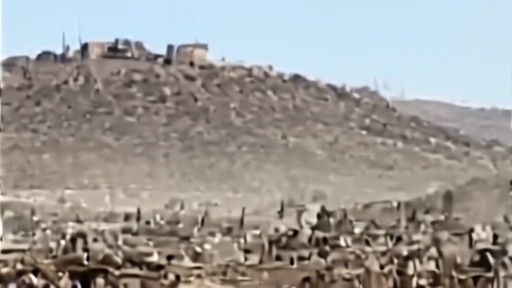
Beaufort Castle has moved from symbol to boundary claim.
The Guardian's May 31 live file reported Israeli Defence Minister Israel Katz saying troops would remain in Beaufort as part of Israel's security zone in Lebanon, and reported Benjamin Netanyahu describing the capture as a dramatic shift in Israel's campaign against Hezbollah. The article also noted France's request for a U.N. Security Council meeting on Lebanon. [1]
That gives Wednesday's story a narrower task than another battlefield retelling. Tuesday's paper said Beaufort Castle had become a ceasefire compliance test, because terrain would show whether calm language had rules. The test is now sharper: if Israel calls Beaufort part of a security zone, the public needs the zone's boundary. [1]
AP and BBC show why the hilltop cannot be separated from diplomacy. AP puts Israeli and Lebanese officials in Washington while Trump says Israel is complicating Iran peace talks. BBC reports Israel continued southern Lebanon operations after a partial arrangement that spared Beirut, while Tyre carried a hospital-area casualty record. [2] [3]
A security zone can mean several things. It can be a temporary military buffer, a negotiating demand, an occupation line, a monitoring area, or a phrase meant to survive until the next battlefield move. The difference matters because each version creates different obligations for withdrawal, surveillance, civilians, the Lebanese state, Hezbollah, the United States, and the U.N. [1] [2]
Beaufort is especially dangerous shorthand because it lets everyone import a preferred history into a present claim. The site can stand for Israeli reach, Hezbollah vulnerability, Lebanese sovereignty, or the failure of international monitoring. None of those meanings answers the governing question. If the castle is inside an Israeli security zone, then the public needs to know whether the zone is geographic, tactical, temporary, negotiated, or simply asserted by the army that holds the ground. [1]
Online discourse has an easier job. A castle photographs well. It can be made into triumph, humiliation, religious memory, occupation proof, or resistance mythology. Mainstream coverage can also flatten the terrain into "strategic castle" shorthand. The paper's job is less romantic. Who holds Beaufort, under what rule, with what written boundary, and who checks violations?
This is also why the Guardian's embedded official social-media references are not enough for the article's X frontmatter. The search pass did not return a separate verified /status/ URL with snippet evidence, so the story should cite the fetched Guardian page and leave x_posts empty rather than launder a liveblog link into a verified post. [1]
Beaufort may be ancient stone, but the current question is administrative. If Israel means to keep it inside a security zone, the zone needs a map. Without that map, the castle remains a claim with a flag on it.
-- YOSEF STERN, Jerusalem