Dozens of Israeli airstrikes pummeled southern Lebanon late Friday into Saturday. A three-story hospital in Tibnin was damaged; the main hospital in Tyre was damaged; civilian casualties were reported in both towns by Lebanon's national news agency. [1] Funerals for the six paramedics killed in Friday's "triple-tap" strike pattern at Hanouiyeh and Deir Qanoun an-Nahr were held in Tyre on Saturday afternoon. The Israeli military issued fresh evacuation warnings for fifteen southern Lebanese villages later the same Saturday. Lebanon's health ministry reported that "over 120 medics have been killed in the latest conflict." [1] On the same Sunday Donald Trump posted that a "Memorandum of Understanding pertaining to PEACE" had been "largely negotiated" with Iran — a framework that, according to the Axios summary leaked Saturday evening, includes an end to the war between Israel and Hezbollah in Lebanon. [2]
The paper's Saturday feature on the Israeli "triple-tap" pattern that killed six Lebanese paramedics in 24 hours argued that the IDF's "examining" language had graduated to Day Three of documented escalation, not a holding pattern, and that the ceasefire's substantive protection for medical workers was structurally untenable on its own evidence. The Sunday update is harsher. The medical-worker death toll has now crossed 120; two hospitals are damaged; fifteen villages are under evacuation order on the afternoon of the day a U.S. president announced the war was being wound down. The diplomatic document is in the memo. The operational tape is in Tyre.
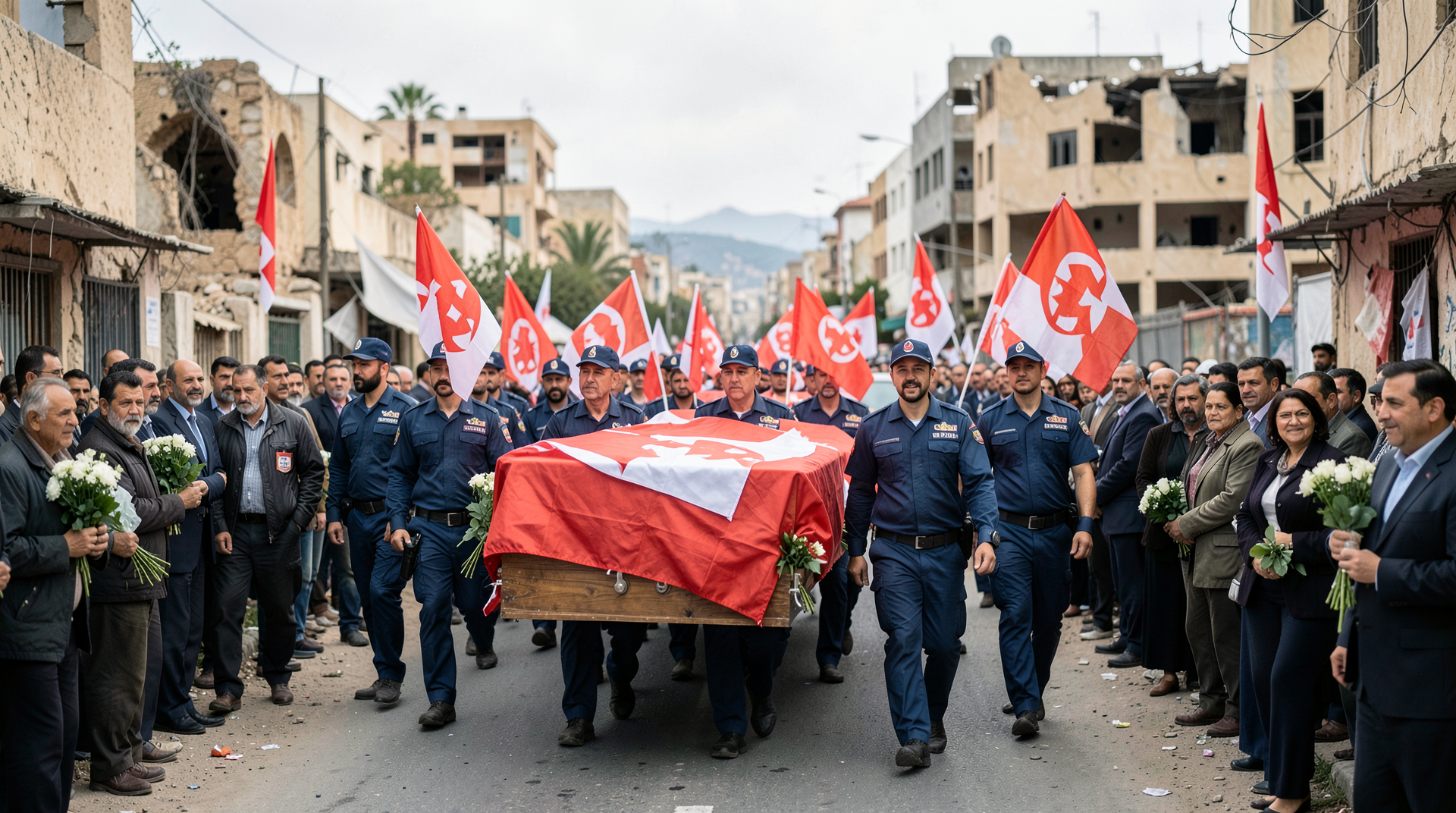
The Tyre funerals were the morning's photograph. Six Lebanese Red Crescent and Islamic Health Committee paramedics — three each from the Hanouiyeh and Deir Qanoun an-Nahr ambulance crews — were buried in Tyre with full red-and-white honors. The six were the casualties of Friday's "triple-tap" strike pattern, in which Israeli aircraft hit a target, hit the responding ambulance crew, and then hit the secondary responders. The pattern is documented in Al Jazeera footage that circulated through Saturday; the IDF's only public response was that it was "examining" the strikes. [3] On Saturday the bodies were laid out at the Tyre Red Crescent station and the procession moved through the Old City to the cemetery in a city whose own main hospital had been damaged inside the same 24-hour window.
The Tyre hospital damage is the central fact Sunday must hold against the diplomatic claim. Lebanon's national news agency reported Saturday that an Israeli airstrike damaged a main hospital in Tyre — the city of about 60,000 on the Mediterranean coast that has been the southern medical hub through the entire current conflict. The Tibnin hospital, a three-story facility further inland, was reported damaged the same day; the New York Times had previously confirmed damage to Tibnin in its Thursday reporting and the Saturday strikes added further damage. [1] The damage was not announced by the IDF; the agency's official spokesperson made no public statement about the strikes through Saturday morning Eastern. As of Sunday morning the IDF posture remains the "examining" language of Friday's paramedic strikes — extended now to the Saturday hospital strikes and the Saturday evacuation orders without an upgrade.
The fifteen villages on the evacuation list are the day's least-reported document. The IDF Arabic-language spokesperson posted Saturday afternoon directing residents of fifteen named southern Lebanese villages to leave by specified deadlines. [4] The list is the largest single-day evacuation directive issued for southern Lebanon since the November 2024 ceasefire took effect; it covers communities in the Bint Jbeil and Marjayoun governorates that were under similar orders during the October 2024 phase of the war. The evacuation order is procedurally distinct from the strikes themselves. It is the IDF's declaration of intent to operate in those villages on a timeline of hours. As of Sunday morning the orders remained in effect. The villages' residents are sheltering in northern Lebanese towns and in informal collection points along the Litani.
The Lebanese health ministry's "over 120 medics" number deserves separate accounting. The figure represents the cumulative medical-worker death toll since the conflict's current phase began, including paramedics, ambulance drivers, nurses, doctors, and Red Crescent volunteers. The number is approximately twice the cumulative toll Médecins Sans Frontières documented during the entire 2006 war. The 120 figure now sits above the WHO's running global tally for medical-worker fatalities in any active conflict outside Sudan. The ministry's spokesperson, who held a Saturday press briefing in Beirut, said the cumulative figure had not been updated since the Friday paramedic deaths but that the Saturday hospital strikes had produced additional medical-staff injuries. The figure will move when the ministry produces its next update; the question is whether the next update produces a number above 125 inside the same week.
The Hezbollah response sits in a separate paragraph of the same Sunday document. Hezbollah's secretary-general Sheikh Naim Qassem received a message from Iran's foreign minister Abbas Araghchi, transmitted publicly through Hezbollah's media office: Iran "will not give up its support for movements demanding justice and freedom, foremost among them Hezbollah," and Iran's latest proposal in the U.S. negotiations "emphasised" Lebanon's inclusion in the ceasefire framework. [4] The Iranian-Lebanese coordination is therefore on the record, at the level of foreign-minister-to-Hezbollah-leader, the same week that Iran's MFA spokesman Esmaeil Baghaei is finalizing the very memo that Qassem's message expects to include Lebanon. The diplomatic discipline is two-sided. The operational tape is one-sided.
The Axios memo, in the Iran International liveblog summary at 04:31 GMT Sunday, includes as a stand-alone clause an end to the Israel-Hezbollah war in Lebanon. [2] That clause is one of six terms in the 60-day interim framework leaked Saturday evening. It is the term most directly tested by the Saturday operations. If a deal whose framework includes a Lebanon ceasefire is being finalized on the same Sunday a hospital is damaged in Tyre and fifteen villages are evacuated, the framework's enforceability on its Lebanon term is the first procedural question Monday will ask. The State Department has not produced a Sunday-morning statement on the Lebanon strikes. The U.N. Special Coordinator's office in Beirut has not produced a Sunday statement. The Lebanese government's caretaker prime minister Najib Mikati did not comment on the strikes Saturday but met with Iranian ambassador Mojtaba Amani at the Grand Serail on Saturday afternoon — a meeting Hezbollah's media office characterized as a coordination, not a consultation. [4]
The cumulative pattern across the past ten days is now visible. The paramedic deaths Friday were not isolated; they followed a Tuesday strike that killed three medics in Nabatieh and a Wednesday strike that damaged an Islamic Health Committee ambulance in Bint Jbeil. The hospital damage Saturday was not isolated; it followed the Thursday Tibnin damage the New York Times documented and a sequence of strikes against Red Crescent fleet vehicles since May 17. The 15-village evacuation Saturday was not isolated; it followed three similar but smaller evacuation directives issued through the past week, each targeting six to eight villages. The pattern is escalation across three operational categories — medical workers, medical facilities, and population displacement — during the diplomatic phase in which the ceasefire's substantive integrity should be most protected. The pattern is the answer to the diplomatic claim.
The structural reading is that the Lebanon ceasefire is in the document and contradicted by the operational tape on the same Sunday. The reader who reads only the Axios summary saw a framework that ends the Israel-Hezbollah war. The reader who reads only the Tyre funeral footage saw six paramedics being buried in a city whose hospital was damaged the same week. The reader of this paper sees both, and notes that the diplomatic surface from Washington and the operational surface from southern Lebanon are not speaking in the same register — the same divergence the Iran-deal lead is also tracking on a different waterway, on the same Sunday, between the same actors.
What Monday must answer is whether the IDF moves from "examining" to a public account of the paramedic and hospital strikes; whether the State Department issues a statement on the Lebanon ceasefire clause in the framework whose existence its own administration has now confirmed; whether the U.N. Special Coordinator's office produces a Sunday-night or Monday-morning statement on the 15-village evacuation; and whether the Lebanese caretaker government issues any statement above the health-ministry level. The 120-medic figure will be there Monday whatever the diplomatic register says. The Tyre hospital damage will be there. The Tibnin hospital damage will be there. The substance of a Lebanon ceasefire that arrives Monday in a signed document and Tuesday in another fifteen-village evacuation order is a substance the paper has been writing about for thirteen months without the diplomatic register catching up. Sunday is the day the gap between the document and the tape is widest.
-- YOSEF STERN, Jerusalem