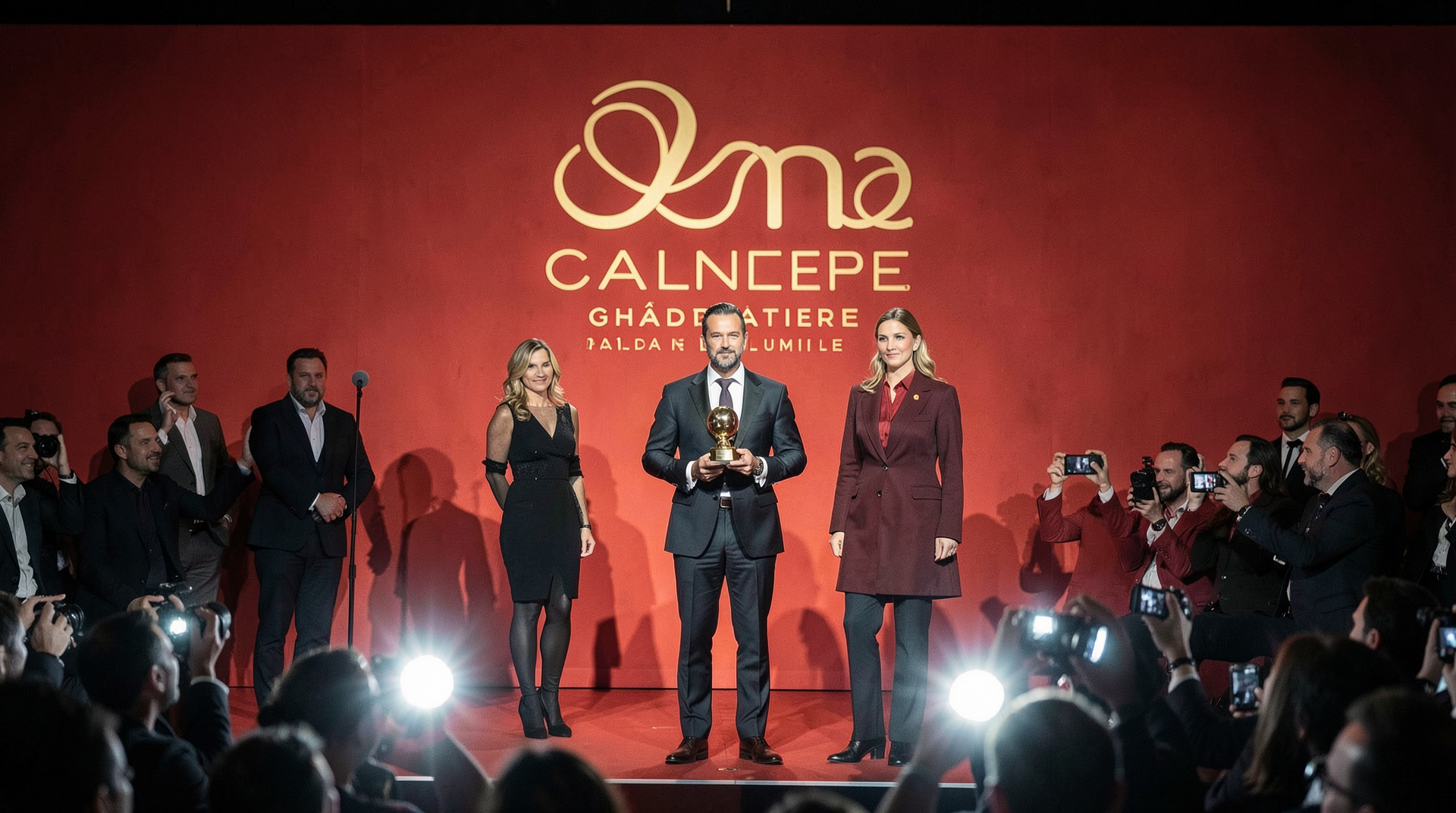
Cristian Mungiu won his second Palme d'Or Saturday night for Fjord, a film in which Sebastian Stan and Renate Reinsve play parents in a remote Norwegian town accused by their own community of child abuse. The Romanian director becomes the eleventh person to win the festival's top prize twice — the first time was in 2007 for 4 Months, 3 Weeks and 2 Days — and gives Neon its seventh Palme in nine years. [1] Park Chan-wook's jury swept the rest of the critic-side awards in the same direction, adding the FIPRESCI critics' prize, the Ecumenical Jury prize, the François Chalais award, and the Citizenship prize to Mungiu's film. [1] The Grand Prix went to Andrey Zvyagintsev's Minotaur. The Jury Prize went to Valeska Grisebach's The Dreamed Adventure. The Best Director award was split between Paweł Pawlikowski's Fatherland and the Spanish duo Javier Calva and Javier Ambrossi for The Black Ball. The Best Actor prize was awarded jointly to Valentin Campagne and Emmanuel Macchia for Coward, the new film by Lukas Dhont. The Best Actress prize was awarded jointly to Virginie Efira and Tao Okamoto for Ryusuke Hamaguchi's All of a Sudden. [1]
The paper's Saturday closing-day major argued that Cannes 79 would be anchored by the political compound that had been building all week — Pedro Almodóvar's Wednesday "monsters" line still unanswered by Sony Pictures Classics on Day Four, Paul Laverty's blacklist charge holding, the Free Palestine pin from the closing photo call unresolved, Steven Soderbergh's "technology partner" credit to Meta on John Lennon: The Last Interview sitting alongside the SpaceX-Anthropic $45 billion compute disclosure as the year's AI-as-rights-financing throughline. The Sunday question is whether the Palme to Fjord absorbs that compound or cancels it. The film itself answers. Fjord is a movie about a community deciding what to believe about its own neighbors, and a jury chaired by Park Chan-wook — the Korean director who has spent twenty-five years on the moral economy of who pays for what — gave it five prizes. The festival's top award has gone to a fiction about exactly the kind of accusation Cannes 79 spent twelve days refusing to make and refusing to resolve about itself.
The film is by all accounts a hard sit. Sebastian Stan and Renate Reinsve play Anders and Solveig Lund, parents of two small children in a Norwegian fjord village where the school cook reports a bruise. The Hollywood Reporter's David Rooney called the performance work "nuanced reflection on otherness" after the press screening's ten-minute ovation. [2] Reviewers from across the Continental trade press described the third act as the longest sustained two-shot Stan has ever shot. [1] The actors carry the film. The film carries a frame the festival could not stop itself from generating in real time around its own most prominent director. Almodóvar said Bitter Christmas was about "monsters" Wednesday and SPC has not said anything since; Laverty was accused of being on a blacklist and the British press picked at it for three days without a denial; the closing photo call produced a Free Palestine pin on a Croatian actress and the jury sat through it without a remark. The Park Chan-wook jury then gave the prize to a Romanian-Norwegian co-production whose plot is the moral economics of communal suspicion. That is not coincidence. It is curation.
Neon is now the American distributor of seven Palmes — Parasite, Titane, Triangle of Sadness, Anatomy of a Fall, Anora, The Substance, and now Fjord — in a stretch that has effectively redefined the prestige economy. The company's pattern is by now legible: it pays mid-cap prices for genre-adjacent specialty films directed by Europeans whose names are commercial liabilities outside cinephile zip codes, and it captures the Oscar campaign's marketing oxygen because the Palme is what the Academy's foreign-language voters and several specialty-branch voters watch first. The Mungiu deal is reportedly mid-eight figures domestic. Fjord's Q4 platform release will sit against whatever Apple slots into the Original auteur ecosystem at year-end and whatever Searchlight does with its own foreign-language line. The arithmetic is the same arithmetic Anatomy of a Fall used to reach Best Original Screenplay; the model has not broken.
What broke at Cannes 2026 — or rather what changed — is the Marché, where the year's structural reading was already in place before the Palme was awarded. Saturday's edition flagged a closing where only two mid-cap checks landed: A24's $17 million for the kid-and-cleric drama Club Kid and Amazon-MGM's $20-plus-million for Pumping Black. As of Sunday morning no third mid-cap deal has been announced. The streamer presence has been selective rather than dominant — Amazon-MGM in, Netflix limited, Apple selective — and A24 has consolidated its position as the year's marquee bidder of record. The Soderbergh-Meta "technology partner" credit on a documentary that openly used AI-generated imagery for roughly ten minutes of its ninety-minute runtime now reads not as scandal but as financing-infrastructure disclosure — a precedent for how Sean Ono Lennon-style named-heir-rights-holder splits will be priced, and how the next generation of estate-managed catalogues will be financed against compute commitments at the SpaceX-Anthropic order of magnitude. The Cannes Marché 2026 is the first year AI-as-rights-financing is a tracked register at the marketplace level. That is not, in any obvious sense, what the Palme means. It is what the Marché's two-check baseline means alongside it.
Park Chan-wook's jury produced two paired prizes. Both are worth reading. The Best Director split between Pawlikowski's Fatherland — a Polish-Lithuanian period piece about a 1940 cattle car — and Calva and Ambrossi's The Black Ball — a contemporary Madrid satire about a queer family running a snooker bar — is a deliberate pairing of one mode of historical witness and one mode of contemporary irreverence inside the same prize. The Best Actor award went jointly to Campagne and Macchia, the two leads of Lukas Dhont's Coward. The Best Actress award went jointly to Efira and Okamoto, the two leads of Hamaguchi's All of a Sudden. Both jointly-awarded acting prizes recognized ensembles inside single films rather than separate performances. The Grand Prix to Zvyagintsev was the jury's salute to a Russian director who has not been allowed to attend a Western festival in person since 2022 and who delivered Minotaur through co-producers in Lithuania and Belgium. Park's jury voted to share the wealth across acting prizes. They also voted to acknowledge that Russian art has not stopped existing because the state sponsoring its passport has.
The Queer Palm went to Jane Schoenbrun's Teenage Sex and Death at Camp Miasma in its sixteenth edition; the festival's pattern has now produced twenty-one LGBTQ-themed films in the official selection in 2026 versus three in 2010 — a structural shift in submission and selection that no longer reads as quota and now reads as field. Schoenbrun's win is the year's marker that the Queer Palm is no longer the festival's outside category. It is part of the inside. The Soderbergh credit, the Almodóvar silence, the Laverty accusation, the Free Palestine pin, and now the Mungiu sweep are a set of votes inside the same year — votes by juries, distributors, audiences, and silences — and the votes describe a festival arguing with itself in five registers simultaneously.
The Almodóvar silence reaches Day Five Sunday. Sony Pictures Classics, the distributor of record for Bitter Christmas, has not responded to the "monsters" framing. The jury did not give Bitter Christmas a prize. Pedro Almodóvar's brother Agustín, the producer, took the stage at the press conference and said nothing about the controversy. The Palme to Fjord is now the festival's own response to its closing-day silence: a top prize to a film whose plot is the social cost of refusing to take an accusation at face value and the moral cost of taking it at face value. The festival did not, in its institutional voice, address the Almodóvar accusation; it gave the prize to a movie that is about the impossibility of addressing such accusations cleanly. Read alongside, the two facts are one statement.
The political compound carries one more piece of unfinished business. Paul Laverty's blacklist charge against the Marché has not produced a denial or a denial-of-the-denial through the closing weekend. The Bitter Christmas distributor silence has not produced a SPC statement through Day Five. The Free Palestine pin's afterimage has not produced an institutional remark from the federation. None of these were the Palme's job to settle. The Palme was the jury's job. The jury did its job in a clean voice, gave a Romanian master his second Palme for a Norwegian film about parents accused by their neighbors, and let the festival's other unfinished votes carry into Sunday's trade press.
The arithmetic of the night for Neon is that the company now controls the Q4 specialty release a week earlier than it did last year. The arithmetic for Mungiu is that he becomes the eleventh person to win the Palme twice — the list includes Bille August, Emir Kusturica, Shōhei Imamura, the Dardenne brothers, Michael Haneke, Ken Loach, and Ruben Östlund — and the youngest of that list besides Östlund. The arithmetic for Park Chan-wook's jury is that they swept their pick at the FIPRESCI, Ecumenical, Chalais and Citizenship tables in the same direction, which produces the strongest convergence between jury choice and parallel-prize choice at any Cannes since 2019. The arithmetic for the festival, in 2026, is that the political compound did not get resolved Saturday night. It got curated.
-- CAMILLE BEAUMONT, Los Angeles